

- How to Write an Introduction for an Assignment: Structure, Examples and University Tips
- What a High-Scoring Assignment Introduction Must Achieve
- Core Structure of an Effective Assignment Introduction (Explained as Logic Flow)
- How to Write an Assignment Introduction (Step-by-Step Decision Process)
- Decode the Assignment Brief Properly
- Identify the Real Question Behind the Topic
- Decide Scope Before Writing Anything
- Build a Single Clear Directional Focus
- Refine After Completing the Body (Alignment Check)
- Practical Ways to Start an Assignment Introduction
- Assignment Introduction Examples for Essays, Reports, and Case Studies
- Essay Introduction Example
- Report Introduction Example
- H3 Case Study Introduction Example
- Applied University Assignments Example
- Common Reasons Assignment Introductions Lose Marks (And How Markers Evaluate Them)
- H2 Assignment Introduction Template and Word Count Guidance
- How Long Should an Assignment Introduction Be?
- Final Checklist for Writing a Strong Assignment Introduction
How to Write an Introduction for an Assignment: Structure, Examples and University Tips
Writing an assignment introduction is often more difficult than students expect. Many introductions lose marks because they fail to show a clear response to the assignment question from the outset. Markers use the opening section to judge whether the discussion is relevant, organised, and academically purposeful. This guide on how to write an introduction for an assignment explains the structure of an effective introduction, the decisions that shape it, common mistakes to avoid, and practical examples that can be adapted to different university assignments.
What a High-Scoring Assignment Introduction Must Achieve
A high-scoring assignment introduction is not judged by how much information it contains but by how clearly it shows control over the task. Markers usually get an early impression of the work from the first section only, so this part quietly signals whether the students understand the question, stay focused and follow all the academic expectations.
In UK universities, what evaluators look at first is the clarity of task understanding. An introduction should show the topic has been interpreted correctly and not just repeated from the brief. It must also stay focused on the specific question and should not wander into broad background information that adds nearly any academic value. As that's what satisfies the key expectation of relevancy.
With that, a strong introduction also gives readers confidence that the discussion has a clear purpose. This does not mean over-explaining the argument but ensuring the reader can sense the purpose and flow of the assignment from the beginning. Remember, weak introductions tend to be descriptive, unfocused, or disconnected from the actual task, which reduces overall credibility.
Before the main analysis begins, markers already form a judgment about structure, clarity, and academic discipline based on this section alone.
Core Structure of an Effective Assignment Introduction (Explained as Logic Flow)
This structure works because it mirrors how academic writing is actually evaluated. A strong introduction does not present information randomly; it builds clarity in a controlled sequence so the reader can immediately understand the purpose and direction of the assignment.
It also helps prevent one of the most common issues seen in university submission, that introductions that are too broad or overloaded with background detail. When writing moves from general context to a specific academic focus, it becomes easier to stay aligned with the assignment question and maintain relevance throughout.
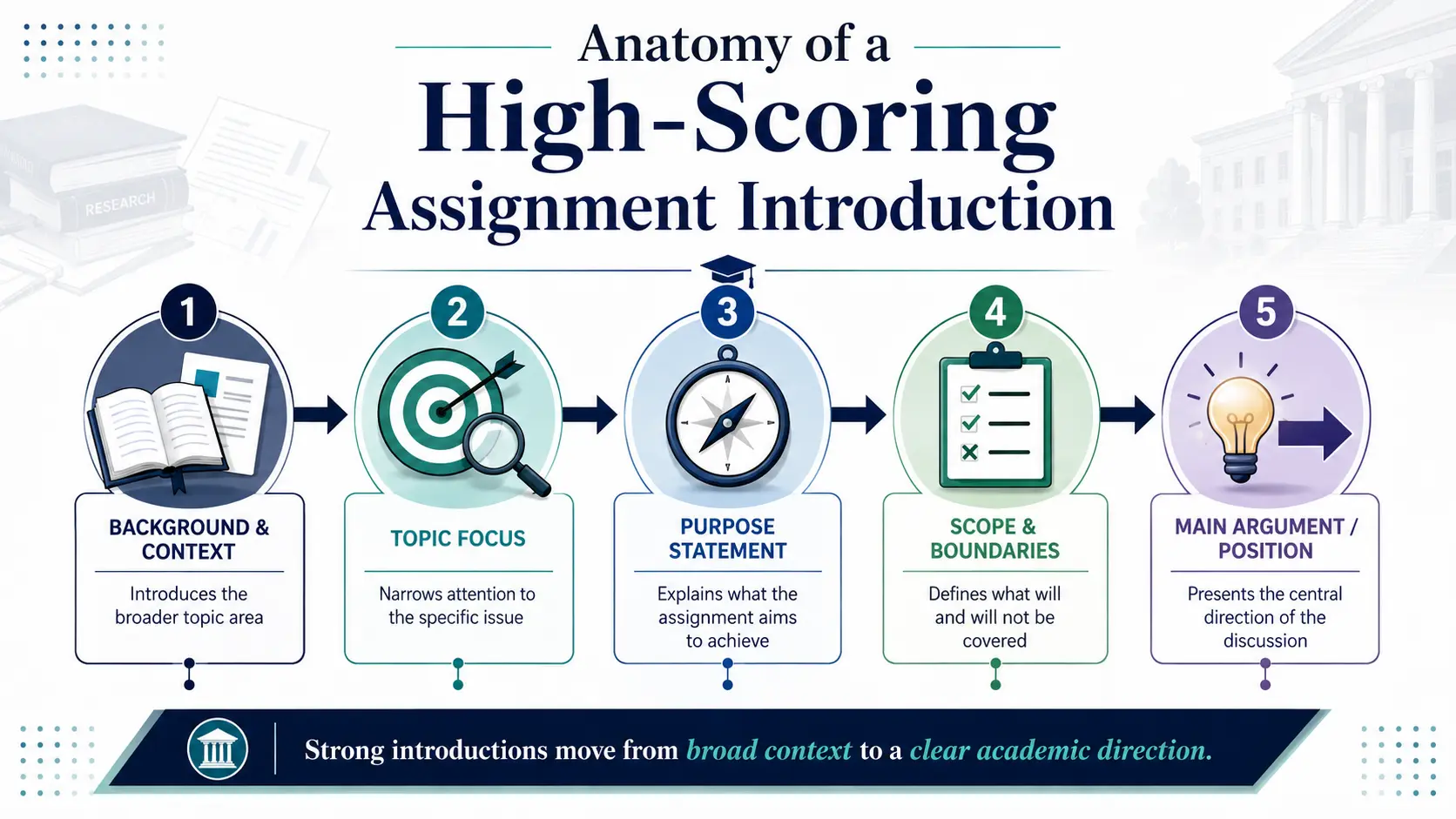
Caption: Visual guide showing five-step structure of a high-scoring assignment introduction for students clearly
From an assessment perspective, this flow supports what markers actively look for: logical organisation of ideas and a clear progression from topic to discussion. These signals are often identified early in the work and influence how the rest of the assignment is interpreted.
In simple terms, the structure works because it filters information rather than expanding it. Each stage removes unnecessary detail and gradually leads the reader toward a clear academic position that supports the main discussion.
How to Write an Assignment Introduction (Step-by-Step Decision Process)
The first sentence is not the first step in writing a strong introduction. As the quality of this section highly depends on a series of decisions that shape how the assignment is approached. And when these decisions are made early, the introduction becomes easier to write and more closely aligned with the task.
Decode the Assignment Brief Properly
Before planning the introduction, identify what the assignment is asking you to do. Instruction words such as 'analyse', 'evaluate', 'compare', or 'discuss' actually reveal the types of answer is expected. A common mistake is treating the brief as a topic rather than a task.
Pay particular attention to:
- Instruction verbs
- Assessment criteria
- Topic keywords
Understanding the task helps keep the introduction relevant to the assessment.
Identify the Real Question Behind the Topic
Many students focus on the topic itself and overlook the issue that needs to be explored. A topic only defines the subject area. The real task is finding the question, problem, or debate within it.
Ask yourself:
- What issue is being examined?
- What problem needs discussion?
- What debate is relevant to the topic?
Once this is clear, the discussion gains a more defined purpose.
Decide Scope Before Writing Anything
A strong introduction does not just try to cover every aspect of a topic. Instead, it signals the limits of the discussion and keeps the focus on the areas that are most relevant. Along with that, clear scope also helps in preventing broad or unfocused openings and presents good academic control from the start.
Build a Single Clear Directional Focus
Once the scope is established, decide where the discussion is heading. Every introduction should provide a clear sense of purpose, whether that becomes an argument, position, or objective. Introducing multiple competing ideas can make the assignment feel uncertain. Readers should be able to recognise the purpose of the discussion before reaching the main body.
Refine After Completing the Body (Alignment Check)
Many students write the introduction first and never revisit it. As the ideas develop during the writing process, rechecking the introduction after completing the body helps you ensure that it accurately reflects the final discussion or not.
During the final review, check that:
- The focus remains accurate
- The scope matches the discussion
- The introduction reflects the final content
The final version should reflect the discussion that actually appears in the assignment. They are refined so that the opening and the content remain fully aligned.
Practical Ways to Start an Assignment Introduction
There is no specific formula to start an assignment introduction. The most effective opening only depends on the topic, the type of assessment, and the purpose of the discussion. Instead of try to attract views with dramatic statements, a strong academic introduction simply establishes relevancy and prepares the reader for what’s coming ahead.
The below-given table will help you understand how to start the introduction of an assignment:
|
Opening Approach |
Best Used When |
Avoid When |
Example Opening |
|
Contextual Entry |
The reader needs background before a specific issue can be understood. |
Large amounts of general information delay the discussion. |
Digital technologies have transformed how organisations communicate with consumers in competitive markets. |
|
Problem Framing |
The assignment explores a challenge, gap, or issue. |
The problem is exaggerated or unsupported. |
Despite growing investment in renewable energy, many countries continue to face barriers to large-scale adoption. |
|
Conceptual Definition |
A key term has multiple interpretations or academic meanings. |
The definition is obvious or copied directly from a dictionary. |
Corporate social responsibility refers to the broader obligations organisations have towards society and the environment. |
|
Evidence-Led Opening |
Research findings or data help establish significance. |
The evidence has little connection to the discussion. |
Recent studies suggest that remote working has become a permanent feature of employment practices across many industries. |
|
Debate Positioning |
The assignment requires evaluation, critique, or comparison of viewpoints. |
The debate is introduced but not explored later in the assignment. |
Researchers remain divided on whether social media has a positive or negative impact on adolescent wellbeing. |
Each of the opening ideas listed above is used for a different academic purpose. Like, contextual entry helps establish the wider subject area before narrowing the discussion. In that place, a problem-framing opening immediately highlights an issue that requires analysis. The evidence-led openings can be mainly effective in research-based assignments because they present relevance from the outset, whereas debate-led introduction beginnings work best when competing viewpoints need to be evaluated. So the strongest choice still depends on the purpose of the discussion. Instead of following a fixed formula, students should prefer an opening that creates a clear and logical starting point for the discussion that follows.
Assignment Introduction Examples for Essays, Reports, and Case Studies
Majorly in all UK university assignments, the structure of a strong introduction remains the same. But the emphasis often changes, mainly depending on the assessment type. The below-provided examples show how introductions are adapted for different academic formats.
Essay Introduction Example
Example:
Social media has become a central part of everyday communication, particularly among adolescents who use digital platforms for social interaction, entertainment, and access to information. While these platforms offer opportunities for connection and self-expression, growing concern surrounds their influence on mental health and wellbeing. Researchers continue to debate whether the benefits of social media outweigh the psychological risks associated with excessive use, online comparison, and cyberbullying. This essay examines the impact of social media on adolescent mental health by evaluating both its positive and negative effects. It argues that although social media can support communication and community engagement, its contribution to anxiety, low self-esteem, and emotional distress presents significant challenges that require greater attention from educators, parents, and policymakers
Why it works: Because this essay introduction moves from the general topic to a specific issue and provides a clear positioning that guides the whole discussion.
Report Introduction Example
Example:
Employee wellbeing has become a growing concern for organisations as changes in working practices continue to reshape the modern workplace. The expansion of remote and hybrid working has created new challenges related to employee engagement, communication, work-life balance, and psychological wellbeing. These issues can have a direct impact on productivity, staff retention, and overall organisational performance. The aim of this report is to evaluate the factors influencing employee wellbeing within contemporary workplaces and assess the effectiveness of strategies used to address these challenges. The report focuses on workplace culture, leadership practices, employee support initiatives, and flexible working arrangements to identify approaches that can contribute to improved employee outcomes.
Why it works: The introduction positions the report's purpose early and also clearly outlines the areas that will be examined.
H3 Case Study Introduction Example
Example
ABC Retail Ltd, a national clothing retailer operating in a highly competitive market, has experienced a sustained decline in customer retention despite continued investment in promotional campaigns and digital marketing initiatives. Recent performance reports indicate falling levels of customer satisfaction and repeat purchases, raising concerns about the company's ability to maintain long-term customer loyalty. As customer retention plays a critical role in profitability and sustainable growth, understanding the factors contributing to this decline has become increasingly important. This case study examines the challenges facing ABC Retail Ltd and evaluates how customer experience, service quality, and relationship management practices may be influencing retention outcomes. It also considers potential strategies that could help strengthen customer loyalty and improve overall business performance.
Why it works: The introduction identifies the situation being examined and clearly defines the problem that the case study will address.
Applied University Assignments Example
Different disciplines place emphasis on different types of issues and evidence.
|
Assignment Type |
Typical Introduction Focus |
|
Nursing |
Clinical issue, patient outcome, or healthcare challenge |
|
Business |
Organisational objective, performance issue, or market challenge |
|
Education |
Learning problem, teaching practice, or policy issue |
|
Social Work |
Service-user need, intervention strategy, or community concern |
The main structure stays the same, even though the subject changes. Essays mainly lay out an argument and report and define their purpose and scope, while the case studies focus on a specific situation or the problem. If students understand these differences, then they can adapt the introduction to the demands of the assessment. Without sticking to the single approach for all the assignments.
Common Reasons Assignment Introductions Lose Marks (And How Markers Evaluate Them)
You can lose marks even if your introduction is well-written if it doesn't clarify what your assignment is supposed to do. Markers usually check the opening section to assess whether the assignment is focused, relevant, and logically planned. Below are the common concerns where students lose marks:
- No clear engagement with the task: The introduction discusses a subject in general terms, and there is no clear answer to the assignment question. The work is vague and unfocused.
- Scope is too wide: Presenting too many ideas at the same time makes it difficult to know what the discussion will be about and reduces confidence in the overall direction of the assignment.
- Description without direction: The subject is described, but the reader has little idea of the purpose or of the argument or line of discussion that will follow.
- Off-topic: The introduction promises topics of discussion that never materialise in the body, creating a disconnect between what is introduced and what is delivered.
- Poor central idea placement: The central idea is either buried, unclear, or introduced too late so that the reader is not sure from the beginning what the purpose of the assignment is.
In most cases, these problems arise before the writing stage. Most introduction problems can be avoided through careful planning before writing begins.
H2 Assignment Introduction Template and Word Count Guidance
If you are unsure how to begin, the templates below provide a practical starting point for drafting an introduction. The templates below provide a practical starting point that can be adapted to most university assignments. Rather than copying them word-for-word, use them to organise your ideas and build a clear academic introduction.
Assignment Introduction Template
[Topic] is an important issue within [subject area, industry, or field] because of its relevance to [broader context or challenge]. This assignment examines [specific topic or question from the brief] with particular focus on [defined aspect or perspective]. The aim is to [analyse, evaluate, discuss, compare, investigate, or assess] [subject] using relevant evidence and academic sources. The discussion will cover [main themes, concepts, or sections] while remaining within the scope of [defined boundaries of the assignment]. It will be argued that [central argument, position, or key finding], providing a clear direction for the discussion that follows.
Essay Introduction Template
[Topic] continues to attract significant academic attention due to its impact on [relevant area]. Although different perspectives exist on this issue, growing attention has been given to [specific debate, concern, or question]. This essay evaluates [focus of the essay] by examining [main themes or arguments]. It argues that [central position or claim] and demonstrates how [supporting factor or evidence area] influences the wider discussion.
If you need help in creating bibliography then we have a detailed guide: How to Write Bibliography?
How Long Should an Assignment Introduction Be?
Well, there’s no fixed rule for the introduction length, but it should remain aligned to the overall assignments. A good introduction should be just long enough to set the scene and explain the purpose of the discussion without getting in the way of it.
- 1,000–1,500-word assignment: 120–180 words
- 2,000–3,000-word assignment: 150–250 words
- 4,000+ word assignment: 250–350 words
These numbers are the general guidelines rather than any strict requirements. And if your university, module handbook or assessment brief provides specific instructions, then you should always prioritise that.
Final Checklist for Writing a Strong Assignment Introduction
Before formatting and submitting your assignment, make sure your introduction tick box all the following points:
- Answers the assignment question rather than simply introducing the topic
- Sets realistic boundaries for the discussion
- Reflects the requirements of the assessment brief
- Introduces the main themes covered in the assignment
- Maintains an academic and objective tone
- Avoids excessive definitions, history, or background detail
- Accurately reflects the content that follows
- Contains no unsupported claims or irrelevant information
- Reads clearly and flows logically into the main body
Your introduction creates the first impression of your academic work and often shapes the perspective of a reader through following discussion. A well-crafted assignment introduction demonstrated focused planning and understanding of the task from the outset. So taking a few minutes to review these points before submission can strengthen the overall quality, coherence and credibility of your assignment. Within that, if you need help in proofreading or editing your introduction, then you can also approach our expert at Native Assignment Help UK for quality submissions.
References
- Bailey, S. (2022) Academic Writing for University Students. 1st edn. London: Routledge.
- Wallwork, A. (2023) English for Academic Research: Writing Exercises. 3rd edn. Cham: Springer.
- Harvard College Writing Center (n.d.) Introductions. Cambridge, MA: Harvard University.
- The Writing Center, University of North Carolina at Chapel Hill (n.d.) Introductions. Chapel Hill: University of North Carolina.

 4 Years | Masters
Sarah Gilbert specializes in academic writing strategies and assignment structure. She produces practical guides that help students write engaging introductions, present clear arguments, and establish a strong foundation for well-organized academic assignments.