.webp)
- What Are Colloquial Words? Meaning, Definition and Examples
- Why Colloquial Language Changes Over Time
- 80+ Colloquial Words Examples and Phrases by Category
- Everyday Colloquial Words Used in Conversation
- British Colloquial Words: UK Examples and Meanings
- American Colloquial Words: US Examples and Meanings
- Common Colloquial Idioms and Phrases With Meanings
- Social Media Colloquial Words, Slang and Internet Terms
- Colloquial Words in Academic Writing: What to Avoid and Use Instead
- Can Colloquial Language Affect Academic Writing Marks?
- Colloquial Language in Literature: Examples and Literary Use
- Colloquialism vs Slang vs Idiom vs Jargon: Key Differences
- How to Check for Colloquial Language Before Submission
- Key Takeaways: When to Use Colloquial Words or Language
What Are Colloquial Words? Meaning, Definition and Examples
The word “colloquial” came from the Latin colloquium, meaning “coversation”. Now this origin tells you almost everything you need to know about it. Colloquial language is simple vocabulary of talking, carried over into writing. Merriam-Webster defines it as language "used in or characteristic of familiar and informal conversation”. While the Cambridge Academic Content Dictionary describes it as words “more suitable for use in speech than in writing”. None of these definitions treat colloquial words as incorrect English. Instead, they are part of standard English, calibrated for a relaxed, spoken context rather than a formal written one.
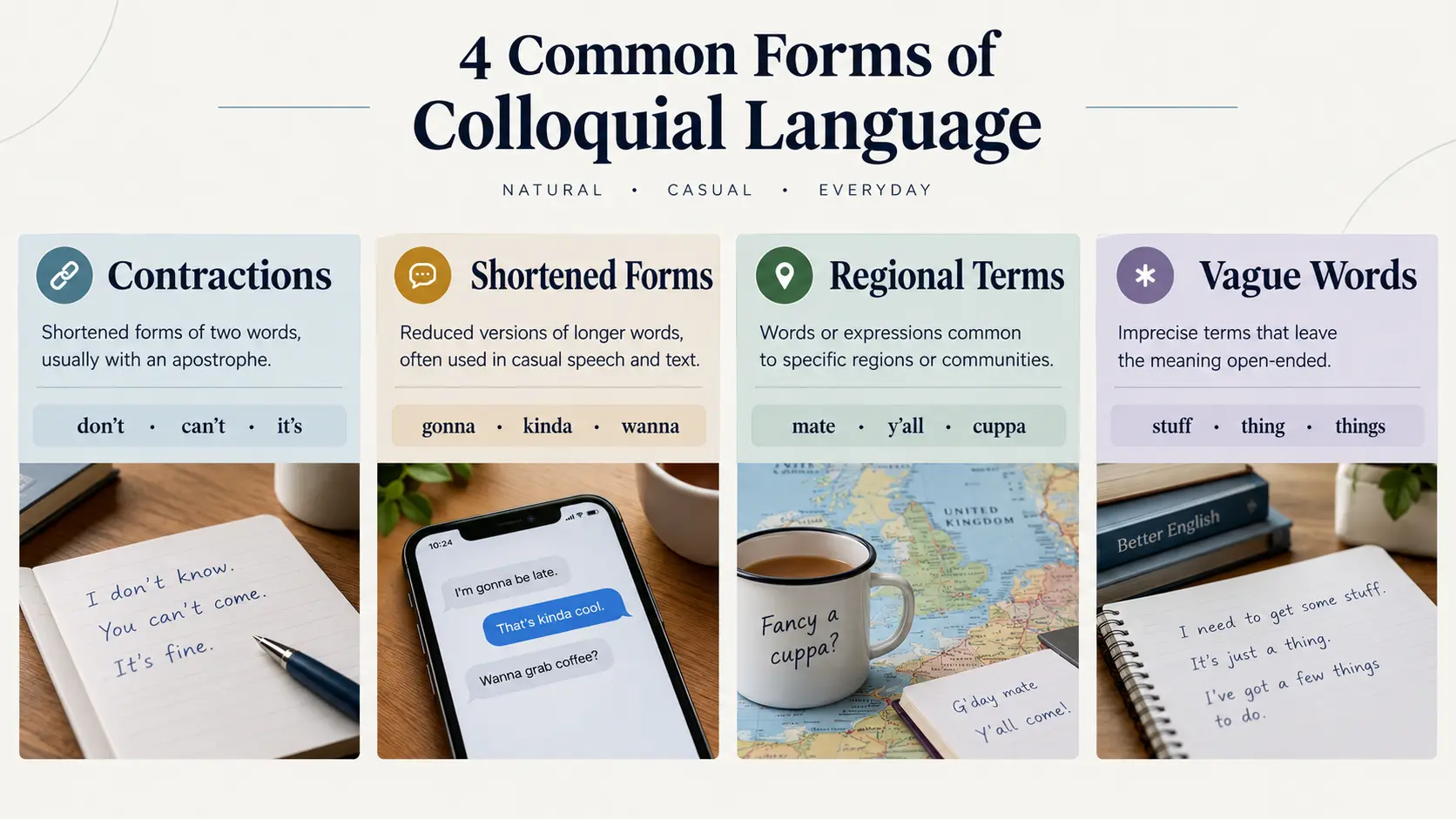
This covers more ground than people usually assume:
- Contractions like "don't" and "can't"
- Shortened forms like "gonna" and "kinda"
- Regional terms like "mate" or "y'all"
- Vague catch-all words like "stuff" or "thing"
Many get confused by colloquial words from slang or jargon. What separates them is covered entirely later in this guide: reach. Colloquialisms tend to be understood across an entire language community, not just within a small group. Nearly every English speaker recognises “kids” for children or “telly” for television, even if they’d never write either words in a report.
Why Colloquial Language Changes Over Time
None of this is fixed. Linguist David Crystal, in his work on internet linguistics, argues that digital communication has become one of the most active forces reshaping everyday English. It's also generating and spreading new informal vocabulary far faster than earlier generations experienced through print or broadcast media. A regional colloquialism might once have taken years to spread beyond its local, but an online phrase can now reach millions of speakers within days.
That speed of adaptation can be seen mostly among young speakers. Research into digital media’s effect on youth language use found that platforms like TikTok and Instagram speed up the adoption of new informal vocabulary directly. Mostly when users fold trending expressions into everyday speech within weeks of first encountering them, often without consciously deciding to.
Along with that, colloquial language sits alongside several other language features that shape how English varies across speech, writing, and context, which is where the next section picks up.
80+ Colloquial Words Examples and Phrases by Category
Colloquial language doesn't look the same everywhere. It shifts by region, by generation, and increasingly by platform, so grouping examples by category makes the differences far easier to actually use.
Everyday Colloquial Words Used in Conversation
Words most native speakers reach for dozens of times a day, regardless of region.
|
Word or Phrase |
Meaning |
|
Gonna |
Going to; used almost exclusively in speech and casual text. |
|
Wanna |
Want to. |
|
Kinda |
Kind of; softens a statement. |
|
Dunno |
Do not know; often shrugged rather than said with confidence. |
|
Stuff |
A vague stand-in for things, items, or unspecified content. |
|
Folks |
People, or specifically one's family. |
|
Buddy |
A close, casual friend. |
|
Grab |
To get something quickly, often food or an item. |
|
Chill |
To relax, or to describe something as relaxed and easygoing. |
|
Sure thing |
An enthusiastic way of saying yes. |
|
No biggie |
Not a problem, not important. |
|
Catch up |
To meet and talk after time apart. |
|
Hang on |
Wait a moment. |
|
Iffy |
Uncertain or slightly doubtful about something. |
|
Rough day |
A difficult or draining day. |
|
Sort out |
To resolve or organise something. |
British Colloquial Words: UK Examples and Meanings
Regional terms shaped by decades of everyday UK use, many missing from standard dictionaries.
|
Word or Phrase |
Meaning |
|
Cuppa |
A cup of tea, central to British social routine. |
|
Knackered |
Exhausted, completely worn out. |
|
Gutted |
Deeply disappointed. |
|
Chuffed |
Pleased or proud. |
|
Dodgy |
Suspicious, unreliable, or of questionable quality. |
|
Bloke |
An ordinary man. |
|
Fortnight |
A two-week period. |
|
Skint |
Broke, with no money. |
|
Brolly |
An umbrella. |
|
Quid |
A pound, in money. |
|
Peckish |
Slightly hungry. |
|
Gobsmacked |
Utterly astonished. |
|
Naff |
Unfashionable or tacky. |
|
Faff |
To waste time doing something inefficiently. |
|
Waffle |
To talk at length without saying much of substance. |
|
Cracking |
Excellent, or very good. |
American Colloquial Words: US Examples and Meanings
Vocabulary spreads globally through film and streaming, though tone still differs from British usage.
|
Word or Phrase |
Meaning |
|
Y'all |
You all; common across the American South. |
|
Rookie |
A beginner or newcomer, often in sport or a job. |
|
Couch potato |
Someone who spends excessive time watching TV. |
|
Freshman |
A first-year student. |
|
Diner |
A casual, inexpensive restaurant. |
|
Bummer |
A disappointing situation. |
|
Sketchy |
Suspicious or untrustworthy. |
|
Screw up |
To make a significant mistake. |
|
Ballpark figure |
A rough, approximate estimate. |
|
Fender bender |
A minor car collision. |
|
Downtown |
A city's central business district. |
|
Cookie-cutter |
Generic and unoriginal, lacking individuality. |
|
Snail mail |
Traditional postal mail, as opposed to email. |
|
Hang tight |
Wait patiently for a moment. |
|
Trash talk |
Boastful or insulting speech, often before competition. |
|
Deadbeat |
Someone irresponsible, especially with obligations. |
Common Colloquial Idioms and Phrases With Meanings
Idioms are colloquial by nature, since their meaning can't be worked out from the individual words alone. Recognising and using them correctly signals a genuinely advanced command of English, well beyond vocabulary memorisation.
|
Phrase |
Meaning |
|
Break the ice |
To ease tension in a new or awkward situation. |
|
Piece of cake |
Something very easy to accomplish. |
|
Hit the books |
To study intensively. |
|
Under the weather |
Feeling physically unwell. |
|
Spill the beans |
To reveal a secret, often accidentally. |
|
Once in a blue moon |
Very rarely. |
|
Cost an arm and a leg |
Extremely expensive. |
|
On the ball |
Alert, competent, and quick to respond. |
|
Bite the bullet |
To accept something difficult after resisting it. |
|
Beat around the bush |
To avoid addressing the main point directly. |
|
Cut corners |
To do something poorly or incompletely to save time. |
|
In the same boat |
Facing the same difficult situation as someone else. |
|
Burn the midnight oil |
To work late into the night. |
|
Jump on the bandwagon |
To join a popular trend after it's already established. |
|
Miss the boat |
To lose an opportunity by acting too late. |
|
Let the cat out of the bag |
To reveal information, usually unintentionally. |
Social Media Colloquial Words, Slang and Internet Terms
This is the fastest-moving category of colloquial English, and several of these terms will look dated within two or three years, since they spread through platforms like TikTok and Instagram far faster than any earlier generation of slang. Some of the more UK-specific slang in this category overlaps with terms covered in our Roadman Slang in 2026 guide, which tracks how fast this particular category shifts.
|
Term |
Meaning |
|
FOMO |
Fear of missing out. |
|
IYKYK |
If you know, you know; implies an in-group reference. |
|
NGL |
Not gonna lie; signals honesty before a statement. |
|
Lowkey |
Secretly, or to a mild degree. |
|
Highkey |
Openly and obviously. |
|
Vibe |
A general feeling or atmosphere. |
|
Ghosting |
Ending contact with someone suddenly, without explanation. |
|
Flex |
To show off, often about an achievement or possession. |
|
No cap |
Being completely honest, no exaggeration. |
|
Rizz |
Charisma, especially in a romantic context. |
|
Glow up |
A noticeable, positive transformation over time. |
|
Main character energy |
Acting with confidence, as if central to the moment. |
|
Delulu |
Delusional, used in a lighthearted, self-aware way. |
|
Touch grass |
Advice to go outside and reconnect with reality. |
|
Living rent free |
Something someone can't stop thinking about. |
|
Ate |
Did something exceptionally well. |
That range, from "mate" to "rizz", shows how differently each type of colloquial word behaves depending on context. Some sound perfectly natural in an essay's reflective section; others would look out of place in almost any piece of formal writing, which is exactly where the next section picks up.
Colloquial Words in Academic Writing: What to Avoid and Use Instead
The words listed in the above tables are the ones people actually notice using. However, ones that cause real problems in student writing are quieter. They are everyday filler phrases that slip into essays without feeling colloquial at all, until a marker flags them. And they mainly fall into three recurring patterns.
- Vague qualifiers → Phrases like "a lot of", "a ton of", and "pretty much" feel precise while writing. But on other hand it looks imprecise to a marker, because they avoid committing to an actual figure or degree.
Colloquial: "A lot of students struggle with referencing."
Academic: "A considerable proportion of students struggle with referencing."
- Opinion markers dressed as fact → "I feel like", "obviously", and "basically" all smuggle a personal stance into a sentence without academic hedging or evidence behind it, which is exactly what markers are trained to flag as unsupported claims.
Colloquial: "I feel like this theory doesn't hold up."
Academic: "This theory appears inconsistent with the evidence presented by Smith (2021)."
- Conversational connectors → "At the end of the day", "in a nutshell", and "things" are spoken-language habits. They are ways of transitioning or summarising out loud, that carry no equivalent formality in writing.
Colloquial: "At the end of the day, things need to change."
Academic: "Ultimately, several factors require reconsideration."
None of these phrases look like slang, which is exactly why they catch students out. They may read as normal, but in competent writing they are compared against the expected academic register, and in that situation marks usually get affected.
Can Colloquial Language Affect Academic Writing Marks?
UK university writing guides treat colloquial language as a marking issue, not just a style preference. Even both, the University of Reading and the University of Sunderland, list colloquialisms and contractions as direct errors, not minor slips, that examiners are trained to flag.
Where that line sits depends on the piece of writing itself:
- Reflective journals and personal statements can carry a conversational tone without penalty, since the format invites a more personal voice.
- Essays, literature reviews, and research reports cannot. These are marked against a formal register as a baseline expectation, not a stylistic preference.
Markers notice this kind of slip because it signals a gap in academic awareness rather than a lack of effort. That difference also separates a strong-mark project from an excellent one on otherwise solid work. If you’re unsure about the academic rules in your own subject, then our English Assignment Help service can assist you by reviewing drafts specifically for tone and refinement before submission.
Colloquial Language in Literature: Examples and Literary Use
Writers use colloquial language on purpose. Because that’s what separates a novelist’s dialect from a student slipping into casual tone by accident, and seeing it done well makes the difference easier to spot in your own writing.
Mark Twain built Huck Finn's entire voice in The Adventures of Huckleberry Finn from dialect, dropped word endings, and used words like "ain't". Readers hear an uneducated, rural Southern boy before Twain tells them anything else about him.
Irvine Welsh goes further in Trainspotting, writing much of the novel in phonetic Scots. The dialect is hard to read on purpose, it puts readers slightly outside the story, mirroring the isolation of the characters themselves.
Harper Lee is more selective in To Kill a Mockingbird. Heavier dialect appears in working-class characters, while Scout's narration stays closer to standard English, quietly marking class differences without ever stating them.
Each writer is using colloquial language as one of several language techniques, the same toolbox as imagery or symbolism, to build voice and character. When it is used for a purpose, it strengthens the writing. And when used by accident, it just looks like a mistake.
Colloquialism vs Slang vs Idiom vs Jargon: Key Differences
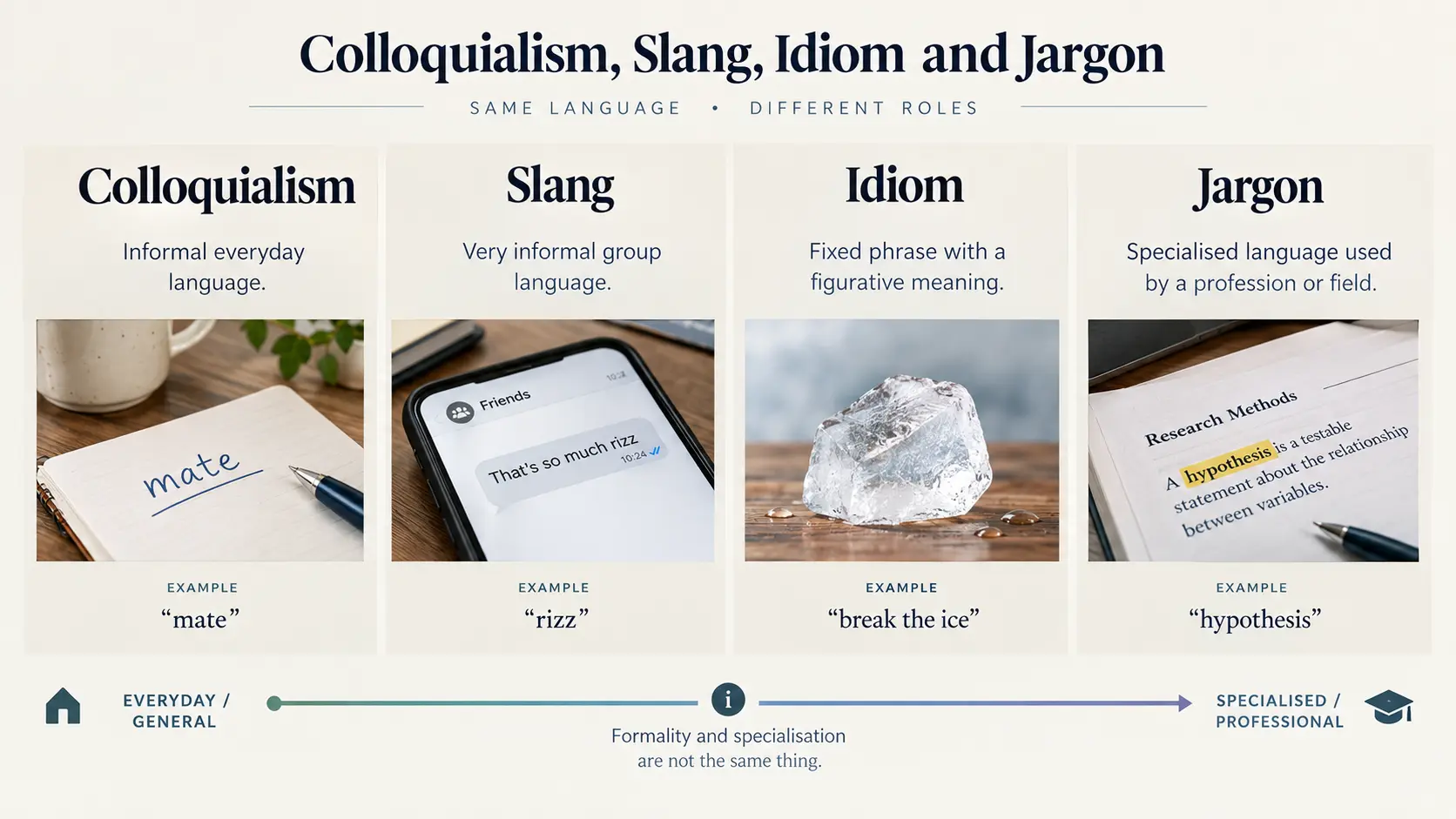
Most guides on this topic list examples side by side without explaining what actually separates the four terms. This table fixes that, using four consistent measures: how formal each one is, who typically uses it, how long it tends to last, and whether it belongs in academic writing.
|
Type |
Definition |
Formality |
Typical Users |
Longevity |
Academic Writing? |
|
Colloquialism |
Informal everyday language, widely understood across a language community. |
Semi-formal to informal |
General public, regional speakers |
Stable, changes slowly |
No, except in direct quotation |
|
Slang |
Highly informal vocabulary coined within a specific in-group. |
Very informal |
In-groups, youth, subcultures |
Short-lived, shifts quickly |
No, in any context |
|
A fixed phrase whose meaning is figurative, not literal. |
Informal to neutral |
General public, across most contexts |
Very stable, often centuries old |
Rarely, and only sparingly |
|
|
Jargon |
Technical vocabulary specific to one profession or field. Sits at the opposite end of the spectrum from colloquial language, which lowers rather than raises the barrier to understanding. |
Formal within its field |
Professionals, specialists |
Stable within the field |
Yes, when the audience is specialist |
Two distinctions are easy to mix up. Colloquialism and slang differ by reach, not tone: "mate" is understood by nearly every English speaker in its region, while slang like "rizz" only lands within the group that uses it, which is also why slang ages out so much faster. Colloquialism and idiom differ by literalness: "gonna" is colloquial but means exactly what it says, while "kick the bucket" is figurative, its meaning has nothing to do with buckets, and that figurative quality is what makes it an idiom rather than a simple colloquialism.
How to Check for Colloquial Language Before Submission
- Read aloud → colloquial phrases sound noticeably different once spoken.
- Search for contractions → replace "don't", "can't", and "it's" with full forms.
- Flag vague fillers → "stuff", "things", and "a lot" need a precise term.
- Check trending phrases → if it's from social media this year, cut it.
- Match your reading list → your set texts show the register you need.
Key Takeaways: When to Use Colloquial Words or Language
Colloquial words are never low on personality; it's just that they simply belong in a different context than academic writing. Knowing where that line sits lets you keep the personality while controlling the risk. So, use colloquial words or language where it’s actually meant to be used, such as conversation, dialogue, and everyday writing, and switch to precise academic vocabulary where marks are on the boundary. Along with that, a single habit of registering or asking for a check from a subject professional, like Native Assignment Help, can prevent flagging the mistakes in well-researched, well-argued work before final submission.
References
- Cambridge University Press (n.d.) Colloquial. Cambridge Academic Content Dictionary. Available at: https://dictionary.cambridge.org (Accessed: 21 September 2026).
- Crystal, D. (2011) Internet Linguistics: A Student Guide. Abingdon: Routledge.
- Garcia, A.C. (2021) 'The impact of digital media on language evolution among youth: A qualitative study', Digital Communication Journal, 9(4), pp. 302-318.
- Lee, H. (1960) To Kill a Mockingbird. Philadelphia: J.B. Lippincott & Co.
- Merriam-Webster (n.d.) Colloquial. Available at: https://www.merriam-webster.com (Accessed: 21 September 2026).
- Queen Margaret University (n.d.) Academic Writing. Edinburgh: QMU Effective Learning Service.
- Twain, M. (1884) The Adventures of Huckleberry Finn. New York: Charles L. Webster and Company.
- University of Reading (n.d.) Academic Writing: Style. Reading: University of Reading Study Advice.
- University of Sunderland (n.d.) Proofreading: Academic Tone. Sunderland: University of Sunderland Library Guides.
- Welsh, I. (1993) Trainspotting. London: Secker & Warburg.

 8+ Years Years | MA in English Language Studies
Ken Follett is an Applied Linguistics specialist with 8+ years of experience in English language research and academic writing. She holds a PhD in Applied Linguistics from the University of Cambridge, with expertise in language variation, academic communication, and modern English usage. Her work focuses on helping students and researchers understand language structures, writing styles, and effective communication practices.