
- What is an idiom? Definition, Meaning and How It Works
- What Are the Four Types of Idioms in English?
- Idiom vs Metaphor, Proverb, Cliché and Euphemism: What’s the Difference?
- British Idioms: 13 Common UK Expressions and Their Meanings
- 25 Common English Idioms, Their Meanings and Example Sentences
- Can You Use Idioms in Academic Writing? Rules, Examples and Alternatives
- Common Idiom Mistakes and How to Avoid Them
What is an idiom? Definition, Meaning and How It Works
At its core, an idiom is a group of set words that means something different from what the words suggest on their own. Swap one word out and the whole meaning will collapse. Like "spill the beans” means to reveal a secret, but “spill the peas” means nothing at all.
Dictionaries agree on the basics even when their wording differs. Cambridge Dictionary describes an idiom as a group of words in a set order with a meaning separate from each word alone. There Collins frames it as words that mean something different together than they would apart. Whereas Oxford Learner’s keeps it simpler still, a group of words whose meaning differs from their parts.
One thing they all have in common is that once a phrase becomes an idiom, it doesn’t change much. That's the reason idioms need to be learned rather than worked out. You can figure out most new words by looking at the context, but an idiom doesn’t give you that option. Either you know what "kick the bucket" means, or you don't understand what it means.
What Are the Four Types of Idioms in English?
Not all the idioms are built in the same way. When you recognise the type, you can simply understand why a phrase works the way it does and how useful the language technique is to reference when analysing a text for coursework.
- Pure idioms: They have no connection to their literal words at all. "Kick the bucket" means to die, and nothing about kicking or buckets explains that. "Let the cat out of the bag" works the same way, meaning to reveal a secret with no cats or bags involved. The meaning survives through repeated cultural use alone.
- Binomial idioms: It pairs two words with "and" or "or" in a fixed order. "Pros and cons" works; "cons and pros" does not sound right, though the meaning would technically stay the same. "Rock and roll", "sick and tired", and "short and sweet" follow the same rigid pattern, and reversing any of them instantly sounds wrong.
- Partial idioms: This one keeps one foot in literal meaning. "Take a rain check" started as a literal postponement of a rained-out baseball game and now means to decline something now and accept it later, for almost anything. Add fuel to the fire" is similar: a literal image that grew into a figurative one describing a situation made worse.
- Prepositional idioms: Here it combines a verb with a preposition to create a new meaning. To "run into" someone does not mean a collision; it means to meet them unexpectedly. To "look into" something means to investigate it; it just means not to look inside it physically. Many phrasal verbs work this way, confusing learners who translate them word for word.
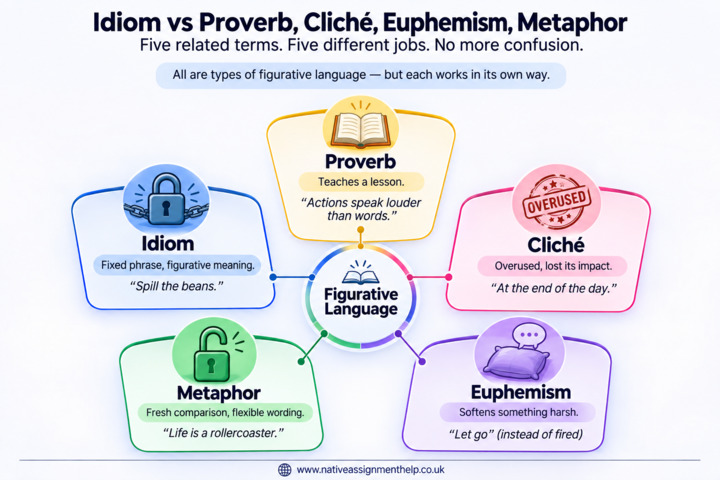
Idiom vs Metaphor, Proverb, Cliché and Euphemism: What’s the Difference?
There are several other figurative devices that sit close to idioms, and mixing them up is a common mistake in essays discussing literary style or technique.
'A proverb' offers advice or a life lesson rather than simply describing something. " Actions speak louder than words" teaches a value. An idiom carries no such lesson: "spill the beans" just describes an action, with nothing to learn from it.
‘Cliché’ is any phrase, idiomatic or not, used so often it has lost its impact. "At the end of the day" and "think outside the box" are clichés because they are overused, not because of what they mean. Many idioms become clichés through repetition, but the labels describe different problems: one is about meaning, the other about overuse.
'Euphemism' softens something harsh or uncomfortable. Saying someone was "let go" instead of "fired" is designed to be polite. The idiom version, "get the sack", does the opposite: it is blunt and informal rather than gentle.
| Term | What It Does | Example |
|---|---|---|
|
Idiom |
Fixed phrase with a figurative meaning |
Spill the beans. |
|
Proverb |
Teaches a lesson or gives advice |
Actions speak louder than words. |
|
Cliché |
Overused phrase that has lost its impact |
At the end of the day |
|
Euphemism |
Softens something harsh or blunt |
Let go (instead of fired). |
|
Metaphor |
Fresh comparison that can be reworded freely |
Life is a rollercoaster. |
Is an idiom a metaphor? You can change the words in a metaphor to fit your needs, but you can’t change the words in an idiom without changing its meaning. "It's raining cats and dogs" can't change to "it's raining pets and puppies", and that's what makes them different. Well, some idioms do start out as metaphors but become fixed phrases over time. If you’re interested in figures of speech in a broader sense, then hypophora is also worth comparing, since it works through structure and rhetorical questioning rather than a locked phrase.
British Idioms: 13 Common UK Expressions and Their Meanings
Different parts of the world use different idioms, and here in the UK students have a different set that doesn’t show up very often in American-focused guides. These are common phrases used in everyday British conversation, from college dorms to lecture halls.
| British Idiom | Meaning | Example in a Sentence |
|---|---|---|
|
Bob's your uncle. |
And there it is, all done. |
Add the milk, stir, and Bob's your uncle. |
|
The bee's knees |
Something excellent |
That new café is the bee's knees. |
|
Taking the mickey |
Mocking or teasing someone |
Stop taking the mickey out of his accent. |
|
A storm in a teacup |
A lot of fuss over something minor |
The whole argument was a storm in a teacup. |
|
Not my cup of tea |
Something I do not enjoy |
Horror films are not my cup of tea. |
|
Chuffed to bits |
Very pleased |
She was chuffed to bits with her grade. |
|
Gutted |
Deeply disappointed |
I was gutted when the trip got cancelled. |
|
Throw a spanner in the works. |
Disrupt a plan. |
The strike threw a spanner in the works. |
|
At a loose end |
Having nothing to do |
I'm at a loose end this weekend. |
|
Take the biscuit. |
Be the most extreme example of something. |
Forgetting the deadline really takes the biscuit. |
|
Do a runner |
Leave suddenly to avoid a bill or duty. |
They did a runner before paying the tab. |
|
Full of beans |
Energetic and lively |
The kids were full of beans this morning. |
|
Over the moon |
Extremely happy |
We were over the moon with the results. |
25 Common English Idioms, Their Meanings and Example Sentences
Five idioms come up more than almost any others in everyday English:
- Break the ice → help people feel more relaxed.
Example: The host told a joke to break the ice.
- Piece of cake → something very easy.
Example: The quiz was a piece of cake.
- Under the weather → feeling slightly unwell.
Example: I'm staying home; I feel under the weather.
- Cost an arm and a leg → very expensive.
Example: That laptop cost an arm and a leg.
- Hit the books → start studying seriously.
Example: Exams start Monday, so it's time to hit the books.
Beyond those five, this wider set covers most of what you will encounter in reading, conversation, and student life:
| Idiom | Meaning | Example in a Sentence |
|---|---|---|
|
Bite the bullet. |
Face a difficult situation with courage. |
She bit the bullet and reset the exam. |
|
Once in a blue moon |
Very rarely |
He calls home once in a blue moon. |
|
See eye to eye. |
Agree with someone |
The team finally saw eye to eye on the plan. |
|
On the ball |
Quick to understand and react |
Our new tutor is really on the ball. |
|
Miss the boat |
Miss an opportunity |
Apply early, or you'll miss the boat. |
|
The elephant in the room |
An obvious problem nobody wants to discuss |
Nobody mentioned the elephant in the room. |
|
Kill two birds with one stone. |
Achieve two things with one action. |
Walking to campus kills two birds with one stone. |
|
Get cold feet. |
Become too scared to go ahead. |
He got cold feet before the presentation. |
|
Cry over spilt milk |
Be upset about something that cannot change. |
No use crying over spilt milk now. |
|
Take with a grain of salt. |
Not take something too seriously |
Take his advice with a grain of salt. |
|
Make ends meet. |
Have just enough to cover your needs. |
Part-time work helps students make ends meet. |
|
A blessing in disguise |
A good thing that seemed bad at first |
Losing that job was a blessing in disguise. |
Can You Use Idioms in Academic Writing? Rules, Examples and Alternatives
Idioms mainly belong to conversations and creative writing, including personal statements, where they add warmth and personality. They do not belong in formal academic writing, and UK markers notice the difference immediately.
What academic writing rewards is clarity and a consistent, objective register over any colour or personality. A phrase unfamiliar to the reader can change the meaning entirely, particularly for international markers assessing work against strict criteria. Along with that, most UK university-style guides ask explicitly for formal, objective language, and idiomatic phrasing is one of the fastest ways to break that tone without realising it. It also signals that a section was written quickly, inviting closer scrutiny of everything around it.
Compare these two versions of the same point:
- Informal draft: "The experiment was a piece of cake, and once we hit the books on the theory, everything fell into place."
- Academic rewrite: "The experiment was straightforward to execute, and a thorough review of the underlying theory clarified the remaining steps.
Here is a second example, this time from a reflective piece rather than a lab report:
- Informal draft: "I was gutted when the first draft got cold feet from the tutor, but I bit the bullet and rewrote the whole section."
- Academic rewrite: "The initial feedback on the first draft was disappointing, but a complete revision of the section addressed the concerns raised."
Both of these examples keep the original meaning intact while matching the tone examiners expect. Also, the fix is rarely about deleting the content; it's about translating the same idea into direct literal language. So if you’re working on essay openings more broadly, then strong sentence starters for essays can help you build that formal register from the very first line. Rather than just fixing it while editing.
The safest rule to apply while drafting: if a phrase would sound out of place in a news report or a textbook, leave it out of your assignment.
Common Idiom Mistakes and How to Avoid Them
- Changing the wording → "Spilled the secrets" isn't the same as "spilled the beans". A marker notices the substitution immediately, however clear the intended meaning is.
- Using them in the wrong context → A playful idiom in any formal writing makes it less serious. Better use idioms only in casual writing or stories; resist using them in assignments or dissertations.
- Overusing them → Stacking two or three idioms in a single sentence makes writing cluttered. Instead, one well-placed idiom weighs more strongly than three competing for attention.
- Explaining the idiom afterwards → Writing "he kicked the bucket and died" is redundant. A well-chosen idiom stands on its own; needing to explain it afterward usually means it was the wrong choice for the audience.
Final Thoughts
Idioms make everyday English feel natural. There, knowing the difference between a pure idiom, a binomial pair, and a prepositional phrase helps you spot them faster. You should learn British idioms like "chuffed to bits" and "gutted", even if you don't plan to use them in formal writing, because you will hear them all the time on campus. One rule that is worth remembering above all others is that idioms belong to conversations, not in your coursework.
If you need any kind of assistance regarding your academic tasks, then you can approach our professional academic writing experts. At Native Assignment Help we assist students to improve their performance and final results.
References
- British Council (2026) LearnEnglish: Idioms. Available at: https://learnenglish.britishcouncil.org/ (Accessed: 22 August 2026).
- Cambridge Dictionary (2026) Idiom. Available at: https://dictionary.cambridge.org/dictionary/english/idiom (Accessed: 22 August 2026).
- Collins Dictionary (2026) Idiom. Available at: https://www.collinsdictionary.com/dictionary/english/idiom (Accessed: 22 August 2026).
- Merriam-Webster (2026) Idiom. Available at: https://www.merriam-webster.com/dictionary/idiom (Accessed: 22 August 2026).
- Oxford Learner's Dictionaries (2026) Idiom. Available at: https://www.oxfordlearnersdictionaries.com/definition/english/idiom (Accessed: 22 August 2026).
.jpg)
 7+ years Years | MA in English Literature, BA in English Language and Communication
Sophia Williams is an experienced academic content writer specialising in English language, literature, and educational topics. She creates well-researched and student-friendly content that helps learners understand complex concepts, improve their writing skills, and develop stronger communication abilities.