
- What UK Markers Expect from Reflective Nursing Essays
- Gibbs’ Reflective Cycle for Nursing Essays: Six Stages With Word Counts
- Analysis Stage: How to Write It at 2:1 and First-Class Level
- Reflective Nursing Essay Mistakes That Keep You in the 2:2 Band
- Step-by-Step Workflow for Writing Your Reflective Nursing Essay
- Pre-Submission Checklist Before You Upload Your Nursing Essay
What UK Markers Expect from Reflective Nursing Essays
Most UK universities mark undergraduate nursing work out of 100. A pass is usually 40, a 2:2 starts at 50, a 2:1 at 60 and a first at 70. Whereas postgraduate programmes often set the pass mark at 50, so check your module handbook.
Markers in universities read your essay against the NMC Code and the standards of proficiency. Reflection is a core skill, because NMC revalidation requires five written reflective accounts every three years.
|
Grade band |
What the marker sees |
|
First (70+) |
Deep analysis, wide reading, clear NMC Code links and a measurable action plan. |
|
2:1 (60-69) |
Clear analysis with good sources, but some points stay at surface level. |
|
2:2 (50-59) |
Mostly description, with limited evidence and a general action plan. |
|
Pass (40-49) |
Basic reflection, weak referencing and little link to practice standards. |
After knowing the target, you can now map the six Gibbs stages onto it.
Gibbs’ Reflective Cycle for Nursing Essays: Six Stages With Word Counts
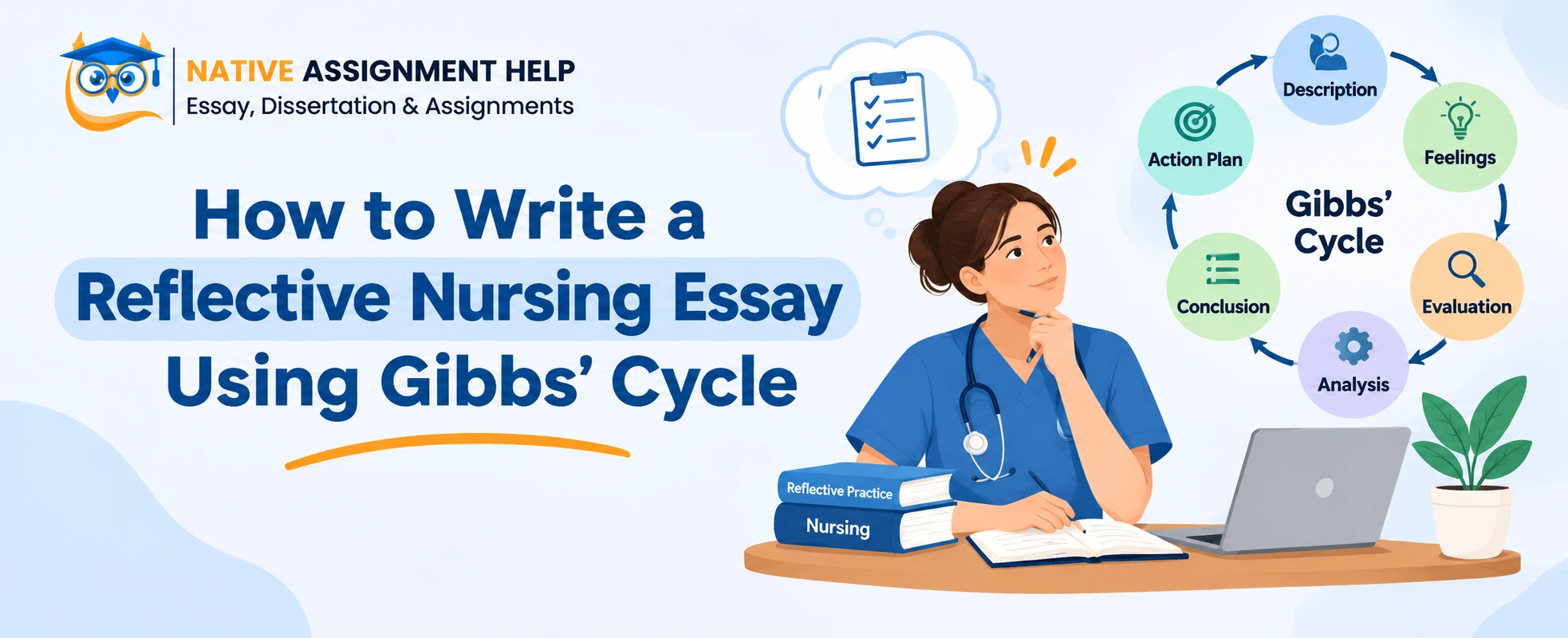
Gibbs’ Reflective Cycle (1988) has six stages. The split below suits a 2,000-word essay, so scale it to your brief.
- Description (250 words) →Set the scene so the reader can follow your analysis. State where, when and what happened in past tense, and anonymise everyone as “Patient A”. Keep opinions out.
- Feelings (200 words) → Show self-awareness without any drama. Clearly state what you thought and felt before, during and after event in calm and professional language.
- Evaluation (250 words) → Be fair when you judge your practice. Pick two or three real moments, like the handover, and explain what worked and what did not in each.
- Analysis (750 words) → Explain why the event happened, because this stage decides your grade. Compare your actions with NICE guidance, the NMC Code and peer-reviewed research, and back every point with a source.
- Conclusion (250 words) → Show what the event taught you. Clear out what you learned about your practice and what you’ll do differently without repeating earlier mistakes.
- Action plan (300 words) → Present your learning as measurable steps. So, set specific actions with dates and a way to check your progress.
Suggestion: feelings may carry a light word count, but markers still expect honest self-awareness within it.
Analysis Stage: How to Write It at 2:1 and First-Class Level
Analysis holds the largest share of words, so it decides your grade. Prioritising people, practising effectively, preserving safety, or promoting professionalism and trust are the code themes involved. A first-class essay also challenges the evidence, for example, by noting where guidance did not fit your clinical setting.
- Weak – “The handover felt rushed, so I will communicate better.”
- Strong – "Our handover missed the patient’s falls risk. Structured tools such as SBAR improve clarity (Author, Year), so I now use one to check every risk.”
Remember, a strong version names the problem, adds evidence and leads to action. Many essays miss this, so here is what to avoid.
Reflective Nursing Essay Mistakes That Keep You in the 2:2 Band
These four errors keep many essays stuck in the 2:2 band.
- Too much description → Limit the event to about 250 words (12% of the essay).
- Identifiable details → Protect confidentiality under the NMC Code and university policy.
- Blaming others → Focus on your decisions and what you could control.
- Vague actions → Set specific goals, such as completing a structured handover course by March.
Here, if you follow a fixed writing order, then you can avoid all four mistakes effortlessly.
Step-by-Step Workflow for Writing Your Reflective Nursing Essay
Follow this order to avoid a last-minute rewrite.
- Pick one specific with a clear learning point, such as a medication query or a delayed escalation.
- Read the essay brief and marking criteria thoroughly and also note the word limit.
- Search CINAHL or PubMed for 5 to 8 recent peer-reviewed sources with current NICE guidance.
- Write Description, Feelings and Evaluation in the first person and past tense.
- Finish the conclusion and the action plan at the last, so they reflect your analysis.
- Leave a week between drafts so you can edit with fresh eyes.
- Ask your personal tutor or academic skills team for feedback on a draft.
A draft is not a finished essay, so close with a careful check. If you’re writing an essay with Gibbs the first time, then you can consider professional assistance. Get help from essay writing support, they will review your work and guide you through first or 2:1-level essay.
Pre-Submission Checklist Before You Upload Your Nursing Essay
Run through this list before you upload your essay.
- Confidentiality: Remove names, ward details, exact dates and anything that could identify a person.
- Word count: Check your limit. Headings and references are often excluded, but confirm this.
- Referencing: Follow your university’s Harvard guide, and match every citation to the reference list.
- Sources: Use current NICE and NMC documents.
- Structure: Confirm all six stages appear, and analysis is your longest section.
- Outcomes: Map each learning outcome to a paragraph.
- Tone: Write in the first person and keep the language professional, not emotional.
- Proofreading: Read aloud, trim long sentences and run a plagiarism check.
If you are not confident with your work or need a second opinion, you can ask our academic professionals for help. At Native Assignment Help, our expert will go through your work and provide support according to your module requirements and your specific idea.
.jpg)
 9+ years Years | BSc Nursing, MSc Nursing
Dr. Amelia Richardson is an experienced nursing academic writer with over 9 years of experience in nursing education, academic research and healthcare writing. She holds a Bachelor of Science in Nursing (BSc Nursing) and a Master of Science in Nursing (MSc Nursing), with specialist knowledge of clinical practice, patient safety, healthcare ethics and reflective practice. Her expertise includes Gibbs' Reflective Cycle, the NMC Code, NICE guidelines and evidence-based nursing practice. She helps students understand reflective writing, develop critical analysis and connect clinical experiences with professional nursing standards. Her work focuses on UK university assessment criteria, academic integrity and accurate referencing to support high-quality nursing assignments.