
- What Is Emotive Language? Definition and Meaning
- Emotive Language Examples: 15 Sentences and Their Effects
- Emotive Language Examples in News, Advertising and Speeches
- Emotive Language Words and Phrases: Examples by Emotion
- Emotive Language Techniques: 8 Methods With Examples
- What Is the Effect of Emotive Language on Readers?
- Emotive vs Emotional Language: What's the Difference?
- How to Analyse Emotive Language in a Text
- Can You Use Emotive Language in Academic Writing?
What Is Emotive Language? Definition and Meaning
Emotive language is the deliberate use of words and phrases that trigger a feeling in the reader instead of simply stating a fact. Like the word “emotive” simply means causing strong feelings. So the emotive language meaning is easy to hold: the writer wants you to feel first and judge second.
Every word does two jobs. Its denotation is the dictionary meaning, and its connotation is the feeling that comes with it. "Thin" and "skeletal" both describe a body, yet "skeletal" adds alarm. You might have seen this same trick on food labels. “Farm-fresh” and “handpicked” describe ordinary tomatoes, but they add warmth and trust.
Whether a word turns emotive depends on these factors:
- Connotation → The word carries a feeling beyond its dictionary sense, as "home" does compared with "property".
- Audience → In this age, culture and beliefs change the reaction. That’s why "patriot" pleases one crowd and annoys another.
- Context → The setting shifts the tone, since "attack" is routine in a football report and alarming in a crime story.
- Purpose → The writer chose the word on purpose, whether to persuade, comfort, warn or sell.
The idea already has deep roots. Stevenson (1937) showed that words can express and stir attitudes. Later work treats emotive wording as a working part of argument (Macagno and Walton, 2014).
Seeing one fact written two ways makes all of this click, so the next section places neutral and emotive wording side by side.
Emotive Language Examples: 15 Sentences and Their Effects
The quickest way to spot an emotive language example is to compare two versions of one sentence. Each pair below keeps the facts and changes the feeling.
|
Neutral sentence |
Emotive sentence |
Feeling created |
|
The dog was thin. |
The abandoned dog was skin and bone. |
Pity |
|
The council reduced funding. |
The council slashed funding. |
Anger |
|
The team won the match. |
The team clinched a thrilling victory. |
Excitement |
|
Workers protested about pay. |
Furious workers rose up against poverty wages. |
Outrage |
|
The teacher was strict. |
The teacher ruled the class with an iron fist. |
Fear |
|
The storm damaged homes. |
The savage storm tore families from their homes. |
Alarm |
|
The nurse helped patients. |
The devoted nurse comforted frightened patients all night. |
Admiration |
|
The rent increased. |
The rent leapt, squeezing families out of their homes. |
Worry |
Look at the funding pair. "Reduced" only says the amount went down. "Slashed" sounds violent, so the council seems careless. The numbers are the same, but the reader feels angry. Positive words work too, since "thrilling" and "devoted" stir feeling as strongly as "savage".
Emotive Language Examples in News, Advertising and Speeches
Outside the classroom, the same tricks appear in places you see every day.
- News headline → "Shameless firm axes 400 jobs" blames the company before any evidence appears, and "axes" adds violence.
- Charity appeal → "Every night, a frightened child goes to bed hungry" uses one child to move donors.
- Advert → Coca-Cola's "Open Happiness" campaign links a drink to a warm, positive feeling.
- Property listing → "A charming, sun-drenched cottage" says nothing measurable, yet buyers picture a home.
- Civil rights speech → Martin Luther King Jr. used "brotherhood" in 1963 to evoke acceptance, equality and community.
- Wartime speech → In 1940, Churchill offered "blood, toil, tears and sweat", turning sacrifice into a shared duty.
- Literature → "Life's but a walking shadow" in Macbeth makes existence feel fleeting and empty.
Across all 15 emotive language examples, one pattern stays the same. The fact and meaning remain as they are, while word choices move the reader. And most of that movement comes from a small pool of powerful words and phrases, so the next section sorts them by emotion.
Emotive Language Words and Phrases: Examples by Emotion
Emotive language words come from every grammar class. Adjectives such as "appalling" pass judgement, while verbs like "betrayed" point a finger. Abstract nouns, including "freedom" and "justice", name ideals people rush to defend.
|
Emotion |
Words |
Phrases |
|
Anger |
furious, outraged, vicious, appalling |
"blood boiling", "a slap in the face" |
|
Fear |
terrifying, menacing, chilling, panicked |
"living in dread", "a ticking time bomb" |
|
Sadness |
heartbroken, desolate, tragic, mournful |
"a heavy heart", "lost and alone" |
|
Joy |
delighted, radiant, triumphant, thrilling |
"over the moon", "a dream come true" |
|
Trust and love |
devoted, cherished, tender, loyal |
"safe hands", "close to my heart" |
|
Hope |
promising, uplifting, bright, encouraging |
"a fresh start", "light at the end of the tunnel" |
Researchers disagree on how many emotions exist. Ekman proposed six basic ones (Ekman, 1992), while a large self-report study found 27 categories (Cowen and Keltner, 2017). Writers rarely need that detail, so this table sticks to six broad families. Well, strength matters as much as the word itself.
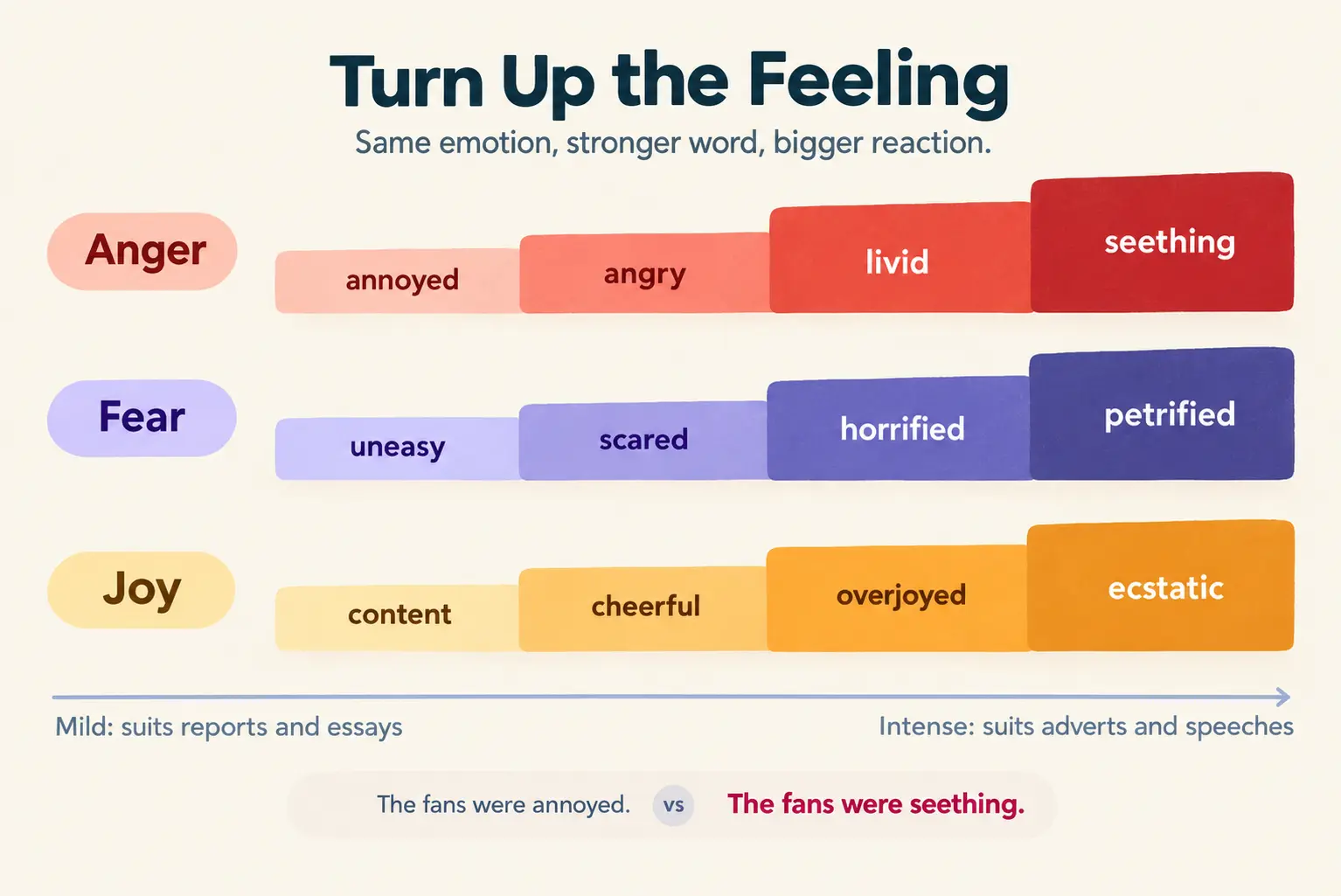
'Upset', 'distressed' and 'devastated' all describe sadness, yet each sits higher on the scale. Similar to this, a weather bulletin says “heavy rain”, while a news story says “torrential downpours”.
Phrases add another layer. Many are idioms, such as "a heart of stone", so the feeling sits in the whole phrase and not in any single word. All these word lists give you the raw material. Whereas writers get results by combining those words with set techniques.
Emotive Language Techniques: 8 Methods With Examples
Emotive language techniques turn word choice into planned effect. Like other language techniques, they appear often in exam reading questions. Below are some of the examples:
- Strong verbs: "Slammed" and "crept" carry more feeling than "hit" and "moved".
- Loaded adjectives: "Cruel" or "stunning" tell readers how to judge before they weigh the facts.
- Connotation: Calling someone "frugal" instead of "stingy" turns blame into praise for identical behaviour.
- Figurative language: A "sea of grief" hits harder than "a lot of sadness" because metaphor turns a feeling into an image.
- Rhetorical questions: "Can we really look away?" pulls readers in and signals the answer the writer wants.
- Exaggeration: "A disaster of epic proportions" raises the stakes fast, which is why headlines love it.
- Direct address: "You" and "we" pull readers into the problem, as in "You could save a life today."
- Repetition: King repeats "I have a dream" to build momentum and keep the feeling alive.
Real appeals often use several of these methods in one line. Take “Will you walk away while a trembling puppy waits for a home?” It mixes a rhetorical question, a direct address and a loaded adjective. Subtle choices often work best because readers rarely notice being steered. That steering has real consequences, which the next section covers.
What Is the Effect of Emotive Language on Readers?
More than 2,000 years ago, Aristotle argued that persuasion rests on logic, character and pathos, which means stirring the audience's feelings (Aristotle, 1924). The idea still shapes modern messaging. American pollster Frank Luntz tests different wordings on audiences to see which ones change opinion most (Luntz, 2007).
The effect of emotive language on readers shows up in a few clear ways.
- Empathy → "Frightened children" moves readers more than "affected minors".
- Memory → Vivid words stick, which is why slogans depend on them.
- Judgement → One loaded word can tilt a sentence towards approval or blame.
- Action → Strong feeling pushes people to donate, vote, sign or share.
The same power also carries risk. When a writer leans on strong feeling and offers little proof, readers start to suspect manipulation. You can test it by yourself. Take a headline like “greedy bosses rob workers” and swap each charged word for a plain one: company cuts pay”. If the claim now sounds weak, the feeling was doing the work that evidence should do. Honest writers use emotion alongside facts, so readers can trust both.
Because the effect depends on precise wording, it helps to separate emotive language from the terms people mix it up with.
Emotive vs Emotional Language: What's the Difference?
Here is the blunt rule: emotive language acts on the reader, while emotional language shows the writer's own feelings.
“I am devastated” is emotional because the speaker reveals a feeling. ‘Devastated families wait for an answer' is emotive because it steers how you feel about the families. Again, a text to a friend saying “I’m gutted” is emotional. A campaign leaflet saying “Don’t let them destroy our library” is emotive.
The quick test is to ask who is meant to feel something. So words describing the speaker’s own state are emotional, and words aiming to change the audience’s state are emotive.
|
Term |
Meaning |
Quick example |
|
Emotive language |
Aims to change how the reader feels |
"Callous cuts leave patients waiting in pain." |
|
Emotional language |
Expresses the speaker's own feelings |
"I am furious about the delay." |
|
Connotation |
The feeling attached to a word |
"Skeletal" instead of "slim" |
|
Loaded language |
Pushes a judgement, often in debate |
"Regime" instead of "government" |
|
Pathos |
Aristotle's appeal to the audience's emotions |
A charity story about one family |
|
Emotive conjugation |
One trait described with rising disapproval (Russell, 1948) |
"I am firm, you are obstinate, he is a pig-headed fool." |
In short, connotation is the engine, and emotive language is what it produces. And with the term separated, you can now put them to work on a real text.
How to Analyse Emotive Language in a Text
GCSE English Language asks students to explain how writers use language to influence readers. As language is a regular target, the same skill carries into university essays. Naming a technique earns little credit. Explaining its effect earns the marks; try using these steps:
- Spot it → Quote the exact word or short phrase, such as a strong adjective, verb or noun.
- Compare → Ask what a plain word would say. The gap shows the feeling added.
- Name the feeling → Say which emotion it creates, such as anger, pity or fear.
- Link to purpose → Explain what the writer wants from that reaction.
Take this sentence: "Heartless landlords are throwing innocent families onto the streets." A full analysis might read:
The adjective "heartless" paints the landlords as uncaring, which sparks anger. A plain verb like "removing" would sound neutral, but "throwing" suggests violence. "Innocent" shows the families did nothing wrong, so readers feel sympathy for them. Together, these words push readers to side with tenants, which supports the writer's aim of backing stronger housing protection.
A common lip is writing that the language “makes the reader want to read on”. That says nothing specific, so tie every effect to an exact word. Try it on any news headline today, start by picking two charged words, name the feeling each creates, then state the writer’s aim. For a full paragraph, structure your point, evidence, explanation and link with the PEEL paragraphs method.
The exact same precision matters in your own essays, where emotive wording behaves very differently.
Can You Use Emotive Language in Academic Writing?
Analysing emotive language is one skill, and using it in your own essay another. Universities expect a formal, evidence-led tone, so charged wording can read as opinion presented as fact.
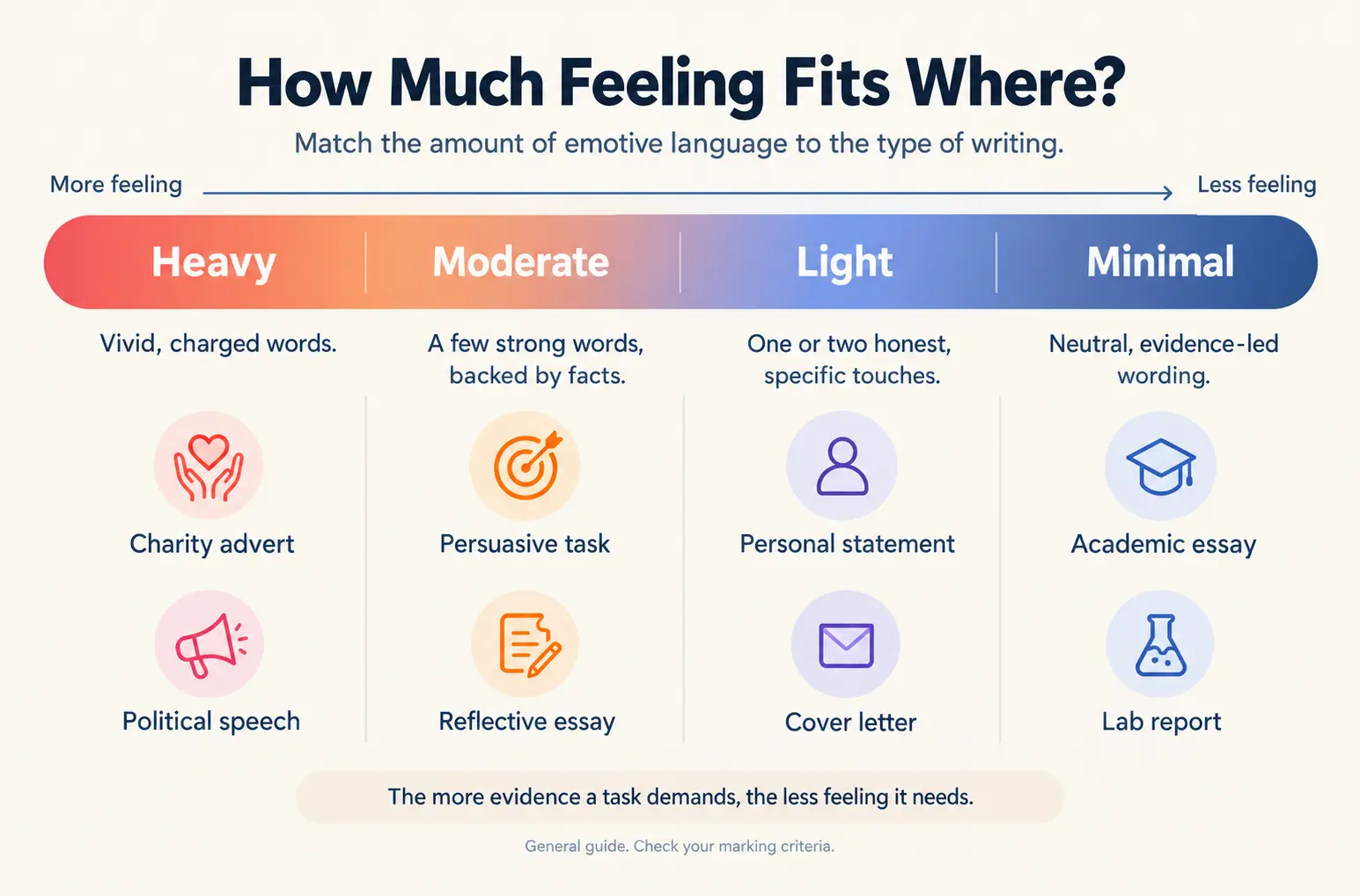
Imagine an essay on high street decline. "The disastrous policy destroyed local businesses" becomes "The policy was followed by a decline in local business revenue." The second version makes the same point and lets the evidence persuade. The same fix works elsewhere: "Shocking results prove the theory is worthless" becomes "The results contradict the theory's main prediction."
A quick edit is to highlight every adjective in your draft, then keep only those that add evidence or precision. Reflective essays and creative pieces welcome feeling, provided it stays specific and honest. Emotive wording also often slips in as slang, such as "mad" for angry, so scan your draft for colloquial words before you submit. Balancing feeling with proof is the habit that turns this knowledge into better marks.
Conclusion
Emotive language works because words carry more than their dictionary meaning. A single verb or adjective can turn a plain fact into a warning, a compliment or an accusation. With the definition, examples, word groups and techniques covered here, you can read headlines, adverts and speeches far more critically. In your own essays, apply the same awareness with restraint. Save strong feelings for reflective and creative work, and let evidence carry every argument elsewhere. Whether you are reading a text or writing one, precise wording is what readers remember. And if you need professional help for perfect implementation, then Native Assignment Help can be a good choice. Our experts will understand your issues and will provide personalised assistance accordingly.
References
AQA (2015) GCSE English Language (8700) specification. Manchester: AQA.
Aristotle (1924) Rhetoric. Translated by W.R. Roberts. Oxford: Clarendon Press.
Cowen, A.S. and Keltner, D. (2017) 'Self-report captures 27 distinct categories of emotion bridged by continuous gradients', Proceedings of the National Academy of Sciences, 114(38), pp. E7900-E7909.
Ekman, P. (1992) 'An argument for basic emotions', Cognition and Emotion, 6(3-4), pp. 169-200.
Luntz, F. (2007) Words that work: it's not what you say, it's what people hear. New York: Hyperion.
Macagno, F. and Walton, D. (2014) Emotive language in argumentation. Cambridge: Cambridge University Press.
Ogden, C.K. and Richards, I.A. (1923) The meaning of meaning. London: Kegan Paul, Trench, Trubner.
Russell, B. (1948) The Brains Trust. BBC radio broadcast.
Stevenson, C.L. (1937) 'The emotive meaning of ethical terms', Mind, 46(181), pp. 14-31.

 8 Years Years | Master’s degree in English Language and Literature
Amelia Miles is an experienced English Language and Literature academic writer with over 8 years of experience supporting students with language analysis, literary studies, rhetoric and academic writing. Amelia Miles holds a Master’s degree in English Language and Literature from the University of Manchester, with specialist knowledge of language techniques, discourse analysis, critical interpretation and persuasive writing. Their academic work follows UK university standards and draws on established approaches to English Language and Literature research.