
- Section 1: Introduction
- 1.1 Background of the Research
- 1.2 Research Rationale
- 1.3 Research Aim
- 1.4 Research Objectives
- 1.5 Research Questions
- 1.6 Research Gap
- 1.7 Research Benefits
- Section 2: Literature Review
- 2.1 Introduction
- 2.2 Main Body
- 2.3 Conclusion
- Section 3: Methodology
- 3.1 Research Philosophy
- 3.2 Research Approach
- 3.3 Data Collection Technique
- 3.4 Type of Data Collected
- 3.5 Data Analysis
- 3.6 Time Scale
- 3.7 Ethical Issues
Section 1: Introduction
1.1 Background of the Research
Organizational culture can be defined as common values and beliefs along with practices that determine how the individuals behave in an organization. It is important in determining the effectiveness of the implementation and sustenance of change in a company. Change management however refers to the systematic process through which individuals, teams and organizations are moved to a future desired state through the current state. The change is usually more sustainable and easier to go through when the cultural values support change efforts.
The Morrisons is one of major supermarket chains in the UK, which has been experiencing some strategic changes over the last few years, such as new leadership, digitalization, and changes of supply chain (Morrison et al., 2021). Managing change in an organization is always a challenge, but in the case of Morrisons, as a huge complex organization, having such a long cultural history, this has multiple challenges and opportunities. An examination of the interface between the organizational culture of Morrisons and change management strategies employed by this company can be approached as a good source of information on the way established players in the retailing world have been adapting to the highly dynamic business environment.
Native Assignment Help provides academic guidance for students researching organisational culture, leadership and change management. An experienced Assignment Helper UK can help you understand management theories, develop research objectives and structure your literature review and methodology. Our support helps students strengthen their critical analysis and academic writing in line with UK university expectations.
1.2 Research Rationale
In the current global business scenario, where businesses are experiencing intense competition, fast scientific development, a disrupted market environment, and a changing customer demand, it is critical to understand the influence of an organizational culture on change management. Cultural resistance, lack of congruence in values, or decreased internal participation are the frequent factors that create a difficulty in change implementation in big organizations (Allworth et al., 2023). This is quite crucial in the retail industry, where changeability is one of the major keys to competitiveness.
Morrisons offers a perfect case study since the company has been modernizing operations and leadership over the recent past. Being one of the largest four supermarkets in the UK, the company offers its products and services in a very competitive and dynamic sector, which is exposed to the pressure of discount stores, online groceries and evolutions in consumer behavior (Love et al., 2023). An examination of the role Morrisons has played in adapting to change with the help of its culture is not only of practical value but also adds value in terms of enhancing academic knowledge that deals with management practices in international businesses.
1.3 Research Aim
In order to evaluate the role played by the organizational culture in determining the effectiveness of change management strategies in Morrisons and to single out major cultural areas that either facilitate or do not support successful organizational change.
1.4 Research Objectives
- To assess the impact of Morrisons' organisational culture on employee adaptability during change implementation.
- To examine the role of leadership and communication in listening to a change management culture.
- To evaluate the challenges and opportunities associated with aligning organ culture with change initiatives at Morrisons.
1.5 Research Questions
- How does Morrisons' organizational culture influence employee adaptability during periods of change?
- What role do leadership and communication play in ensuring a change management culture?
- What challenges does Morrisons face in aligning its organizational culture with change initiatives, and how can these be addressed?
1.6 Research Gap
On the one hand, the literature on the same topic, namely the organizational culture and the management of change separately, is rather extensive; however, little is known about the interdependency between the two in the particular environment of the UK retail industry. Most of the available research centers around manufacturing or technology, but less on consumer facing business such as supermarkets.
Moreover, recent case studies on Morrisons are not available, especially in the conditions of the post-COVID-19 environment and the latest structural and strategic changes in the organization. Some of them are the changes in customer engagement activities, supply chain transformation, and digital transformation (Morrison and Mota, 2023). The development or adaptation of these changes concerning specific organizational culture is absent in most of the current literature as an opportunity to conduct consequent research.
1.7 Research Benefits
There are a number of significant implications of this research both to practice as well as academia. To begin with, the results will present applied value to Morrisons and other big retail companies by determining the impact of particular cultural characteristics on whether the change organization is successful or not. Being aware of these dynamics can make businesses plan and introduce changes more effectively, decrease resistance and increase the engagement of employees.
Second, the paper will add an academic contribution to the fields of business management because the paper will fill the gap between the theoretical studies of culture and change management and their actual implementation in the business sector in the retail sector (Errida and Lotfi, 2021). It will add value to the current knowledge by a new case study of a leading UK retailer that was able to manage the change in the post-pandemic business world.
Third, the study will present strategic information to management and business leaders that work in a culture-centric environment. It will provide them with the background on how to fit organizational culture with the objectives of strategic change hence enhancing flexibility and long-term success (Piwowar-Sulej, 2021). The realizations made can especially be of assistance to managers in other companies with the same structure or multinational retail companies with similar change issues.
Section 2: Literature Review
2.1 Introduction
The reviewed literature paints a critical picture of the current studies on the relationship that exists between change management and organizational culture and emphasizes how cultural dynamics may influence or facilitate the process of implementing change. This is meant to provide a theoretical and conceptual background to the proposed study, which would underscore critical models, ready arguments and the gap in the existing knowledge.
The review starts with the consideration of some fundamental theories and models of change management, including the Three-Stage Model by Lewin and the 8-Step Model by Kotter that help derive an idea of how change is formulated and implemented. It then talks of significant models of organizational culture such as the one by Schein and Hofstede. The critical relationship between culture and change, the investigation of the ways the cultural resistance or alignment may influence the outcomes of change has also been explored in the review.
2.2 Main Body
Theoretical Directions toward Change Management
Change management is a process, which enables organizational change. Lewin Three-Stage Model and Kotter 8-Step Model belong to the number of most frequently referred change models. Besides Lewin, presented that the process of change entailed three main phases: Unfreezing of the status quo, Changing through the addition of new behaviours or processes and Refreezing to settling down the new situation (Phillips and Klein, 2023). The theme in this model is that change should be prepared in an organization first before implementing the change and change should be integrated in the culture.
Besides, Kotter, however presents a more elaborate process in eight steps involving creation of a sense of urgency, creation of guiding coalitions, and production of short-term wins. In his model, one of the key aspects of introducing effective change is leadership and communication (Hayes, 2022). The two frameworks are practically applicable in organizations such as Morrisons that need a systematic process of handling transitions within departments and employees. The models are common in various fields although their success might be different given the current culture of the organization and its willingness to change.
Knowledge About Organisational Culture
The culture of any organization would be the collection of beliefs, values, and assumptions that dictate the actions of the individuals in the company. According to Liu et al. (2021), there are three levels of culture which are; artifact (that seen and which are structure and processes), espoused values (star schema reviewed and goals) and the basic assumptions (deeply ingrained beliefs). His model has played a key role in determining the working of culture in organizations both tangible and intangible.
Khaksar et al. (2023) added to this knowledge by defining six dimensions of culture, namely; power distance, uncertainty avoidance etc. that determine the behavior of organization. Even though the work by Hofstede was more inclined on the national culture, it has been used both in organizations to appreciate the internal diversity and the way decisions are made. The theories identify a framework on which the cultural factors that determine the perception of change and implementation in a firm can be analyzed.
Connection of Culture With Change Management
There is a symbiotic nature of organizational culture and the change management thereof. Culture plays a major role in influencing the process of change in the context of whether change is accepted, not accepted or understood in an organization. Bagga et al. (2023) observed that change implementation has suffered little success when it is not well-fit in the current cultural state of the organization. When the change is somehow affected in a way that is in conflict with firmly held beliefs, resistance will be experienced.
This is backed by a study by Griffioen, (2022) involving identification of cultural archetyping of an organization such as clan, adhocracy, market, and hierarchy archetypes to create more culturally-compatible plans of change. When applied to the case of Morrisons, provided that the organizational culture is focused on stability and hierarchy, then top-down change initiatives can be even more effective than collaborative ones.
Resistance to Change and Cultural Preferences
Resistance to change is normal when change poses a threat to the set routine or norm. Evans and Britt (2023) cited some of the reasons terrorists are resisting, among which are the fear of the unknown, feeling of lost control and habit. Culture is very important in the way these reactions will be portrayed. Change would be regarded suspiciously or with anxiety in a culture that cherishes tradition and predictability, not the hierarchical organization.
Cho et al. (2021) observe that cultural compatibility with organizational values would affect the level of preparedness of employees to change. The resistance becomes worse when employees feel they are out of touch with the management or that change is against company values. In the case of Morrisons, resistance management ought to involve an insight into cultural preferences and values.
The leadership Role in Cultural Change
Leadership plays a key role in organizational culture shaping as well as change management. In particular, transformational leaders can be effective in initiating cultural change through making the employees feel inspired and motivated in adopting the new values and ways of doing things. Jerab and Mabrouk, (2023) indicated that transformational leadership includes idealized influence, inspirational motivation, intellectual stimulation and individualized consideration, which facilitate cultural fit in the process of change efforts. Kotter (1996) also focuses on the leadership process in his 8-stage model and more specifically on the process of establishing a powerful guiding coalition and developing a powerful vision of the change (Love et al. 2023). Leaders are also role models and the way they behave matters a lot to the way employees see and respond to change.
Leadership in the case of Morrisons needs to be part of the cultural change that they desire. This has been done through clear messages, openness and visible efforts of change. Leaders can ameliorate the problem by showing coherence between their words and their deeds and minimize their uncertainty to facilitate the ingraining of new cultural norms to make long-term change successful.
Organisational Dynamics and Change Sustainability
Organizational dynamics can be defined as an interaction of people, systems, structures and processes in an organization. To make change sustainable, there is a need to keep these in line with the intended results (Lozano, 2022). Transformational change: Model indicates that transformation change affects the whole system and the continuance of changes needs modifications in various levels: strategic change, structural change, and behavior change.
To Morrisons, maintaining cultural change involves the incorporation of new values into the performance measuring tools and communication systems as well as leadership approaches. Continuous support in terms of training, feedback and rewards enables institutionalization of change and prevents creation of a single event change but rather an event that becomes entrenched in the entire organization.
Gaps in Literature and Research Opportunities
Though a good theoretical explanation between culture and managing change exists, the literature that is available does not give any empirical reports on the UK retail industry and especially Morrisons. There is a general or industry (healthcare, IT, or manufacturing) focus on most of the studies (Gencer et al., 2023). There is not much that can give post-COVID research on how retail organizations deal with change amidst digital change, labor issue, or changing behavior amongst consumers.
This study bridges that gap, as it provides a case-specific, real world account of Morrisons, as well as to theory and practice. It is also used to appreciate how the retail firms can use cultural match to enhance the results of change in the competitive markets.
2.3 Conclusion
The review has discussed the premises of change management and organizational culture whose principals contain a more complicated relationship than other theories have tried to portray. It stressed that the effective change is usually determined by cultural fit, sponsorship and resistance management capabilities of the organization. Models like those by Lewin and Kotter can offer structural assistance to a change, whereas models of cultural elements presented by Schein and Hofstede have an ability to show how internal beliefs and behaviors can enhance outcomes of the change. It strives to provide realistic suggestions to Morrisons and other organizations, which aim at enhancing their change initiatives by ensuring enhanced cultural convergence.
Section 3: Methodology
3.1 Research Philosophy
The study takes an interpretivist philosophy, which is suitable in studying the relationship between culture in an organization and change management due to its complicated and social nature.
Interpretivism draws upon perceived behavior, beliefs and social interaction, in an attempt to realize the thoughts of the participants, not objective, universal truths. Since culture is a subjective concept based on values and symbols as well as shared meanings, an interpretivist position would make it possible to understand the role of cultural forces in the change initiatives in a better way.
In contrast to positivist research where the measurable variables and statistical testing define the field, interpretivism encourages the application of qualitative analysis including internal communications, narratives about leaders, and culture descriptions that are available in case reports or case studies (Imran and Jingzu, 2022). This school of thought goes hand in hand with the objectives of the study which aims at determining the implications of culture at Morrisons on change management practices in practice. It allows a close exploration of contextual issues, which can provide more insightful material that can be used in both theory and business practice in the globe management domain.
3.2 Research Approach
Inductive research design will be used because study aims at pursuing discovery and formulation of theoretical knowledge of phenomena observed in the qualitative data. The method is appropriate in exploratory research, where little is known about the topic of investigation, especially in this case, since few studies exist on Morrisons and the UK retail industry after the pandemic.
The research will commence with reviewing secondary qualitative data instead of basing it on a hypothesis and identification of themes associated with culture and change accordingly (Imran, Arshad and Ismail, 2021). This activity favors theory generation rather than theory testing which is complementary to the interpretivist philosophy and adds to flexibility of interpretation relating to the dynamics of an organization.
3.3 Data Collection Technique
In carrying out this study, secondary data collection process shall be adopted and various reliable sources shall be used in this regard including annual reports of Morrisons and other internal sources (where applicable), press releases of the company, media reports on the company, academic case studies of the company, and analysis reports in the industry.
The use of secondary data is convenient and suitable to conduct the research because time and accessibility limits were involved and information was available in a considerable number on the secondary data already (Piwowar-Sulej, 2021). It is also ethical and complies with ethical research since there is no direct contact with any of the employees or stakeholders, which involves a lot of approvals.
Also, due to secondary data, the analysis can be historical and comparative to enable the tracking of how the cultural changes compared to the changes of leadership, management and performance of the company. It also facilitates triangulation of results of different sources that increases the strength of the research results.
3.4 Type of Data Collected
The study will focus on studying mainly qualitative data including statements within the case study, delivery of leadership talks, interviews to the media, in house communications and strategic reports. The data these types involve is extremely contextual and meaningful - that is why it can fit the exploration of the ins and outs of organizational culture and its involvement to change management.
The qualitative data presents information on the attitude of employees, messages of the leader and cultural stories that quantified data would have failed to capture (Errida and Lotfi, 2021). It enables the researcher to make conclusions based on patterns and conclude on how the values, norms, and behaviour influence the manner of implementation and sustainability of the change. This aids an understanding of the change processes of Morrisons in a more contextual examination.
3.5 Data Analysis
Thematic analysis, a qualitative approach to analysis, will be used to analyze the data raised in this research so that the patterns (themes) within data will be identified, analysed, and reported. The use of this method is suorous considering the interpretive nature of studies and the inductive design. Thematic analysis enables the interpretation of the details and nuances of a qualitative secondary data like company reports, communications issued by the leadership, and case studies of interest with flexibility.
This will entail a number of steps that will include: data familiarization, occurrence of common themes, reviewing and refining its themes and interpretation of the findings in view of organization culture and change in Morrisons (Morrison et al., 2021). Such important themes could be resistance to change, leadership communications, employee involvement and cultural fit to strategy.
3.6 Time Scale
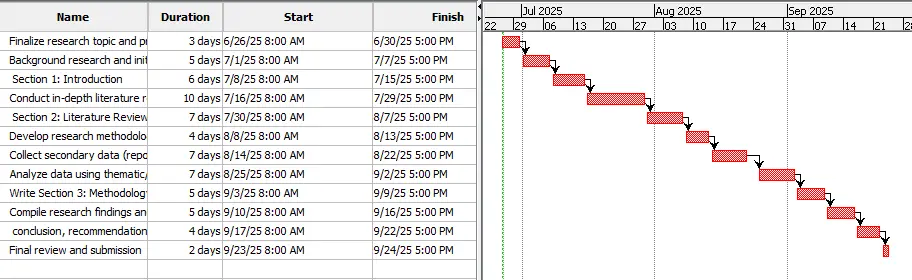
Figure 1: Gantt chart
3.7 Ethical Issues
Although they are secondary data, ethics are equally important in this research. Only the sources that are publicly available and are non-disputed in terms of credibility will be used in the study, meaning official reports provided by companies, scholarly works, and actual news media. Harvard referencing will be applied in all the sources in order to provide a sense of intellectual integrity and fair play.
Since no original data will be taken, the problems of consent and confidentiality do not concern the research directly (Gencer et al., 2023). Nevertheless, should such expansion be done in future using interviews or surveys, these would be done in full knowledge with the anonymity and confidentiality of the participants, safeguarded by the institutional requirements of ethics.
Researcher bias will be averted by objective interpretation of the data and basing the findings on evidence, instead of assumptions. The research will also apply to obtain institutional ethical approval to ensure that it is corroborated with academic standards provided against any misconduct in carrying out the research. All in all, the given research values academic integrity, ethical responsibility, and the adherence of the code of conduct on student research at the university.
Reference List
Journals
Allworth, J., Morrison, J., D'Souza, L. and Henning, G.W., 2023. Design thinking in student affairs: A primer. Routledge.
Bagga, S.K., Gera, S. and Haque, S.N., 2023. The mediating role of organizational culture: Transformational leadership and change management in virtual teams. Asia Pacific Management Review, 28(2), pp.120-131.
Cho, Y., Kim, M. and Choi, M., 2021. Factors associated with nurses' user resistance to change of electronic health record systems. BMC medical informatics and decision making, 21, pp.1-12.
Errida, A. and Lotfi, B., 2021. The determinants of organizational change management success: Literature review and case study. International Journal of Engineering Business Management, 13, p.18479790211016273.
Evans, M.I. and Britt, D.W., 2023. Resistance to change. Reproductive Sciences, 30(3), pp.835-853.
Gencer, G., Atay, H., Gurdogan, A. and Colakoglu, U., 2023. The relationship between organizational culture, organizational silence and job performance in hotels: the case of Kuşadasi. Journal of Hospitality and Tourism Insights, 6(1), pp.70-89.
Griffioen, D.M., 2022. The Origin, Content and Context of Changing Research–Education Connections. Creating the Desire for Change in Higher Education, p.21.
Hayes, J., 2022. The theory and practice of change management. Bloomsbury Publishing.
Imran, M. and Jingzu, G., 2022. Green organizational culture, organizational performance, green innovation, environmental performance: A mediation-moderation model. Journal of Asia-Pacific Business, 23(2), pp.161-182.
Imran, M., Arshad, I. and Ismail, F., 2021. Green organizational culture and organizational performance: The mediating role of green innovation and environmental performance. Jurnal Pendidikan IPA Indonesia, 10(4), pp.515-530.
Jerab, D. and Mabrouk, T., 2023. The role of leadership in changing organizational culture. Available at SSRN 4574324.
Khaksar, S.M.S., Chu, M.T., Rozario, S. and Slade, B., 2023. Knowledge-based dynamic capabilities and knowledge worker productivity in professional service firms the moderating role of organisational culture. Knowledge Management Research & Practice, 21(2), pp.241-258.
Liu, G., Tsui, E. and Kianto, A., 2021. Knowledge-friendly organisational culture and performance: A meta-analysis. Journal of Business Research, 134, pp.738-753.
Love, P.E., Matthews, J., Ika, L.A., Teo, P., Fang, W. and Morrison, J., 2023. From Quality-I to Quality-II: cultivating an error culture to support lean thinking and rework mitigation in infrastructure projects. Production Planning & Control, 34(9), pp.812-829.
Lozano, R., 2022. Organisational change management for sustainability. In Toward sustainable organisations: A holistic perspective on implementation efforts (pp. 75-88). Cham: Springer International Publishing.
Morrison, A.D. and Mota, R., 2023. A theory of organizational purpose. Academy of Management Review, 48(2), pp.203-219.
Morrison, V., Hauch, R.R., Perez, E., Bates, M., Sepe, P. and Dans, M., 2021. Diversity, equity, and inclusion in nursing: the pathway to excellence framework alignment. Nursing Administration Quarterly, 45(4), pp.311-323.
Phillips, J. and Klein, J.D., 2023. Change management: From theory to practice. TechTrends, 67(1), pp.189-197.
Piwowar-Sulej, K., 2021. Organizational culture and project management methodology: research in the financial industry. International Journal of Managing Projects in Business, 14(6), pp.1270-1289.
Go Through the Best and FREE Samples Written by Our Academic Experts!
Native Assignment Help. (2026). Retrieved from:
https://www.nativeassignmenthelp.co.uk/gbm5rem-research-methods-assignment-54129
Native Assignment Help, (2026),
https://www.nativeassignmenthelp.co.uk/gbm5rem-research-methods-assignment-54129
Native Assignment Help (2026) [Online]. Retrieved from:
https://www.nativeassignmenthelp.co.uk/gbm5rem-research-methods-assignment-54129
Native Assignment Help. (Native Assignment Help, 2026)
https://www.nativeassignmenthelp.co.uk/gbm5rem-research-methods-assignment-54129
- FreeDownload - 42 TimesDigital Well Being Assignment Sample
Digital Well Being Assignment Sample Introduction: Digital Well Being...View or download
- FreeDownload - 41 TimesImportance Of Record Keeping In Contemporary Nursing Assignment Help UK Sample
Importance Of Record Keeping In Contemporary Nursing Are you in search of the...View or download
- FreeDownload - 46 TimesEquity and Trusts Assignment Sample
Introduction Of Equity and Trusts OPERATION OF TRUSTEE ACTS 1925 The...View or download
- FreeDownload - 39 TimesProfessional Values and Parameters of Practice Assignment Sample
Introduction This practice-focused portfolio of evidence aims to reflect on...View or download
- FreeDownload - 37 TimesClinical Benefit Assessment vs Cost-Effectiveness in Healthcare Assignment
Introduction This assessment aims to conduct a comparative analysis between...View or download
- FreeDownload - 38 TimesSH4007QA Mental Health Challenges and Public Health in Ashton-under-Lyne Sample
Introduction Ashton-under-Lyne is a market town in Tameside, Greater...View or download
-
100% Confidential
Your personal details and order information are kept completely private with our strict confidentiality policy.
-
On-Time Delivery
Receive your assignment exactly within the promised deadline—no delays, ever.
-
Native British Writers
Get your work crafted by highly-skilled native UK writers with strong academic expertise.
-
A+ Quality Assignments
We deliver top-notch, well-researched, and perfectly structured assignments to help you secure the highest grades.