

- Why Students Lose Marks in Balanced Scorecard Assignments
- Balanced Scorecard Structure: Financial, Customer, Internal and Learning Perspectives
- Financial Perspective
- Customer Perspective
- Internal Process Perspective
- Learning and Growth Perspective
- Balanced Scorecard Format, Structure and Template for Assignments
- How to Apply Balanced Scorecard in Assignments Step by Step
- Balanced Scorecard Template for UK Assignment Writing
- Balanced Scorecard Marks Criteria: What Examiners Expect vs Common Mistakes
- Balanced Scorecard Example: UK Supermarket Case Study with Real Business Application
- Balanced Scorecard Advantages, Limitations and Assignment Use Cases
Why Students Lose Marks in Balanced Scorecard Assignments
Students don’t lose marks because they cannot define the Balanced Scorecard. They lose marks because they fail to convert it into structured, measurable analysis. In UK assignments, this gap between knowing and applying is what directly reduces grades, not lack of theory.
The first main issue is weak KPI design. Students rely on vague outcomes more like “increase sales” or “improve performance” without defining numbers, timeframes, or benchmarks. In UK this is treated as descriptive writing, not analysis. Here examiners expect measurable signals that show control over strategy, not just general intent.
A second issue is a broken logical linkage between perspectives. Students write financial, customer, internal process and learning areas as separate lists, rather than connected outcomes. For instance, staff training is mentioned without showing how it improves operational efficiency or customer satisfaction. This takes away the strategic depth and results in fragmented evaluation, and that's what lowers your marks.
The final issue is not understanding what assessment actually measures. Here a balanced scorecard is not just a reporting exercise; it tests whether a student can really build cause-and-effect relationships across business objectives. Any sign of reasoning or alignment is lost when writing becomes descriptive instead of analytical. And that level of work consistently looked as mediocre in UK marking standards.
Balanced Scorecard Structure: Financial, Customer, Internal and Learning Perspectives
A balanced scorecard uses four linked perspectives to turn strategy into measurable business outcomes. These perspectives must be connected to others and not appear as a separate section in your assignments. Here students need to define clear KPIs in each area and show how they connect across the scorecard. Your marks will improve when these links are clear and supported with specific measures; if points are written in isolation, the analysis becomes weak and loses its value. Look at the below given to understand how these perspectives build on each other.
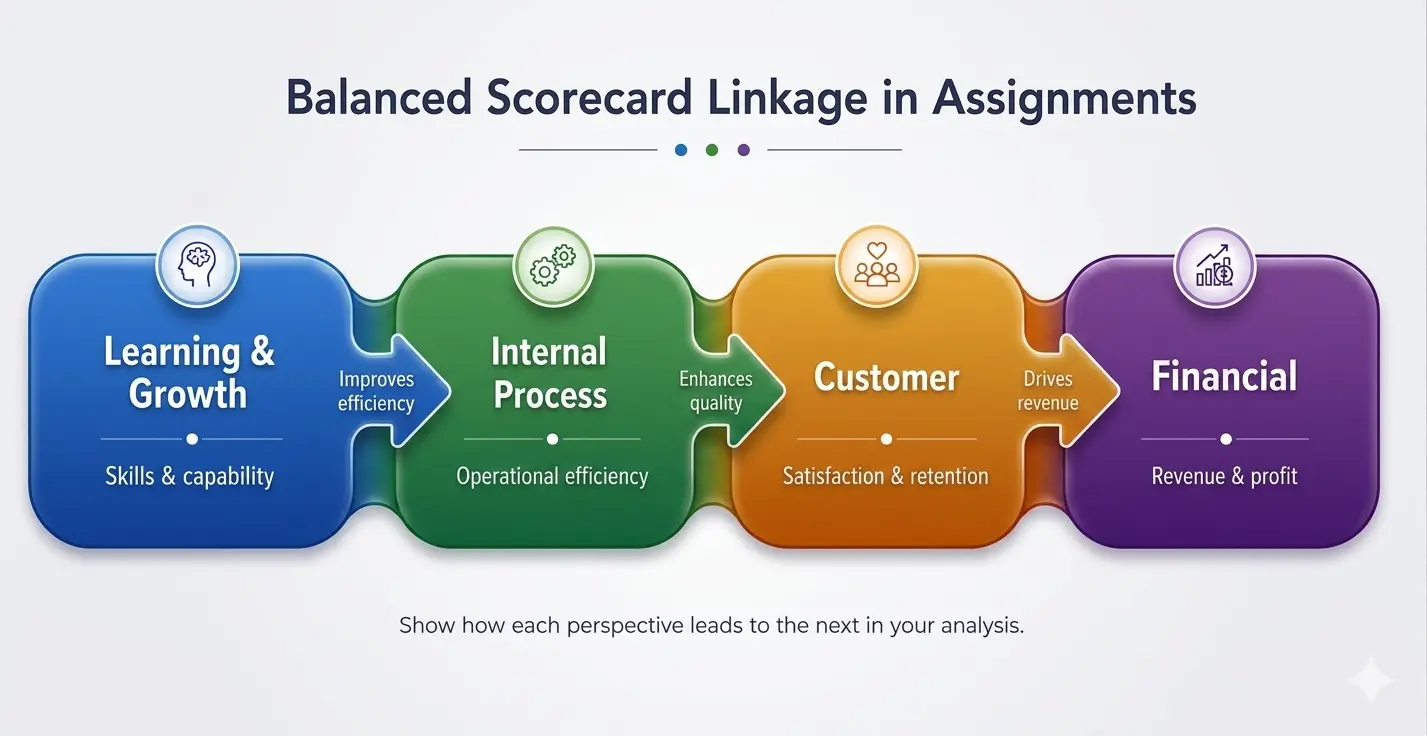
This flow illustrates how improvements in capabilities strengthen internal processes, enhance customer outcomes, and drive financial performance.
For a student's understanding, this linkage is very important when you need to structure and analyse each perspective in your assignment.
Financial Perspective
In this section, students are expected to define clear financial outcomes that show the final impact of the strategy. The focus should stay on profitability, cost control, or revenue performance, not just general improvement.
- Define a financial objective that reflects real business results.
- Use a KPI with a clear number and timeframe, not broad targets.
- Avoid vague terms like “increase sales” without measurable detail.
- Example: Increase profit margin from 12% to 18% within 12 months.
In a weak answer, students often make a list of financial goals without clear targets, and that turns the section into a description rather than an analysis. Whereas stronger responses show whether the strategy delivers results and that then links to customer performance.
Customer Perspective
Here students need to show how the strategy improves customer outcomes using clear, measurable indicators. The focus should be on results such as retention, satisfaction, or acquisition and avoid broad statements that do not show change. For example, improve the customer retention rate from 70% to 85% within 12 months. This thing works because it reflects a clear shift in customer behavior, not just the intent. Because answers that only describe customer goals without data lose marks, as they do not show the actual impact. Well, internal processes shape these outcomes, which the next section explains.
Internal Process Perspective
This is the section where students must show how internal activities lead to measurable performance improvements, not just describe how the business operates. It focuses on processes that directly affect delivery, speed, or quality and express all of them with clear results. For example, reduce order processing time from 5 days to 2 days. This works because it shows a direct fix in operational effectiveness.
On this stage many answers fail by listing processes without showing change, which removes analytical value. But strong responses make it clear how these improvements strengthen overall performance and support business outcomes. Mostly these changes depend on the right skills and systems that are developed in the next section.
Learning and Growth Perspective
In this section, students need to show what inputs are required for the organisation to improve performance in all other areas of the scorecard. The focus should be on specific capabilities such as skills, systems, or training that directly enable better execution, not general development statements.
- Identify a clear capability gap linked to operational or strategic performance
- Define a measurable input such as structured training, system adoption, or skill improvement
- Avoid vague statements like “provide training” without scale, target, or timeframe
- Example: Train 90% of staff in digital systems within 6 months
When you give weak answers, you treat learning and development as separate tasks, which makes the scorecard less logical. Whereas strong responses show how these imports affect process efficiency and ultimately support overall business performance.
Together, these perspectives form one connected system. The next step is structuring them into a complete balanced scorecard response for assignments.
Balanced Scorecard Format, Structure and Template for Assignments
This section shows how to structure a Balanced Scorecard answer in a way that can be directly used in UK assignments. So it focuses on converting theory into step-by-step formatting, using measurable KPIs and structured representation. What we are aiming for is to help students move from understanding the model to actually applying it in an assessment-ready format.
How to Apply Balanced Scorecard in Assignments Step by Step
Students should build a balanced scorecard answer using a clear execution sequence rather than writing random points. Here, each of your steps should move your answer close to a complete, structured output.
- Understand the case context and identify what the organisation is trying to achieve in practical terms
- Define strategic objectives that are specific, outcome-based, and linked to performance improvement
- Assign measurable KPIs for each perspective, ensuring every KPI includes a number or clear target
- Connect perspectives logically so one outcome supports the next instead of standing alone
- Present the final scorecard in a structured format with clear separation of perspectives
Each of these steps should build logically on the last one, ensuring the final answer reads like a connected system rather than a separate point.
Balanced Scorecard Template for UK Assignment Writing
|
Perspective |
Objective |
KPI |
Target |
Initiative |
|
Financial |
Improve profitability |
Profit margin |
12% → 18% |
Cost reduction strategy |
|
Customer |
Improve customer retention |
Retention rate |
70% → 85% |
Loyalty program |
|
Internal Process |
— |
— |
— |
— |
|
Learning & Growth |
— |
— |
— |
— |
This template should not be treated as a form-filling task. Each row must represent a different part of business performance, and together they should show how the organisation improves overall results through structured decisions.
Balanced Scorecard Marks Criteria: What Examiners Expect vs Common Mistakes
This section evaluates how Balanced Scorecard answers are actually marked in UK assignments.
|
What Gets Marks (Examiners Expect) |
What Loses Marks (Common Mistakes) |
|
Clear logical linkage across all four perspectives |
Treating each perspective as an isolated section |
|
KPIs that are measurable and strategically relevant |
Using vague indicators with no numerical structure |
|
Consistent cause–effect reasoning from input to outcome |
Random selection of KPIs without business logic |
|
Alignment between objective, KPI, and target |
Mismatch between goals and measurement method |
|
Evidence of analytical thinking in explanation |
Pure description of what the business does |
Examiners focus on whether the answer shows clear decision logic. They expect each part of the scorecard to be justified and connected, not written as separate pieces of information. A strong balanced scorecard is not built by listing correct points. It is built by showing how each decision connects to a larger performance system, where objectives, KPIs, and outcomes work together in a structured way.
- You can also consider reading the primary vs. secondary research blog for deeper assignment understanding.
Now that the structure and application method are clear, the next section shows how a complete balanced scorecard looks when applied to a real UK case study.
Balanced Scorecard Example: UK Supermarket Case Study with Real Business Application
Case Context –
A large UK supermarket chain working in a low-margin grocery market is pressurised from rising labour costs, aggressive online delivery competitors and increasing customer expectations for faster service. And now instead of expansion, the company is focusing on operational efficiency and cost control to protect profitability.
|
Perspective |
Objective |
KPI |
Target |
Initiative |
|
Financial |
Protect profitability under rising operational costs |
Operating profit margin |
4.2% → 5.5% |
Reduce logistics and store operating costs |
|
Customer |
Maintain customer satisfaction in price-sensitive market |
CSAT score |
77% → 83% |
Improve checkout speed and service consistency |
|
Internal Process |
Improve stock accuracy and reduce delays |
Stock accuracy rate |
92% → 97% |
Upgrade inventory management system |
|
Learning & Growth |
Improve workforce efficiency under cost constraints |
Staff productivity rate |
+10% improvement |
Targeted digital and process training |
Cause–Effect Logic –
Improving staff productivity allows the business to handle a higher workload without increasing labour costs. This gradually strengthens internal processes by improving stock accuracy and reducing the delays. Within that, better availability and faster service improve customer satisfaction, even in a price-sensitive environment. These operational gains help protect the profit margins in a low-margin industry where cost efficiency is more important than expansion.
Balanced Scorecard Advantages, Limitations and Assignment Use Cases
The balanced scorecard works best in UK assignments when students are required to analyse business performance in a structured way. There, efficiency depends not just on knowing the model but on applying it in the right context with clear reasoning and measurable outcomes.
Advantages:
- Helps organise complex business information into a clear and structured view of performance
- Strengthens analysis by linking different areas of a business instead of treating them separately
- Shifts answers from description to evaluation, which improves academic quality
- Makes arguments easier to follow, which helps in marking and assessment clarity
Limitations:
- Becomes weak if the business context is not properly understood before applying it
- Loses accuracy when KPIs are unclear, unrealistic, or poorly defined
- Breaks down when perspectives are written in isolation without clear connections
- Not suitable for questions that only require theory without practical application
When to Use:
- In strategic management and performance evaluation assignments
- In case-based coursework where business situations must be analysed
- When the task requires measurable outcomes and structured decision-making
When Not to Use:
- In purely theoretical questions with no real-world application required
- When there is no data or basis for measurable evaluation
- In tasks focused only on explaining concepts without analysis
Conclusion
A strong balanced scorecard answer is judged by how well it is applied, not just defined. Within that, the higher marks also rely on clear links between all four perspectives and measurable KPIs that support logical outcomes. When students present a structured, connected response, it improves clarity, strengthens analysis, and meets UK assignment expectations more effectively.
Still, in any condition you find difficulty in applying the balanced scorecard, you can seek assistance from Native Assignment Help experts. They will analyse your requirements and provide guidance accordingly so you can easily score higher grades with confidence.

 9+ Years | PhD
George Taylor develops academic resources on business strategy and performance management. His content explains management frameworks with practical examples, helping students apply strategic concepts in university assignments.