
- Formative 2
- Section 1: Introduction
- 1.1 Research Topic
- 1.2 Background information
- 1.3 Research rationale
- 1.4 Research aim
- 1.5 Research Objective
- 1.6 Research Question
- 1.7 Research Gap
- 1.8 Research benefits
- Formative 3
- Section 2: “Literature review”
- 2.1 Introduction
- 2.2 Empirical Studies
- 2.3 Models and theories
- 2.4 Conceptual Framework
- 2.5 Literature Gap
- 2.6 Conclusion
- Formative 4
- Section 3: Methodology
- 3.1 Introduction
- 3.2 Method Outline
- 3.3 Research Philosophy
- 3.4 Research approach
- 3.5 Research Method
- 3.6 Techniques of data collection
- 3.7 The “Data Collection process”
- 3.8 Data Analysis Method
- 3.9 Time Scale
- 3.10 Research ethics
- 3.11 Research Limitations
Formative 2
Section 1: Introduction
Native Assignment Help supports students in understanding research topics, structuring academic assignments and developing well-organised literature reviews. As an Assignment Helper UK, we provide guidance on research methodology, critical analysis and referencing to help students understand UK university academic requirements.
1.1 Research Topic
The research is aim at comprehending, the influence of financial assistance and funds access on the development of the technology oriented small and middle sized enterprises (SMEs) of the United Kingdom. These kinds of business have been recognized to conceive innovation and employment (Altuntas and Gok, 2023). Nonetheless, most of them find it difficult to expand because of issues relating to the provision of financial assistance. The research will find out the existing systems of support, as well as the challenges that these businesses go through as they seek to borrow funds.
1.2 Background information
SMEs or Small and Medium Enterprises play a valuable role in the UK economy. It contribute to growth in the number of employments and local growth. Out of these, however, the technology based SMEs are even more beneficial since they bring in new products, services and systems which facilitate the growth of other departments.
Over the past few years, the UK government and other privately owned institutions have attempted to assist SMEs by offering it with financial aid. This comprises of the government loans and grants, tax credits, improved government and the contribution of the privately owned banks and investors (Nurdiyanti and Ananthakkarasu, 2025). Nevertheless, technology SMEs are still struggling to get such funds. It can hardly qualify because of being very strict in their requirements, unavailable information or very weak financial history.
The Technology SMEs usually have to raise big sums of money to develop products, market them, and employ experienced employees. They cannot develop and grow without sufficient funding. This brings an issue since such companies are supposed to lead the way towards innovation in the UK in the future.
1.3 Research rationale
This research is aimed at learning more about the issue of financial assistance and funding availability in the development of technology SMEs. Even though a lot of literature is being written about SME financing, the effects of this financing where applied to tech-based firms is fewer.
The challenges that Tech SMEs have are not as similar as those affecting other small businesses (Barth-Fagan, 2024). They require extra investment and there are rapidly evolving markets. Researching their experience with financial assistance may aid in correcting funding programs and policy of the government.
The research analysis will facilitate the diagnosis of the issues and the kind of assistance that is most effective. It will also reveal the impacts on business performance such as growth, employment, and expansion of businesses, resulting due to availability of money.
1.4 Research aim
The aim of the study is to evaluate the impact of financial support and accessibility on business growth of technology-based SMEs in the UK.
1.5 Research Objective
- To analyse the extent of government financial support available to technology-based SMEs in the UK.
- To examine the challenges technology-based SMEs face in accessing financial resources for business growth in the UK.
- To assess the influence of financial accessibility on the growth of technology-based SMEs in the UK.
1.6 Research Question
- What is the extent of government financial support available to technology-based SMEs in the UK?
- What are the challenges technology-based SMEs face in accessing financial resources for business growth in the UK?
- What are the influences of financial accessibility on the growth of technology-based SMEs in the UK?
1.7 Research Gap
Not much specific studies on the impacts of financial support on technology based SMEs are available. Available studies have considered SMEs generically and fail to give special attention to tech companies. Moreover, there is few research that compares the support that exists and the issues that such firms are actually experiencing when it comes to securing funding.
This research will attempt to address such gap by integrating opinions of businesses, reports and available literature (Kang, S. and Kim, 2023). It will demonstrate the available support and its impacts on the actual growth. It will as well be finding out why businesses are not receiving the necessary assistance. The research will provide new knowledge to this field by paying attention to technology-based SMEs.
1.8 Research benefits
The research will prove to be helpful in numerous ways. First, it will be able to make government agencies realize what financial support programs are effective and where improvement is necessary. This is able to produce superior policies and funding mechanisms.
Second, it will assist the business owners to know the various forms of financial support that they can utilize (Veiga et al.2024). It can also help to demonstrate them how they should better prepare when seeking funds.
Third, the study will provide the banks and investors an overview on the needs and issues of the technology SMEs. This will enable them to come up with improved financial products and services.
Finally, the research will contribute to academic research concerning the growth of SMEs and funding. Subsequent investigators will be able to use this study to address more like-minded issues in other companies or countries.
Formative 3
Section 2: “Literature review”
2.1 Introduction
This review of literature will look at the literature that has been conducted in the past and in the contemporary world concerning financial support and access of technology based SMEs in the “United Kingdom”. The review will enable the research to have the depth it takes so that what is already known and the gaps which still remain will be identified. It will revolve around three key areas which are the levels of government finance support, the difficulties presented against technology SMEs in their attempts to access finance and also the effects of the access of finance in the growth of the business. The review will also demonstrate how the research you will conduct is going to present some new ideas and explain to them why the topic is vital in policy and business development in the UK country into the future.
2.2 Empirical Studies
2.1Subtheme 1: The scope of Government Finance on Technology based SMEs in the UK
Cowling and Dvouletly (2023) reported, among the unemployed, that there were more than 85,000 new businesses on the UK government-backed start-up loan. Although the scheme provided early-stage capital and encouraged financial inclusion, not every applicant could receive funding without any problems. The unemployed entrepreneurs obtained lower loans and a higher default rate, which indicates that they still do have support, but it is unequally distributed, and highly dependent on the personal situation.
The critique of the article
Although the disadvantaged groups had more access to the programmer, it was not balanced. The criteria of the loans and the eligibility rules have a dependent level on the circumstances of the individuals and this can limit the overall positive result to the high-growth tech SMEs who require more capital and more favorable conditions.
Bora et al. (2024) reported 22 percent of SMEs in the UK had low investments as they could not get external finance. Raising interest rates and limiting collateral requirements as well as the fear of being rejected were cited by many people as some of the main obstacles. Despite the existence of finance options, the study showed that risk aversion and financial illiteracy still deter many SMEs to exercise the full extent of available help.
The critique of the article
This research points out that accessibility is not guaranteed by the availability. SMEs have to cross informational and psychological obstacles even when they have support available. These challenges can be even more restraining to technology based SMEs which are usually lacking in collateral or steady cash flow.
According to Cowling and Liu (2023), the UK SMEs that have invested in clean technologies possess a higher need of external funds and do not receive much support of the conventional lenders.
The critique of the article
The research indicates that the traditional finance methods fail to serve innovative SMEs. This implies that there should be more dynamic, specific financial programmers, which should keep into consideration the growth and risks tendencies taken by the technology based businesses.
According to Owen et al. (2023), despite the government of the UK meeting financial supply targets in SMEs, demand-side uptake is low. Lack of application and confidence amongst most technology SMEs discourages their involvement in bank borrowing; they do not engage in official sources of finance.
The critique of the article
Although the study discusses issues on the demand side, it fails to explain at length how the gap might be narrowed down by support services such as mentoring or training on how to complete an application. It further generalizes on all SMEs which could miss the unique plight of high-growth tech companies requiring special programmers of funding.
2.2 Subtheme 2: Problems of Technology-based SMEs to Finance Resources
According to Mukherjee et al. (2024) described the systematic review on the barriers that are faced by the UK SME’s in its early stages. The article examined the issue of funding green startups in the early stages that include insufficient investments to develop them by private investors, extreme reliance on government financing, and the inability to provide definite outcomes of impact. It indicates the necessity to establish new models of finance and incremental support in terms of “policies to advance green technologies businesses”.
The critique of the article
On the one hand, the study is useful, although it concentrates primarily on green innovation and not on all tech SMEs. It also does not present any UK-specific data and is based, largely, on more general data at an international level.
Djabang et al. (2025) analyzed the way, in which financing decisions in the market of UK SMEs can be made with references to the “pecking order theory (POT)”. The research was carried out after interviewing 45 owners and managers and defining that most SMEs use self-financing funds followed with debt and equity funds. This is facilitated by the need to shun high costs of interest charges, lack of control, and distrust towards the financial institutions.
The critique of the article
Though the research provides powerful evidence with regards to SME preferences when funding their businesses, the study is conducted in single region of UK namely; Yorkshire and Humber thus the study is limited in its generalisability in a national context. It also fails to go far into how external financial literacy programs or newer types of funding options to curtail over dependence on conventional sources funding like crowdfunding may shift these conventional funding preferences by the tech-based SMEs.
Aguda (2024) used 141 high-tech SMEs in the UK and observed that when firms were able to access the financial and strategic sources, these companies showed better performance in innovation as a result of strong technology orientation.
The critique of the article
Though the research provides strong in-depth observation on innovation and management of resources, it is constructed on solely quantitative approaches. This restricts an individual SME experience.
2.3 Subtheme 3: The Effects of the “Financial Accessibility on the SMEs Growth and Innovation”
Tawil et al. (2024) studied 85 SMEs in the UK and identified that data-driven tools and real-time financial systems will achieve an increase in growth and innovation even faster. The SMEs who had the access to the digital decision-making tools had the opportunity to spend more on the researching and the product development. It was also revealed in the study that this kind of firms had better chances of expanding in the market as a result of better allocation of resources and strategic plans.
The critique of the article
The paper provides good SME perspectives with no national representation, and it ignores funding challenges besides underrepresenting digital issues of very small businesses which is the primary criticism of this articles.
The article by Lambe and Lambe (2023) seeks to discuss the impact of technological innovation on the development of MSME based on qualitative interviews with the UK entrepreneurs. The major research findings indicate that entrepreneurship in the process of innovation and increase and that its adoption is impeded by the insufficient funds, technical expertise and awareness.
The critique of the article
Despite the wealth of insights that the study provides, the study has limitations in the sense that the sample is small and gender-homogenous as well as the geographic coverage is restricted.
According to Parkinson, (2024) influential factors for the micro digital business owners from the “Norwest England” regions. The object of study is the way micro-businesses in Northwest England embrace digital technologies namely “SMAC (social, mobile, analytics, cloud)” and impact thereof on their productivity. It both emphasizes the effects of the COVID-19 on patterns of adoptions and corrects an absence in the research, in examining micro-businesses, rather than SMEs. It collects novel information, theories, and practical implications that can be used to bolster digital adoption with the help of mixed methods.
The critique of the article
Although that makes it insightful, the study is equipped to only one region and thus may not apply to the whole of the UK. It is also specific to micro-businesses, which is why it can not be generalized beyond general tech-based SMEs.
2.3 Models and theories
Application of the” Pecking Order Theory”
The theory of “Pecking Order” provides that business organizations love to utilize their own money. They prefer to take loans rather than sell their shares in case of the need of more money. This will assists in explaining the financing behaviour of SMEs.
Application of the “Resource Based View (RBV)”
According to the “Resource-Based View (RBV) model”, companies also expand with the help of their valuable resources. When SMEs get access to finance, they will be in a position to develop more formidable skills and properties.
2.4 Conceptual Framework
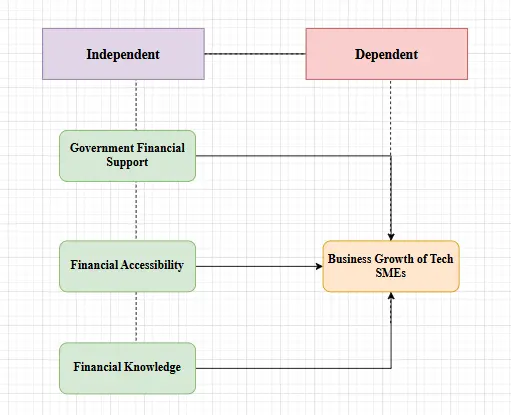
Figure 1: Conceptual Framework
2.5 Literature Gap
A “gap in literature review (LR) gaps” refer to the information, unnoticed issues, or underdeveloped research that information contained in the current research requires supplementary exploration. The problem that Cowling and Dvouletly (2023) overlook is how high-growth tech SMEs are restricted by loan regulations. Bora et al. (2024) reveal obstacles but fail to demonstrate solutions to them. Zhang and Wang (2022) do not concentrate on the UK, but on China.
2.6 Conclusion
This literature review has indicated that funding and access matters when it comes to the development of technology based SMEs in UK. Lots of businesses are assisted by government loaning and other investments which are not always easy to reach among SMEs. These make them unable to employ existing financial schemes. It was also demonstrated that improved access to funds makes SMEs realize accelerated growth, enable them to invest in innovative ideas, and recruit talented individuals
Formative 4
Section 3: Methodology
3.1 Introduction
This part will discuss the method in which the research shall be conducted. It will demonstrate how the information was collected and studied. These research will employ an secondary method. This implies that it will act on available case studies, reports and data concerning the “UK technology SMEs”. The target is to see the implication of financial support and access on their business development.
3.2 Method Outline
A secondary research method will be used in this study. This implies that new data collection will not be undertaken. Rather, the study shall rely on the use of “case studies, government reports, and published academic papers”. The information offered by these sources will be helpful to find out more information about the way UK tech SMEs develop after receiving financial assistance (Barth-Fagan, 2024). The idea is to know the actual experience of SMEs in the real life by dong the analysis of the already existing data.
3.3 Research Philosophy
The study will be using an “interpretivist philosophy”. This implies that the study will examine the perceptions and the experiences of SME owners as reflected in case studies. It will attempt to know how financial assistance influences their choices and development (Schillinger, 2022). The philosophy is useful in studying real life situations where use is made of written reports and stories.
3.4 Research approach
The current research will adopt an “inductive approach”. This implies that it will first look into available information and make ideas based on them. The study will read the case, studies and reports first and develop findings out of it instead of the study based on a theory (Lin and Qamruzzaman, 2023). It is the ideal method of conducting secondary research, which investigates real corporate experiences.
3.5 Research Method
The study will be conducted in the style of “qualitative secondary mono research method”. It will analyze data on “case studies, government documents, journal articles and reports” of companies. These information souces will demonstrate the ways in which financial support and access has boosted or constrained SME growth. It will not use any survey or interviews.
3.6 Techniques of data collection
The information related to this study will be based on the public and trusted sites and will consist of “UK government sites”, the site of the “British Business Bank” which gives the official data on financial support measures to SMEs. The published case studies of technology-based SMEs in the UK will also be referred to get a glimpse of the real business experiences (Aripin and Matriadi, 2024). Moreover, research results will be introduced in academic journals where practice and trend insights will be presented in industry reports. These sources combined should allow to provide an in-depth picture of the influence of financial assistance and accessibility on the development of SMEs in the UK.
3.7 The “Data Collection process”
A “qualitative multiple case study design” will be used in the research. It implies that it will not examine a single instance of SMEs. Comparing various businesses will be done with the help of these case studies, so that some universal themes are identifie (Schillinger, 2022). This design will be relevant since the topic of the research has already been narrowed down to a case study of the UK technology SMEs.
3.8 Data Analysis Method
The paper shall apply the concept of “thematic analysis” in comprehending the information. This implies that it will search areas that are similar in the case studies and reports. As an example, when several SMEs state that they are experiencing delays in terms of getting funding, then this will be identified as a major theme (Akoh and Lekhanya, 2022). It will also sort the findings into themes based on financial support, access issues, and growth outcome.
3.9 Time Scale
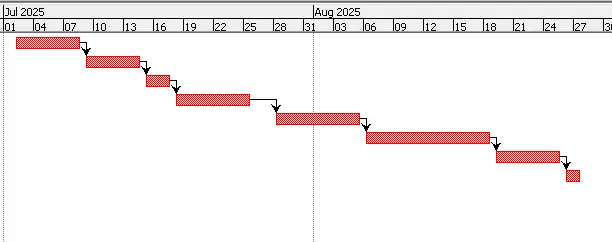
Figure 2: Gantt Chart
3.10 Research ethics
Direct contact with people will not occur since secondary data will be used in this research. This decreases the ethical risks. All the sources will be extracted on trustful and legal websites or published journals. The names and personal details will never be a part of the research. All the data will be cited accordingly. A form of ethics will also be filed regarding the university guidelines.
3.11 Research Limitations
This study has limitations to an extent. One, it will not utilize primary data such as surveys or interviews. This implies that it is unable to pose new inquiries to enterprises. Second, the study will be based on the quality of existing case studies. Failure to provide details in the reports will mean failure to cover some points (Kang, S. and Kim, 2023). Third, it might not contain all forms of the technology SMEs in the UK.
4.0 Expected Outcomes
This study is likely to discover that, technology SMEs grow faster when provided with financial support. It will probably demonstrate that with easy accessibility to funds, the firms will be able to invest in new products and grow. It can also demonstrate that the support of many SMEs remains to be problematic to obtain due to regulations, time consuming, or ignorance. The results will assist in the enhancement of support systems and other future studies.
Reference List
Journals
Formative 2
Altuntas, F. and Gok, M.S., 2023. A data-driven analysis of renewable energy management: a case study of wind energy technology. Cluster Computing, 26(6), pp.4133-4152.
Nurdiyanti, N., Anisa, A. and Ananthakkarasu, V., 2025. Digital Literacy of Senior High School Science Students: A Case Study of Technology Use in Daily Academic Life. JPPS (Jurnal Penelitian Pendidikan Sains), pp.173-184.
Barth-Fagan, C.S., 2024. A Case Study of Technology Integration at a Community College During a Disruption of Learning Due to a Global Pandemic.
Kang, S. and Kim, C., 2023. How do strategic networks help SMEs upgrade in global value chains? A cross-national analysis. Cogent Business & Management, 10(1), p.2202833.
Veiga, P.M., Marnoto, S., Guerra-Mota, M. and Rexhepi, G., 2024. Building new business models in MSMEs: digital capabilities, global value chains integration and the moderating role of entrepreneurial failure. Journal of Small Business and Enterprise Development, 31(3), pp.492-514.
Formative 3
Aguda, A., 2024. The impact of technology orientation, strategic firm resources and resource orchestration on small high-tech firms innovation: evidence from the UK.
Bora, N., Cottell, M., Karmakar, S., King, B., Nyamushonongora, K. and Sengul, S., 2024. Identifying barriers to productive investment and external finance: a survey of UK SMEs. Bank of England Quarterly Bulletin.
Cowling, M. and Dvouletý, O., 2023. UK government-backed start-up loans: Tackling disadvantage and credit rationing of new entrepreneurs. International Small Business Journal, 41(7), pp.714-733.
Cowling, M. and Liu, W., 2021. Access to finance for cleantech innovation and investment: Evidence from UK small-and medium-sized enterprises. IEEE Transactions on Engineering Management, 70(3), pp.963-978.
Djabang, P., Shubita, M. and Konstantopoulou, A., 2025. Pecking order theory’s impact on the financing of small-and medium-sized enterprises (SMEs) in the UK. International Journal of Organizational Analysis, pp.1-22.
Lambe, K.I. and Lambe, T.J., 2023. Exploring the Perceptions and Experiences of Entrepreneurs regarding Technology Innovation and its Impact on Growth of MSMEs in UK: A Qualitative Study.
Mukherjee, A., Owen, R., Scott, J.M. and Lyon, F., 2024. Financing green innovation startups: a systematic literature review on early-stage SME funding. Venture Capital, pp.1-27.
Owen, R., Botelho, T., Hussain, J. and Anwar, O., 2023. Solving the SME finance puzzle: an examination of demand and supply failure in the UK. Venture Capital, 25(1), pp.31-63.
Parkinson, M., 2024. An investigation into digital technology adoption by micro-businesses owners in the Northwest of England and the impact on productivity (Doctoral dissertation, Manchester Metropolitan University).
Tawil, A.R.H., Mohamed, M., Schmoor, X., Vlachos, K. and Haidar, D., 2024. Trends and challenges towards effective data-driven decision making in UK Small and Medium-sized Enterprises: Case studies and lessons learnt from the analysis of 85 Small and Medium-sized Enterprises. Big Data and Cognitive Computing, 8(7), p.79.
Formative 4
Barth-Fagan, C.S., 2024. A Case Study of Technology Integration at a Community College During a Disruption of Learning Due to a Global Pandemic.
Schillinger, D., 2022. Teachers as Leaders: A Case Study of Technology Implications Within an Elementary School. St. John's University (New York).
Lin, J. and Qamruzzaman, M., 2023. The impact of environmental disclosure and the quality of financial disclosure and IT adoption on firm performance: does corporate governance ensure sustainability?. Frontiers in Environmental Science, 11, p.1002357.
Aripin, Z., Wibowo, L.A. and Matriadi, F., 2024. ANALYSIS OF REVIEW RATING DYNAMICS FOR NICHE AND MAINSTREAM BRANDS: A CASE FROM THE INDONESIAN MARKET. Journal of Economics, Accounting, Business, Management, Engineering and Society, 1(3), pp.19-33.
Akoh, E.I. and Lekhanya, L.M., 2022. Social entrepreneurship and networking challenges: Impact on sustainable development in South Africa. Problems and Perspectives in Management, 20(4), p.195.
Kang, S. and Kim, C., 2023. How do strategic networks help SMEs upgrade in global value chains? A cross-national analysis. Cogent Business & Management, 10(1), p.2202833.
Go Through the Best and FREE Samples Written by Our Academic Experts!
Native Assignment Help. (2026). Retrieved from:
https://www.nativeassignmenthelp.co.uk/gbm5rem-research-methods-a-case-study-of-technology-small-and-medium-enterprises-54201
Native Assignment Help, (2026),
https://www.nativeassignmenthelp.co.uk/gbm5rem-research-methods-a-case-study-of-technology-small-and-medium-enterprises-54201
Native Assignment Help (2026) [Online]. Retrieved from:
https://www.nativeassignmenthelp.co.uk/gbm5rem-research-methods-a-case-study-of-technology-small-and-medium-enterprises-54201
Native Assignment Help. (Native Assignment Help, 2026)
https://www.nativeassignmenthelp.co.uk/gbm5rem-research-methods-a-case-study-of-technology-small-and-medium-enterprises-54201
- FreeDownload - 42 TimesDigital Well Being Assignment Sample
Digital Well Being Assignment Sample Introduction: Digital Well Being...View or download
- FreeDownload - 42 TimesAmazon Corporate Social Responsibility Assignment Sample
Amazon CSR Assignment: Impacts and Aspects Introduction - Amazon's Global...View or download
- FreeDownload - 40 TimesClassroom Communication Assignment sample
Introduction: Classroom Communication Assignment sample The report is all...View or download
- FreeDownload - 41 TimesPromoting Equality, Diversity, Inclusion and Human Rights Assignment Sample
Introdcution The equality, diversity & inclusion (EDI) makes sure...View or download
- FreeDownload - 39 TimesCommunication in Caring Professions Assignment
Task 1 Communication Systems and Practices in the Care...View or download
- FreeDownload - 38 TimesEvidence-Based Practice and Reflection in Upholding Patient Dignity Assignment Samples
Foundations Of Nursing And Evidence-Based...View or download
-
100% Confidential
Your personal details and order information are kept completely private with our strict confidentiality policy.
-
On-Time Delivery
Receive your assignment exactly within the promised deadline—no delays, ever.
-
Native British Writers
Get your work crafted by highly-skilled native UK writers with strong academic expertise.
-
A+ Quality Assignments
We deliver top-notch, well-researched, and perfectly structured assignments to help you secure the highest grades.