
Task 1
Introduction
Employment, unemployment, underemployment, and overemployment are important variables describing the situation in the labour market and concerning different forms of workforce involvement (Kahn 2022). Employment means a state in which the people of a certain country are mapped into productive jobs employed either as employers or as employees, and paid wages or salaries for their services.
On the hand, unemployment refers to a situation whereby those who are physically able to work, and are willing to work, are without jobs to do (Kreshpaj et al. 2020). It works as an important sign of the economy and can be caused by factors such as the economic conditions, for example, during recession, changes in technology or the skills employers demand and what employees are able to offer.
Under employment refers to employment where people are not fully utilized to their optimum capacity either through a less number of working hours than preferred or through job mismatch. This can lead to job dissatisfactions and poor utilization of man power resources.
On the other hand, overemployment arises when employees fill positions that are not their desired or expected wage-work in today’s society, with some workers working extra hours than they would like to or than contracted, because they have to earn a living or meet organizational requirements (van Hooft et al. 2021). Although it is likely to increase revenue it is likely to compromise the work-life balance and lead to increased infections.
Explanation of causes of the key features
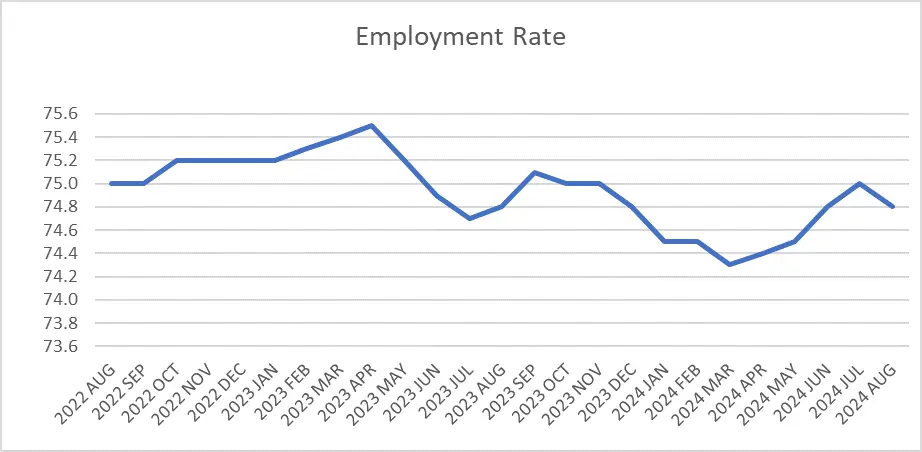
Figure 1: UK employment rate of last 2 years
Key features of unemployment graph
- The employment rate remained constant by at approximately seventy-five percent from the period of the late 2022 through to early of the year 2023 (Mousteri et al. 2021). That has been recording a decline between April and June 2023 but somewhat recorded a better performance from July 2023 to mid of year 2024, but a slant again at some point in August 2024.
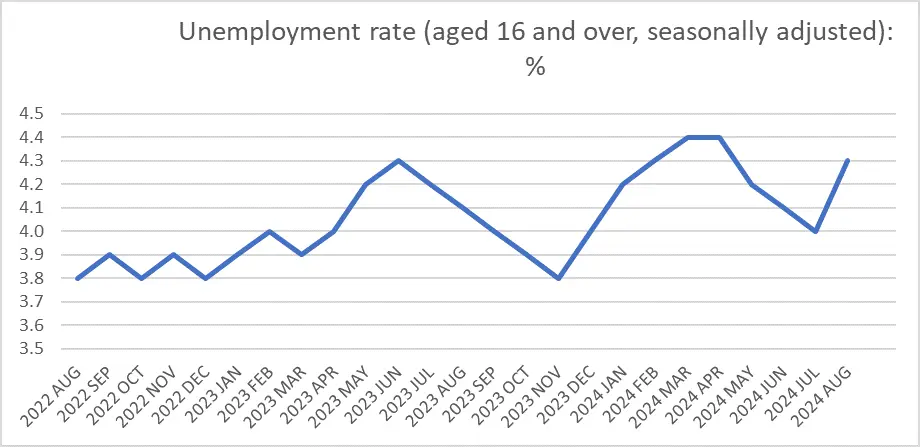
Figure 2: UK unemployment rate of last 2 years
Key features of unemployment graph
- This varies over the monitoring period ranging from 3.7 percent to 4.4 percent (Abomaye-Nimenibo and Samuel 2021). The schistosomiasis transmission rate reached up to 4.4% in early 2024 and then dropped again and suddenly shot up to 9% in August 2024.
- We observe a gradual rise of unemployment in the period of from the end of 2022 to the beginning of 2033, then will slightly decrease in mid-2023 and again sharply increases mid 2024 onward (Bell and Blanchflower 2021).
Possible cause of key features
Causes for unemployment rate
Economic Cycles and Market Conditions: Fluctuations in unemployment usually occur within two outsider cycles like during a slowdowns or recessions and during peak economic growth. They show that the peak in early 2024 and the increase in August may be associated with changes in the conditions of the economy (Moore 2024). For instance, inflation, increase in the interest rates and or world economic problems could have held back expansion and therefore hiring and created job opportunities in the corporate world. Sometimes due to financial challenges such as downsizing in an organisation to deal with expenses, companies might have set so many people free, which pushed the unemployment rate higher.
Seasonal Factors: Another causative factor is the cyclical unemployment, whereby employment levels also rise and falls with seasons because of hires and layoffs. A lot of firms including those in retailing services, tourism, and farming generally have demands for workers’ services at certain periods of the year and this impacts on unemployment (Clark 2024). Increased percentage in August 2024 may be attributed to labour seasonality whereby some may have been let go from service or employment probably due to the tourism or agricultural activity.
Structural Shifts: Self development, technological and consumer preferences may as well bring structural shifts in the labour market due to structural dynamics. If the industries become automated, machines take over, or are disrupted through technical progress at some point some types of jobs cannot be done, thereby increasing unemployment. Unemployment increasing in 2024 may be due to continuing realignments to digitalization of the economy or changes in labor market demand.
Causes for employment rate
Employment rate has almost remained constant with a slight decline between the months of April to June of year 2023 and then rising as shown below. The above decline could be as a result of economic instability (Abraham and Kearney 2020). For example, operation costs and prices may go up that forces companies to reduce staffing or halt recruitment processes. These economic challenges may have made corporations to halt their growth projects or even demographers sometime in the process in specific industries. But the revival in mid of 2024 shows that may be businesses have finding ways of coping with all these odds and confidence to invest in people by hiring again is back. The slight dip in August 2024 could be due to probability of a short term decrease in the job market since organizations might experience a reduction in human capital demands seasonally or due to fluctuations in internal or external economics, politics conflicts globally and the likes.
Thus, both employment and unemployment are influenced by cyclical and acyclic factors, as well as structural changes in demand on the labor market. Understanding of these causes can help forecast the future tendencies in the labor market and to concentrate initiatives of the authorities on stimulating employment growth.
Explanation of the impact/implications of the features
General Impacts and Implications
The effects of these adverse changes include firstly the employment rates decreasing, secondly, the mid-2023 labor market is volatile, and lastly, the cyclical fluctuations harming the stability of the economy and welfare of the society. Lower employment standards lower household earnings discouraging consumption and dampening growth. The increasing unemployment rate has burdened the social security systems and increased demands for the state to step in such as providing unemployment benefits and retraining programs (Kassir et al. 2023). Fluctuations in events at the workplace level weaken stability within employment organizations eradicating certainty for employers and employees alike. Some antisocial effects include future skills imbalance and discouraged skilled workforce hence slow economic recovery. These trends can also deepen social inequality when marginalized populations can only find it difficult to attain decent paid work as ongoing structural shifts in the economy unfold.
Impacts on Hospitality Management
In the context of the value-chain credence attributes in the hospitality sector, these labor market trends bring some specific difficulties. Reduced employment and growth of unemployment influence the staff numbers, and since there are fewer qualified employees at any time, recruitment gets expensive. Fluctuations upset working force planning and continuity, putting pressure on service delivery throughout the year, especially during busy times (Demirtaş-Milz 2022). Flexible and gig-based work arrangements will increase staff shortages because employees prefer industries with stability. also, through automation and digital transformation hiring patterns could change, meaning that employees might need new skills and hence change. A new economic environment can lead to cost-cutting measures as demands for hospitality businesses put pressure on revenue sources and customer experiences to create competitive advantage and prospects of long-term sustainable growth.
Task 2
Comparison of Unemployment Rates: UK, Canada, and USA
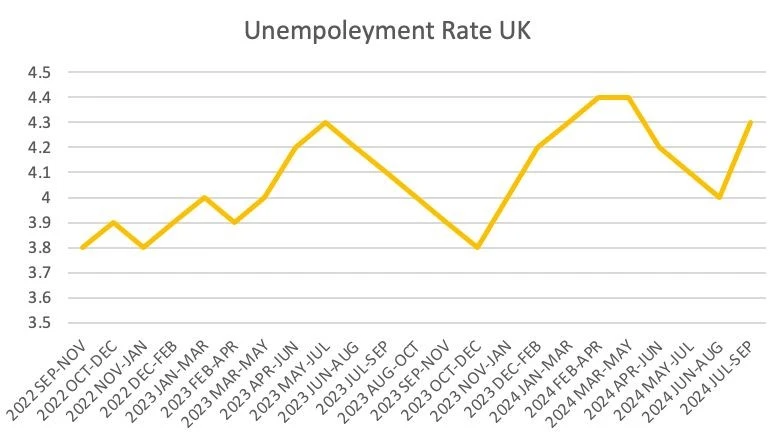
Figure 3: Unemployment rate of the UK
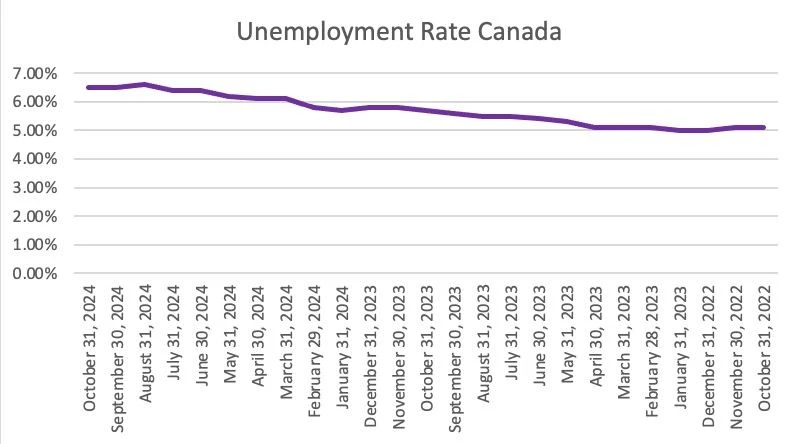
Figure 4: Unemployment rate of Canada
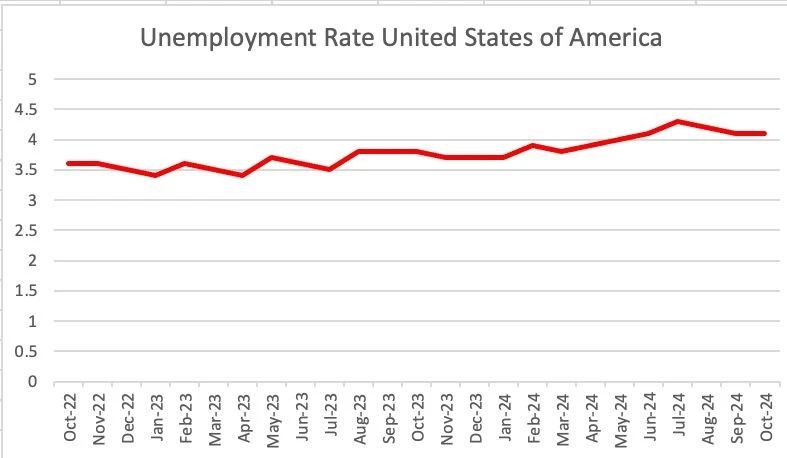
Figure 5: Unemployment rate of America (USA)
Trend Analysis: The level of unemployment in the three major economies can be seen to exhibit different trends in the observed periods. This is exemplified by the UK with a high level range of 3·8-4·4 % with some insignificant up and high curves (Chakraborty et al. 2021). On the other hand, the results depicted for Canada show a relatively decreasing pattern starting from about 6% and reducing to about 5%. The US has the least fluctuation between different months and years, ranging between 3, 5% and 4, 5%; though slightly rising in the recent past.
Range and Volatility: The UK has the highest short-term unemployment variation with fluctuations monthly and fluctuations that alternate between a 3.8% to 4.4%. For instance, at the overall level, Canada’s working-age population growth ranges from 5-6 % and with fluent transition from one period to another. The US has the best and least volatile trend of the three and remains between 3-5% and 4-5% respectively though showing less of an upward trend in the recent period.
Recent Developments: In the latest data points, all the countries have the different path, as it is represented in the picture below. Turning to the UK, the rate of increase accelerates to approximately 4.3%, from a reduction to 4% on the previous year. Latter, we find that Canada’s rate seems to have leveled off at 5%, making it have a possibility of not continuing the declining trend. The US indicates slightly fluctuating rates around 4.2%, after the trends of gradual rise.
Comparative Economic Implications: From the data, different economic issues and opportunities are identified for each country. Higher volatility may represent a more responsive labour market, perhaps through the wake of other assorted changes (Bell and Blanchflower 2020). The rates for Canada are higher but declining which illustrate continually advancing labor market for the nation, however Canada retains higher average level of unemployment compared to other countries of the OECD.
Regional Differences and Policy Implications: These differences in unemployment fluctuations could, therefore, be due to different policy regimes and structures of the economies. But the revival in mid of 2024 shows that may be businesses have finding ways of coping with all these odds and confidence to invest in people by hiring again is back (Hernández et al. 2021). The slight dip in August 2024 could be due to probability of a short term decrease in the job market since organizations might experience a reduction.
Native Assignment Help offers professional Assignment Help services to students seeking expert academic guidance on economics, labour market trends, and research-based topics. With structured solutions and in-depth analysis, students can improve their understanding and achieve higher academic performance in complex assignments.
Reference List
Journals
Abomaye-Nimenibo, P.P. and Samuel, W.A., 2021. Which of these economics jargons-underemployment, overemployment, unemployment, rightemployment, overqualification and overeducation is appropriate for an economy. Global Journal of Human-Social Science: E Economics, 21(4).
Abraham, K.G. and Kearney, M.S., 2020. Explaining the decline in the US employment-to-population ratio: A review of the evidence. Journal of Economic Literature, 58(3), pp.585-643.
Bell, D.N. and Blanchflower, D.G., 2020. US and UK labour markets before and during the Covid-19 crash. National Institute Economic Review, 252, pp.R52-R69.
Bell, D.N. and Blanchflower, D.G., 2021. Underemployment in the United States and Europe. ILR Review, 74(1), pp.56-94.
Chakraborty, T., Chakraborty, A.K., Biswas, M., Banerjee, S. and Bhattacharya, S., 2021. Unemployment rate forecasting: A hybrid approach. Computational Economics, 57(1), pp.183-201.
Clark, J.M., 2024. Business acceleration and the law of demand: A technical factor in economic cycles. In Classics in Institutional Economics, Part II, Volume 6 (pp. 24-43). Routledge.
Demirtaş-Milz, N., 2022. The Transforming Context of Global Economy and Mobility Regimes: Forecasts About the Migrant Positions in the Light of the COVID-19 Pandemic with an Overview of Its Impacts on Italy. COVID-19 and Society: Socio-Economic Perspectives on the Impact, Implications, and Challenges, pp.259-277.
Hernández, B., Voll, S., Lewis, N.A., McCrory, C., White, A., Stirland, L., Kenny, R.A., Reilly, R., Hutton, C.P., Griffith, L.E. and Kirkland, S.A., 2021. Comparisons of disease cluster patterns, prevalence and health factors in the USA, Canada, England and Ireland. BMC Public Health, 21, pp.1-15.
Kahn, R.F., 2022. Unemployment as seen by the Keynesians. In Richard F. Kahn: Collected Economic Essays (pp. 225-239). Cham: Springer International Publishing.
Kassir, S., Baker, L., Dolphin, J. and Polli, F., 2023. AI for hiring in context: a perspective on overcoming the unique challenges of employment research to mitigate disparate impact. AI and Ethics, 3(3), pp.845-868.
Kreshpaj, B., Orellana, C., Burström, B., Davis, L., Hemmingsson, T., Johansson, G., Kjellberg, K., Jonsson, J., Wegman, D.H. and Bodin, T., 2020. What is precarious employment? A systematic review of definitions and operationalizations from quantitative and qualitative studies. Scandinavian journal of work, environment & health, 46(3), pp.235-247.
Moore, H.L., 2024. Economic cycles: Their law and cause. In Business Cycle Theory, Part II Volume 8 (pp. 23-59). Routledge.
Mousteri, V., Daly, M. and Delaney, L., 2020. Underemployment and psychological distress: Propensity score and fixed effects estimates from two large UK samples. Social Science & Medicine, 244, p.112641.
van Hooft, E.A., Kammeyer-Mueller, J.D., Wanberg, C.R., Kanfer, R. and Basbug, G., 2021. Job search and employment success: A quantitative review and future research agenda. Journal of Applied Psychology, 106(5), p.674.
Go Through the Best and FREE Samples Written by Our Academic Experts!
Native Assignment Help. (2026). Retrieved from:
https://www.nativeassignmenthelp.co.uk/mod008862-data-skills-assignment-43402
Native Assignment Help, (2026),
https://www.nativeassignmenthelp.co.uk/mod008862-data-skills-assignment-43402
Native Assignment Help (2026) [Online]. Retrieved from:
https://www.nativeassignmenthelp.co.uk/mod008862-data-skills-assignment-43402
Native Assignment Help. (Native Assignment Help, 2026)
https://www.nativeassignmenthelp.co.uk/mod008862-data-skills-assignment-43402
- FreeDownload - 43 TimesBA Health And Social Care Assignment Sample
1.0 INTRODUCTION: BA Health And Social Care Assignment Health and social care...View or download
- FreeDownload - 41 TimesBH6017 Psychology for Business and Management Assignment Sample
Individual presentation Overview of the Presentation The current...View or download
- FreeDownload - 37 TimesEntrepreneurial Ventures Assignment Example
Entrepreneurial Ventures Introduction: Entrepreneurial Ventures An...View or download
- FreeDownload - 41 TimesStudy Skills for Higher Education Essay
Study Skills for Higher Education Essay Introduction - Discuss How study...View or download
- FreeDownload - 41 TimesPsychological Consequences of Cyberbullying Assignment Sample
Introduction Cyberbullying takes place over the digital devices such as...View or download
- FreeDownload - 38 TimesStrategic Analysis of Huawei Assignment Sample
Strategic Analysis of Huawei Assignment Sample Looking for Help With...View or download
-
100% Confidential
Your personal details and order information are kept completely private with our strict confidentiality policy.
-
On-Time Delivery
Receive your assignment exactly within the promised deadline—no delays, ever.
-
Native British Writers
Get your work crafted by highly-skilled native UK writers with strong academic expertise.
-
A+ Quality Assignments
We deliver top-notch, well-researched, and perfectly structured assignments to help you secure the highest grades.