
- Chapter One: Introduction
- 1.1 Research Background
- 1.2 Aim and objectives
- 1.3 Research significance
- 1.4 Research rationale
- 1.5 Dissertation structure
- Chapter Two: Literature Review
- 2.1 Introduction
- 2.2 Concept of crew resource management and its significance
- 2.3 Diverse challenges relating to air traffic
- 2.4 Interrelationship between CRM and air traffic management
- 2.5 Conclusion
- 2.6 Literature Gap
- Chapter Three: Research Methods
- 3.1 Introduction
- 3.2 Research Type
- 3.3 Research Approach
- 3.4 Research Philosophy
- 3.5 Data Collection
- 3.6 Sampling
- 3.7 Data Analysis
- 3.8 Ethical Consideration
- 3.9 Research Limitation
- 3.10 Reliability and Validity
- 3.11 Conclusion
- Chapter Four: Data Analysis And Findings
- 4.1 Findings
- 4.2 Discussion
- Chapter Five: Conclusion And Recommendations
- 5.1 Conclusion
- 5.2 Recommendation
- 5.3 Limitation
- 5.4 Reflection
Chapter One: Introduction
1.1 Research Background
The Crew Resource Management is defined as a training procedure which is used within the aviation industry to ensure that human errors are negligible and the management and safety within the aviation operations are effective. Within the aviation operation, there are many chances of air accidents which can happen due to different issues like flight data recorders, cockpit voice recorders and others. Thus, to manage all these the effective resource management training is required and is assistive in improving the operational efficiency and safety of the aviation operational activities. The CRM includes having different types of knowledge, attitude, and skills for managing all the work and ensuring that effective teamwork is managed, so that there are no issues or errors while flying (Wen et al, 2021).
The current study is based on National Air Traffic Services, which is stated as NATS. It provides the en route to a traffic control service to flights which are within the division of the UK and the Shanwick Oceanic Control area. This holding provides the air traffic control services for approximately 14 of the UK airports and is headquartered in the UK, and was founded in 1962. The current thesis will outline the role of the crew resource management training for managing the air traffic issues which are present in the workplace. It will outline the interrelationship which the CRM training and Air Traffic management has an impact on the safety and operational efficiency of the company. Moreover, the evaluation of the challenges relating to the air traffic management for which the requirement of CRM training is needed is also highlighted.
Native Assignment Help provides academic support for students working on aviation, management and research-based assignments. Our Assignment Help Services can assist students in structuring complex topics, developing research-based discussions and presenting findings clearly according to academic requirements.
This sample demonstrates how CRM training can be examined in relation to air traffic management, operational efficiency and aviation safety, using NATS as the organisational context.
1.2 Aim and objectives
Research Aim
The aim behind conducting the current study is to determine the impact of CRM training on the safety and operational efficiency of air traffic management within the National Air Traffic Service (NATS).
Research Objectives
- To study the concept of Crew Resource Management (CRM) training and its significance.
- To evaluate diverse challenges associated with air traffic management within NATS.
- To analyse interrelationships between CRM training & air traffic management’s operational efficiency and safety within NATS.
- To recommend competent strategies to NATS’s manager for boosting operational efficiency and safety in air traffic management.
Research Questions
- What is the concept of crew resource management training?
- What are the challenges related to air traffic management?
- What is the interrelation between air traffic management and CRM training?
1.3 Research significance
In the current environment, many accidents and issues are taking place within air travel. For this reason, appropriate aviation safety measures must be managed and maintained. Compliance with Crew Resource Management (CRM) is crucial because it helps improve aviation safety. The primary focus of CRM is to enhance aviation safety and also to improve interpersonal communication and decision-making among employees within the aircraft cockpits. This assists in effectively managing air traffic and other challenges faced while operating the aircraft (Badrinath and Balakrishnan, 2022). The significance of the current research topic lies in its potential to assist pilots and cabin crew members in effectively managing and maintaining the safety of the aircraft and its passengers. Additionally, there are various types of human errors and challenges that can arise while operating the aircraft. To ensure minimal issues, compliance with CRM is essential within aviation companies. This study holds significance for NATS as it aims to improve the usage of CRM for air traffic management. Furthermore, this study is relevant to all competitors of NATS and other organisations operating in the aviation industry. It is so because they can use the findings of the study and can also improve their CRM training
1.4 Research rationale
In the current competitive environment the safety of the passenger and public is vital while travelling. Therefore, compliance with CRM training for managing the safety and efficiency within the aviation company is essential. Moreover, according to the recent trends the safety has become the top most priority for the companies and by compliance with the crew resource management training the aviation companies can ensure it. It is the major reason for selection of the current research topic as it will help the company in understanding the importance of CRM training and try to implement it into the working. Moreover, it is also the interest area of the researcher based on both the academic and the personal choice. Hence, it is another reason for conducting the current study on the present research topic.
1.5 Dissertation structure
Chapter 1: Introduction
This chapter will emphasis on providing a brief outline of the research topic along with the objectives formulated for the current study.
Chapter 2: Literature Review
The next chapter outlines the in-depth analysis of the existing data based on the research topic, which includes evaluation of the various books, articles, journals and other publications concerning the topic of study.
Chapter 3: Research Methods
The methodology chapter outlines the different types of methods that these scholars can use for accomplishing the study and the rationale for selecting the particular methods.
Chapter 4: Results and Analysis
The data analysis chapter outlines the evaluation of the collected data for reaching to reach a conclusion. It includes the application of different methods for the evaluation of the data.
Chapter 5: Conclusion
It is the chapter which concludes the findings from the above gold study. It includes the crux of all the chapters discussed within the study. Also, it includes some recommendations for improving the study in future.
Chapter 6: Reflection
Lastly, comes the reflection where all the personal learning throughout the research journey will be outlined, along with the knowledge of these skills developed through this project.
Chapter Two: Literature Review
2.1 Introduction
The LR or the review of different literature is defined as the evaluation of the various books, articles, journals and other published data in context of the research topic. To make the study successful, the appropriate type of literature must be collected and evaluated. The current literature review chapter will highlighting the significance of implementing CRM within the aviation companies. Moreover, it will also assist in analysing the different challenges which are related to air traffic management and also affect the operation and efficiency of the aviation industry. Moreover, it will highlight the interrelationship present between the Crew Resource Management and the air traffic management. For the successful working of the aviation industry, the crew resource management must be effectively maintained so that the overall performance is improved.
2.2 Concept of crew resource management and its significance
According to the views of Terzioğlu (2024), the crew resource management is defined as a concept which includes undertaking effective use of the provided resources so that the personnel within the crew can effectively ensure safe and efficient operations of the aviation work without any error and avoid stress. Similarly, MacLeod (2021) also stated that CRM is stated as the various procedures relating to training that are particularly used in the aviation industry to reduce human error, so that the devastating effects can be reduced. The major focus of crew resource management is on enhancing the communication which need to be present among flight attendants and the pilots and the operational personnel so that the overall flight services are effectively provided and the air traffic management is controlled. In support of this, Ashcroft, Wilkinson and Khan (2021) stated that effective CRM training is very significant within the aviation industry because it assists in identifying and mitigating all the potential risks which can affect the flight and hamper operational efficiency. Thus, the compliance with CRM is very necessary so that the working is improved and operational efficiency is enhanced.
On the other side, Yoo, Jeon and Shin (2025) contended that the CRM training is very significant for mitigating all the scope errors and mistakes. With the help of effective training for CRM, the appropriate type of errors can be identified and mitigating strategies can be implemented on time. Further, Harris, Mansikka, and Virtanen (2021) also contemplated that compliance with the CRM training has a crucial role in the development of the confidence of employees. With the help of the CRM training the effective communication is improved, and the confidence level of the employee increases and with its help it they can effectively manage the working of the aviation industry. Further in the views of de Andreis et al, (2022), it was highlighted that the CRM training also assists in improving teamwork and allocation skills among the employees. However, when this CRM training is implemented then it will improve the teamwork and task allocation skills among the employees, and ultimately delegation of work will be effectively implemented. Further, with the evaluation of the work of Ant (2024), it was examined that CRM training also assists in effective conflict management. When the appropriate type of teamwork is improved, then automatically the conflicts at the workplace will be managed, and ultimately it will increase the productivity of the aviation industry.
2.3 Diverse challenges relating to air traffic
With the valuation of the work of Haji Amiri, Kuşakcı and Güngör (2025), it is evident that various issues and challenges are present within the air traffic management and not following the CRM. All these challenges and issues affects the working efficiency of the company and ultimately it hampers the operational efficiency. Moreover, the company exist in the external environment and within it there are many other challenges and issues as well. Hence, for the successful working of the company all the challenges and issues within the aviation industry are evaluated so that the company is able to manage and improve the working better. Marrón and Redondo (2023) highlighted that the most common challenge while managing the air traffic includes the fact is the infrastructure issue. The infrastructure issue includes the fact that all the infrastructure is outdated. This simply means that the infrastructure present within the aircraft and other related aspects is very outdated, and it creates a lot of issues. For instance, the ATM which are operated within the working of NATS are very outdated and follow obsolete technology.
Moreover, Kaynak (2024) also contended that there are safety issues and concerns relating to air traffic management due to the use of outdated infrastructure. This indicates that the working of the aviation industry and the company will not be affected, as all the updated infrastructure is being used by the company. On the other side, Alhawsawi and Macedo (2024) explained that having technological research is the most common issue within air traffic management. However, many times there is a technical breakdown and the process of data analysis and other related aspects or delayed. Hence, eventually, it creates a negative impact on the overall efficiency of the air traffic management and ultimately, work is hampered. The example of a technological issue included the fact that within NATS, once there was a failure of a computer, and ultimately, data was affected, and the travel plan of a different passenger was affected. This simply means that the technology issue can create a lot of challenges for managing the air traffic, and as a result of the work of the aviation company can be hampered.
Further, Griffioen, van der Drift and van den Broek (2021) contended that another challenge faced while managing Air Traffic includes the disruptions relating to weather changes. There are a lot many different changes in the environment and the weather which can affect the working of the aviation company. Hence, it can create issues in managing the Air Traffic. The weather changes are unpredictable, and the conditions can include situations of hurricanes, fog, thunderstorms and many other types of weather changes. Hence, for the aviation companies they effectively try to manage the weather updates and try to predict and work.
In the view of Samunderu (2024), another major challenge faced by companies in managing air traffic includes the lack of skilled personnel and employees within the aviation industry. Many times, it is possible that the employees of the company are not highly efficient and skilled and also the operational efficiency is affected. They are not able to manage their work, and ultimately, the overall efficiency is affected. Thus, it is difficult for the employees to manage the situation of Air Traffic. In addition to this, there are also many different changes within the environment, and in case the employees are not skilled and highly competent, then they will not be in a position to adapt to the technology and other changes efficiently. Hence, it is mandatory for aviation companies they recruit highly competent people so that the complete working can be improved and management of Air Traffic can be done effectively.
Moreover _it_ articulated that another challenge which can affect air traffic management includes the supply chain disruption. Further, within the external environment, there are many different changes, and the supply chain might be affected. Due to the maintenance of the supply chain, it can result in delay or cancellation of the work and ultimately, Air Traffic can be affected. Hence, it can create or result in creating operational challenges for the aviation companies, and ultimately, Air Traffic will increase. Thus, for the successful management of the challenges, that the appropriate crew resource management is followed. When the effective resource management principles and practices are followed then it is helpful to the company in managing the traffic effectively. In addition to this _it_ stated that the changes in the behaviour and needs of the consumer might also affect the working of the air traffic. Trends are currently changing, and the capability of the aviation industry might get affected. Balancing global connectivity is very necessary for companies to effectively operate in the aviation industry. Also, with the help of global connectivity, the use of flights has increased, and the management of the work is affected. But by complying with effective crew resource management, the company is capable of managing the air traffic, and ultimately the efficiency and capability of the company are improved.
In addition to this, another major challenge which is faced by companies in managing the air traffic includes the development in the technology. Currently, the technology is expanding to a great extent, and complying with the successful working of the companies and the aviation industry. Hence, for this, the appropriate compliance with the crew resource management must be undertaken so that the overall working of the aviation companies can be improved. By adopting the appropriate usage of crew resource management, the company is capable of providing better working conditions to the customers, and ultimately, operational efficiency and market position will increase. Hence, the challenge of technological development can be improved, and also, the overall capability of the aviation company can be increased, and the work will be enhanced well.
2.4 Interrelationship between CRM and air traffic management
By the analysis of the work of Muñoz-Marrón and Segura-Redondo (2023), it is clear that the compliance with the crew resource management training and Air Traffic management has a good relationship with one another. Also, when the effective type of CRM training is provided to the employees than it assists in improving the management of the Air Traffic. Hence, the overall efficiency of the aviation companies improves, and ultimately, it enhances the working capability to a great extent. The most common type of impact which is created on air traffic management is the improvement of communication skills. When, the CRM training assists in improving the overall communication, and the employees can communicate with one another and ensure better Air Traffic management. With the help of clear communication, the employees can share all the information, and eventually better coordination is maintained within the work of Air Traffic. Further, many statistics have outlined that with better communication, the air traffic accidents and casualties have reduced to a great extent, and it is beneficial for the better working of Air Traffic and, alternately, the overall efficiency of the aviation companies will improve.
On the other side, Karaarslan and Erkmen (2021) argued that with positive impact, some negative effects are also created on the working of the company and the air traffic. With the evaluation of the work of Du and Zhu (2022), it was analysed that there are different jargon errors and assumption errors, which can be caused due to a lack of communication. This affects the work of the employees and ultimately, the proper air traffic is not managed, and casualties can occur. Hence, it is mandatory for the employees that they must efficiently have the appropriate type of training related to crew resource management so that the overall working efficiency can be improved and better decisions can be made by the employees.
In addition to this Jiang et al, (2020) stated that another interrelationship between the crew resource management in the air traffic management is that it ensures safety and efficiency of the working. However, by utilising the CRM, the employees increase that team working and communication. Hence, eventually the overall working is improving, and also, the safety and efficiency of the operation of activities increases. Also, when the communication is clear, then automatically the overall working will be improved, and ultimately, the working capability will also be enhanced. Moreover, by utilising the CRM practice, the company can effectively make better decisions, and this will assist in managing all the complex situations easily. Ultimately, the air traffic management will improve and assist people in managing aviation activity effectively. On the other side Kamper (2020) contemplated that by complying with the effective CRM, the situational awareness among the people will also increase. Thus, the people will be in a position to manage and maintain the changes taking place in the external environment. The environment is very dynamic, and any change can occur and can create conflict within the working of the aviation industry. Hence, with the help of the effective CRM principles and practices, the company will be in a position to manage all the changes effectively, and the conflicts will be resolved efficiently.
On the other hand MacLeod (2021) also stated that when effective compliance with the crew resource management training is attained, then it assists in continuous improvement within the training and the air traffic management. When the appropriate training sessions are conducted, then it will be beneficial in improving the working capability, and also, overall efficiency will be improved. With effective compliance with the crew resource management, the company will be in a position to effectively attract more people towards the aviation company and its operations. Moreover, with the compliance with effective crew resource management, the people can delegate the task effectively according to the efficiency of the people. Hence, ultimately, the overall working will be improved. Also, the compliance with effective crew management is assistive in managing the air traffic, and eventually it will improve and boost the sales of the aviation industry. In addition to this, the work of Maneenop and Kotcharin (2020) stated that for managing the air traffic control, the compliance with the CRM is necessary for managing stress and fatigue. Many times in complex situations, employees become stressed, and with effective CRM performance and techniques, they will be able to manage their work. Hence, the overall working capability will be improved by utilising the CRM principles and practices. Moreover, by the management of stress, the employees will be in a position to improve their resilience and well-being, which will ultimately assist them in controlling the air traffic management. With the examination of the work of Marrón and Redondo (2023) it is stated that the CRM and Air Traffic management are highly interrelated to one another. with the use of effective CRM principles and practices, the companies in the aviation industry are in a position to manage their work appropriately. Ultimately, this enhances the efficiency and working.
Ultimately Mulisa (2022) also stated that compliance with the crew resource management is helpful to the aviation companies in managing the work appropriately. However, when the effective type of management of resources is done, than automatically improves the working of the air traffic management. Hence, it can be stated that the Air Traffic management is highly controlled with the help of the appropriate CRM principles and practices. Also, there is a high relationship present between the work of an aviation company and it improves its efficiency. Also, when the appropriate type of work is done then it assists in improving and enhancing the work effectively (Praetorius, Hult and Österman, 2020). Hence, for the aviation companies, it is required that they effectively abide with the practices of crew resource management so that the efficiency can be improved and the air traffic can the managed successfully. In case effective working is not managed, then it will affect the working capability of the company, and the profitability might be reduced. Hence, for the improvement of the work, the company must be capable of managing the resources efficiently so that the overall work is improved.
2.5 Conclusion
Lastly, it is concluded that effective compliance with the crew resource management is necessary to ensure the effective working of the company. Also, the crew resource management helps in providing training to the employees relating to ensuring the safety of the people by working on the available resources. It emphasises the effective use of resources so that the appropriate safety and efficiency can be managed and improved. The above literature also highlighted that complying with the crew resource management includes many challenges, as the employees might not be well educated and might face issues in operating well. Hence, it was also highlighted that the compliance with the CRM will help the company in managing the working and air traffic effectively and smoothly, ensuring the successful working of the company.
2.6 Literature Gap
The present chapter assisted in highlighting the gap that is present into the literature. Different studies have been conducted in relation to the importance and requirement of crew resource management. But no studies have been conducted focusing on the effect of the crew resource management on the air traffic management (Prineas et al, 2021). Thus, the present study will be helping in identifying and analysing the implications of using the CRM training on Air Traffic along with the maintenance of good operational efficiency and safety within the aviation industry.
Chapter Three: Research Methods
3.1 Introduction
The methods of research are a systematic process with help of which the person is able to identify and research the problem effectively. To accomplish any of the research it is mandatory that the appropriate type of the methods are selected. This chapter will examine the different methods which are currently and easily available to the scholar to use. Along with the different choices of the methods the current chapter will also be highlighting the methods used in the assessment of the present study which is based on effect of crew resource management on the operational efficiency and safety of the people within the company. The reason for selecting the methods will also be highlighted in the current chapter with will provide more clarity relating to the methods used in the present study.
3.2 Research Type
The type of research is stated as the study that is conducted for evaluating a particular question or a research topic. To complete any of the research, the correct type of research method is selected. Research type is stated as the method which will be assistive in accomplishing the objectives of the study. Qualitative and quantitative study are the two various type of the study that can be implemented into the study to attain the objectives of the study. The compliance with the qualitative study is implemented at the time of conducting current study based on assessing the effects of CRM training on the operational efficiency and the safety (Aguas, 2022). It is selected by the scholar because it assists them in evaluating the non-numeric information easily. Operational efficiency and safety are non-numerical terms and cannot be measured in numbers or cannot be quantified. Hence, the effect of the CRM on operational efficiency can only be analysed with the help of a qualitative study. Also, another reason for abiding by qualitative study is that the current research topic is qualitative in nature and due to this the study is effectively accomplished.
3.3 Research Approach
The research approach is stated as the plan and the procedures which the scholar undertakes for analysing and collecting the data about the research. There are a lot many datasets which are available for the completion of the study, but their selection depends on the approach which is used by the scholar. Inductive and deductive are the two different types of approaches which are readily available to the scholar for use. The inductive approach is utilised by the researcher for completing the present study based on CRM training and its effects on the air traffic management (De Oliveira, 2023). The scholar has implemented the use of an inductive approach because it assists in generating more ideas and insights relating to the available data based on the research topic. This assists in exploring the existing theories and assessing the key concepts and important aspects from the existing data. Ultimately, it assists in gaining a wide range of data for accomplishing the objectives of the study. The qualitative study complies with the inductive approaches and is beneficial as a wide variety of data can be used based on this approach.
3.4 Research Philosophy
The philosophy of research is stated the belief or system which underlies present behind the selection of any method. Various methods used in the study are selected by the scholar for some particular reason. This research philosophy is defined as the reason which is based for the selection of a particular type of the study. Hence, for the successful completion of the study use of correct philosophy is needed. There are two choices present for the researcher to select from for the philosophy, which include positivism and interpretivism. For assessment of the effect of CRM on the operational efficiency and Air Traffic management, the selection of interpretivism is made by the scholar because it majorly focuses on the subjective nature and increases the knowledge about the research topic (Dawadi, 2020). In the current case as well, the CRM and operational efficiency both are qualitative concepts, and also, the interpretivism theory will help the scholar in developing detailed information in relation to topic of research. Ultimately, it provides a wide variety of subjective knowledge in relation to the research topic, and ultimately, the scholar is capable of attaining all the aim and objectives of the present study. Moreover, the compliance with the interpretivism theory is followed by the scholar as it is more suitable in case of the study which is qualitative in nature.
3.5 Data Collection
To accomplish any of the study successfully the correct type of the data needs to be followed. The data is defined as the raw facts and information in relation to the research topic that can be used by the scholar for attaining the objectives of the study. Thus, to make the study successful it is necessary that correct type of the data sources are used. Currently there are two major sources of data that is primary and secondary which can be utilised by the scholar for collecting the data. The combination of primary and secondary is implemented by the researcher for evaluating the effect of CRM training on the operational efficiency and safety of aviation companies (Callanan and Loughlin, 2021). For gaining a deeper insight into the research topic, the scholar has selected a combination of both methods. The compliance with the primary data will assist the scholar in generating first-hand information relating to the effect of CRM. In addition to this, the compliance with the different articles, books, journals and existing sources will assist in authenticating the information gathered with the help of the primary respondent. Hence, this combination of both methods will be providing a wider range of data which is assistive in effectively conducting the research and accomplishing the objectives of the study. The primary analysis is conducted with the help of a survey with employees of NATS, and for the use of secondary sources, the different sources, with the help of the internet and the university library portal, will be followed.
3.6 Sampling
Concerning the research, the sampling is defined as the selection of a small group of people from the whole population, that is, the larger group. The population present in the study is large, and to ensure effective compliance with the data, the smaller segment is selected. Thus, for overcoming this issue, the researcher effectively selected a particular small segment of people from the whole population. The sample is selected in such a way that it possesses the characteristics of the whole population, and ultimately, the overall accurate data is selected (Peel, 2020). To assess the effect of crew resource management on air traffic management, the compliance with the random sampling is made and based on 25 employees of NATS are selected as a sample is selected. Here, the scholar has implemented the use of the random sampling method because this method provides an opportunity to all the people present in the population to have a fair chance to become participants in the study. Effectively, by complying with this method, the scholar has collected data from 25 employees of the company, and based on it, the whole research is conducted to assess the objectives of the study.
3.7 Data Analysis
The analysis of the data is referred to as the process which is implemented by the researcher to effectively evaluate the collected data. Hence, there are different techniques through which the collected data can be analysed and evaluated. The various methods of analysing the data include the use of either thematic analysis or SPSS. The assessment of the current research topic is based on evaluating the effects of crew resource management training on the management of Air Traffic, and here the use of thematic analysis is undertaken. The use of thematic analysis is helpful to the researcher because, with the help of this method, they are able to create different themes based on the questions asked and display the data with the help of tables and charts (Xu and Zammit, 2020). This pictorial presentation of the data is assistive in providing a better overview of the data, and ultimately, it will assist in the accomplishment of the aim of the study. Additionally, the major benefit of selecting the thematic analysis is that it will help in easily evaluating the large data set, and better patterns and themes can be analysed relating to the current research.
3.8 Ethical Consideration
Within the research, there are certain types of ethical principles which are to be followed. The ethical principles are defined as the moral principles which guide scholars in accomplishing the study in an ethical way. There are many times the situation where a scholar undertakes the use of unethical practices, which makes the work and outcome ineffective. Hence, it is the responsibility of scholars they appropriately implement the ethical principles within the research. While assessing the effect of crew resource management on air traffic management, compliance with informed consent is ensured. This informed consent is a principle which ensures that all the primary data gathered is used with the permission of the respondent. Before seeking the data for the studies, an informed consent sheet is signed by the participant, which ensures that the research participant is providing the information according to their choice, and it can be used in the study (Morris, 2021). Additionally, another ethical principle followed is the maintenance of confidentiality during the study. According to this principle, while conducting the study, the researcher has not revealed any of the personal information of the participants, such as the name, email-id or address of the participants. Further, concerning the secondary sources as well, there are certain types of ethical consideration which needs to be followed. The most common is the time duration of using the articles and different journals. This principle states that all the latest information and articles must be selected, and to comply with this scholar has implemented the use of all the articles which have been published after 2020. When too old data is used, then it does not provide the actual outcome, and ultimately, the objectives are not accomplished.
3.9 Research Limitation
The limitation within the research is defined as the constraint which can affect the successful completion of the study. While conducting the study, there are many different instances which can result in creating restrictions on the successful completion of the study. Hence, while assessing the effect of crew resource management training on the efficiency and safety of the aviation companies, the major limitation faced was related to the resources. The resources available for conducting the study are very limited, and other scholars are also present who are conducting the study. So, with the help of effective allocation skills, the scholar was able to allocate all the scarce resources to every activity, which resulted in the successful completion of the study. Additionally, another limitation that was encountered by the scholar was the time for gathering the data. Collecting the primary data takes a lot of time, as the researcher has to go to every participant and then collect the data. Thus, to overcome this limitation, the scholar has selected a less number of sample, which is 25 and also the survey will be gathered through an online medium. Within this, the questionnaire will be prepared and will be communicated to every participant with the help of email. Also, the response to the questionnaire will be collected through email only, and this will save a lot of time for the researcher.
3.10 Reliability and Validity
The reliability and validity are defined as the key measures which ensure that all the data selected and utilised in the study are authentic and reliable. Hence, it is the responsibility of this scholar that they effectively ensure that all the reliable and valid information is utilised in the study. For ensuring the reliability and validity in the present study, the scholar has focused on collecting data from sources and websites which have copyright on them. This copyright ensures that all the information provided by that particular website is correct and authentic. Moreover, another fact for ensuring the reliability and validity is that the scholar has implemented the use of Keyword searching and Boolean operators. With the help of keyword searching, the researcher can identify the articles which are accurately based on the current research topic only. Moreover, the Boolean operator is used by the researcher to ensure that all the research findings and articles selected are more accurate to the research topic, which is the effect of crew resource management on the air traffic and safety of aviation companies.
3.11 Conclusion
By assessing the above chapter, it can be stated that deciding the correct methodology is very necessary for the success of the study. The whole study and its success are based on the selection of the right type of methods only. For assessing the effect of crew management training on operational safety and efficiency, the use of qualitative study is implemented. It will assist the researcher in guiding the work better and ultimately will improve the working capability. Moreover, a sample of 25 employees is selected to gather data with the help of a questionnaire and will be examined based on thematic analysis. Lastly, it was assessed that certain limitations are faced, such as limited resources and time. Also, the reliability and validity are ensured with the help of complying with copyright sources, which provide authentic information in relation to the research topics.
Chapter Four: Data Analysis And Findings
4.1 Findings
Theme 1: Yes, there is awareness present relating to the concept of Crew Resource Management.
|
Particular |
Respondents |
% of Respondents |
|
Yes |
21 |
84 |
|
No |
4 |
16 |
|
Total |
25 |
100 |
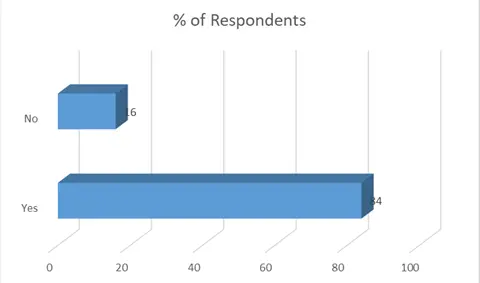
Interpretation: The primary analysis of the data collected from 25 employees it was evaluated that majority of the respondent are having the knowledge relating to the concept of Crew Resource Management. 84% of the participant stated that the effective crew resource management knowledge is present among the employees. it is the latest concept and in case the employees will not be having the appropriate knowledge related to CRM training then the working will be affected. Hence, with the help of the present study it was analysed that majority of the people are having the knowledge relating to the latest concept of CRM training. In support of this Serou et al, (2021) stated that it is the latest trend and need to be present among the employees of Aviation companies so that they can effectively try to manage the air traffic and increase the operational efficiency.
Theme 2: Agree that the company is following the Crew Resource Management for increasing operational efficiency.
|
Particular |
Respondents |
% of Respondents |
|
Strongly agree |
5 |
20 |
|
Agree |
12 |
48 |
|
Neutral |
2 |
8 |
|
Disagree |
4 |
16 |
|
Strongly disagree |
2 |
8 |
|
Total |
25 |
100 |
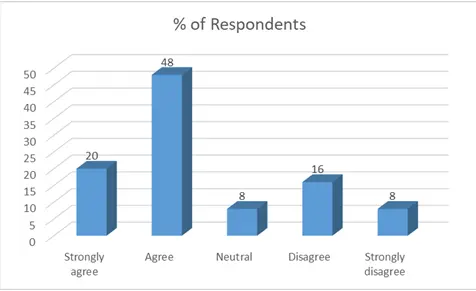
Interpretation: By analysing the data gathered with the help of the primary survey, it was evaluated that 48% of the participants believe that the company is complying with the crew resource management training for working. The current latest trend within the aviation industry is to comply with CRM training, and NATS is effectively complying with this, and the overall efficiency is improved. Some of the respondents strongly agree, and some do not agree with the fact that effective CRM training needs to be implemented. It is particularly necessary because when the appropriate training is implemented then it will improve the working efficiency of the employees. Thus, compliance with effective CRM training will guide the employees to work efficiently, and the overall operational efficiency and safety of the crew employees will increase. In support of this Sikora, Hari and Hanusch, (2020) stated that when the effective type of operational efficiency needs to be improved then it is it responsibility of the crew employee to effectively follow the CRM training sessions so that the overall Air Traffic management and other operations can be improved.
Theme 3: Yes, the implementation of CRM training assists in improving operational efficiency and safety.
|
Particular |
Respondents |
% of Respondents |
|
Yes |
19 |
76 |
|
No |
6 |
24 |
|
Total |
25 |
100 |
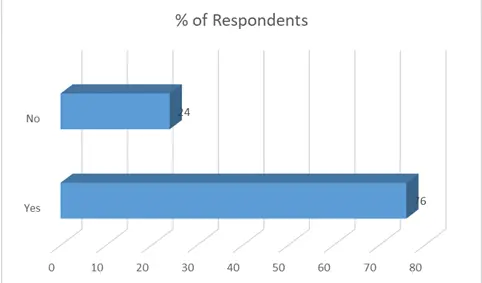
Interpretation: The examination of the data assisted in highlighting the fact that the implementation of the CRM training increases the operational efficiency and safety of the employees. With the appropriate use of the CRM training, the employees are provided with appropriate guidance relating to the working pattern and procedure for managing the air traffic. Hence, it assists in analysing and improving the working capability. When the appropriate training is provided to the employees, then they have in-depth knowledge relating to the overall work, and eventually, the operational efficiency and safety are improved. In support of this Smallwood (2023) contended that when the CRM training is abided then automatically it increases the operational efficiency and safety. It is so because with the help of the correct guidance, the employees work efficiently, and this helps in improving the efficiency of the employees as well.
Theme 4: All of the above are important relating to the implementation of the CRM training.
|
Particular |
Respondents |
% of Respondents |
|
Assist in mitigating errors and mistakes |
5 |
20 |
|
Developing confidence among employees |
4 |
16 |
|
Enhances teamwork and allocation |
5 |
20 |
|
All of the above |
11 |
44 |
|
Total |
25 |
100 |
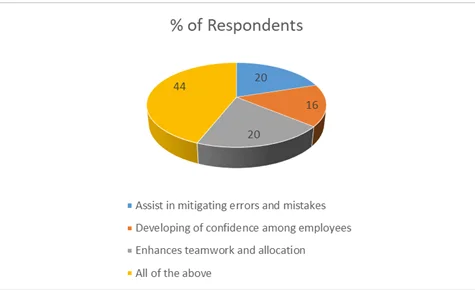
Interpretation: By the examination and evaluation of the data gathered with 25 employees of NATS, it is clear that there is are wide importance of the implementation of CRM training. Out of all, 44% of the respondents stated that all of the above are of major importance in implementing the use of CRM training. Hence, all of the above include the importance of assisting in mitigating the errors, along with developing confidence among the employees and enhancing teamwork and allocation among the employees. Suri (2020) supported that when the effective CRM training is applied, then all these important of enjoyed by the company, and this improves the overall safety and operational efficiency within the Air Traffic management. Hence, when NATS is effectively implementing the CRM training then it improves the working capability of the employee and ultimately provides better guidance for work, and this ultimately improves the overall efficiency of work.
Theme 5: Yes, non-compliance with the CRM can result in creating challenges for managing operational efficiency.
|
Particular |
Respondents |
% of Respondents |
|
Yes |
17 |
68 |
|
No |
8 |
32 |
|
Total |
25 |
100 |
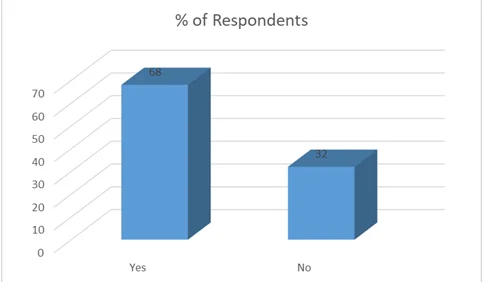
Interpretation: Accordingly to the evaluation of the data gathered from 25 employees, it was found that when the CRM training is not followed, then it results in the development of many different types of challenges. However, when the appropriate type of training is not implemented them it will result in the development of challenges, and the overall efficiency of the employees will reduce. Due to ineffective training, the employees will not have proper knowledge, and as a result of this, operational efficiency will reduce, and ultimately performance of NATS will reduce. Hence, Tang and Zhang (2021) contemplated that effective CRM training is significant for the successful working of the business. With the effective use of CRM training, the employees will be in a position to manage operational safety and efficiency and will reduce air traffic.
Theme 6: All of the above are the various challenges that the company faces due to a lack of CRM training within the operation.
|
Particular |
Respondents |
% of Respondents |
|
Infrastructure issues |
2 |
8 |
|
Disruption relating to weather |
3 |
12 |
|
Lack of skilled personnel |
5 |
20 |
|
Supply chain disruption |
5 |
20 |
|
All of the above |
10 |
40 |
|
Total |
25 |
100 |
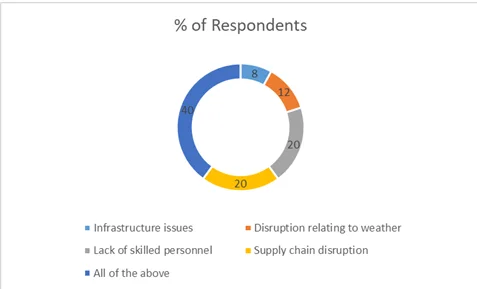
Interpretation: With the examination of the data, it is clear that there are a lot many challenges faced by the company due to ineffective CRM training. As agreed by 40% of the respondents, all of the above are the major issues which are faced by the company faces due to ineffective CRM training. All of the above include various challenges such as disruption due to weather changes, infrastructure issues, lack of skilled personnel within the workforce and supply chain disruption. All these elements affect the working and operational safety of the company (Tooley and Wyatt, 2024). With the examination of the data, it is clear that all these challenges create a negative effect on the working and operational efficiency. Hence, it is the responsibility of NATS they effectively comply with the latest CRM training session so that operational efficiency is improved. When the efficiency is enhanced, then automatically the work will be improved, and this will greatly increase the working capability.
Theme 7: Positive impact is created with the implementation of CRM training within the operational efficiency and management of Air Traffic.
|
Particular |
Respondents |
% of Respondents |
|
Positive |
16 |
64 |
|
Negative |
5 |
20 |
|
No impact |
4 |
16 |
|
Total |
25 |
100 |
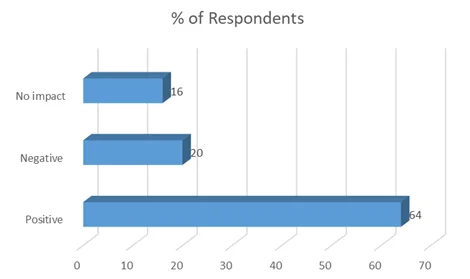
Interpretation: With the examination of the data collected from the 25 employees of NATS it was analyse that majority of them agreed that positive impact is developed on the working of company. Nearly 64% of the respondent stated that positive impact is developed with the help of the appropriate CRM training. For the effective management of the crew it is necessary that the appropriate training is provided. With the help of the correct training the employees are capable of understanding the requirement and ultimately it enhances the overall working (Wadud, 2020). Hence, for the successful working of the company within the aviation industries, it is necessary that the appropriate CRM training is implemented. It is needed because with the help of the correct and appropriate uses of CRM company can effectively manage the working and eventually it enhances the overall safety and operational efficiency.
Theme 8: All of the above includes the interrelationship that is present between both Air Traffic management and CRM training.
|
Particular |
Respondents |
% of Respondents |
|
Improves communication skills |
2 |
8 |
|
Ensures effective safety and efficiency |
3 |
12 |
|
Situational awareness among people |
3 |
12 |
|
Continuous improvement |
5 |
20 |
|
Helpful in managing stress and fatigue among employees |
4 |
16 |
|
All of the above |
8 |
32 |
|
Total |
25 |
100 |
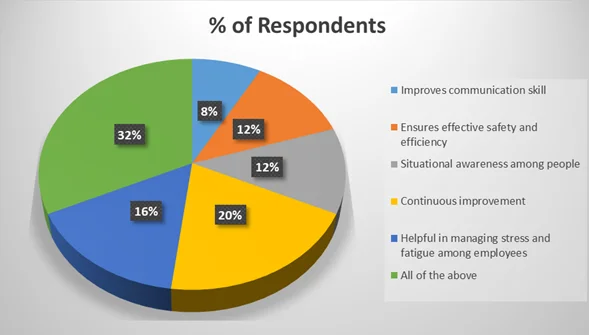
Interpretation: With the examination of the data gathered from 25 employees of NATS, it is evident that the effective implementation of CRM training is helpful in improving air traffic management. Also, when the effective type of CRM training is implemented then it enhances the efficacy of the employees. With the CRM training, the interrelationship with the air traffic management is improved, and it enhances the capability of the company. As agreed by 32% of the respondents, it is clear that all of the above is the frequently answered option. All of the above include various interrelationships that are present between both the variables, which include improving communication skills, ensuring safety and efficiency, improving situational awareness among the people, emphasising continuous improvement and many other different types of benefits (Zhang and Graham, 2020). All these benefits assist the company in improving the working capability, and the management is maintained in a better way. With the compliance with crew resource management training, the employees are having proper guidance relating to their work, and they perform their activities better. In addition to this, all the employees, whether it be a pilot, crew staff or any other type of employee, have the appropriate knowledge relating to the roles and responsibilities. Ultimately, this increases the efficiency of the company, and overall air traffic management is improved. In support of this Maneenop and Kotcharin (2020) stated that with the effective compliance with the CRM training, the company is capable of managing all the issues relating to the air traffic. Ultimately, Air Traffic will be reduced and it will be resulting in a better outcome and, ultimately, sales and efficiency of NATS will increase.
4.2 Discussion
By analysing the findings of the study, it is clear that crew resource management is very necessary for the successful working of the aviation industry. The findings highlighted that crew resource management is defined as the concept which focuses on managing and utilising the resources in such a way that it ensures safe and efficient operations of the flights. In case crew resource management is not effectively implemented within the aviation company, then it can create issues, and resultantly the efficiency is affected. According to the view of Kamper (2020), the appropriate compliance with the CRM training must be undertaken in the business. The appropriate CRM training assists the company in improving the knowledge level of the employees. Hence, employees will be in a position to work effectively, and all the problems within the aircraft will be solved easily. With effective compliance with CRM training procedures, the aviation companies can manage the issues well, and ultimately, the overall capabilities are improved.
In support of this MacLeod (2021) stated that compliance with CRM training there are lot many developments taking place for the employees. The most common type of benefit highlighted with effective compliance with crew resource management is the improvement in communication skills. Communication is the key to any work, and in case it is not appropriate, then it can create issues. The compliance with the communication skill ensures the effective working and, eventually the overall capability is enhanced. This can be done with the help of setting objectives with emphasis on conveying the information to one another. Hence, ultimately in every situation, the employees will be communicating with one another, and all the cases of emergency and incident and accident errors will be solved. Moreover, the crew communication will be assistive in improving the working capability, and the team and overall efficiency will be enhanced. Additionally, the finding also stated that compliance with the correct crew resource management training will assist the company in reducing the challenges of Air Traffic management.
Further, with the help of the appropriate CRM training, situational awareness among the employees will increase. Hence, ultimately, it will create a better environment, and the employees will be in a position to evaluate and analyse the issues and problems of the crew employees easily. It will assist NATS in improving their work, and eventually it will enhance the working capability. Moreover, with the help of the appropriate usage of the CRM training, the employees within the crew will have having wider range of knowledge and ultimately, the employees will be ensuring and working for safety and making the work successful. However, when the effective type of situational analysis is undertaken by the employees, then they will be in a better position to assess the situation and highlight the issues identified under the vigilance. Marrón and Redondo (2023) supported that when effective situational awareness is present among employees then automatically they will be ensure better safety in their work. So it will result in better accomplishment of the objectives, and the efficacy will be improved.
Further, with the help of effective compliance with the CRM training, the findings highlighted that effective compliance with the CRM training improves the team working spirit among the employees. Ultimately, it increases the efficiency of the employees and eventually results in better improvement of the working environment within the aviation company, which is NATS. Hence, with the help of effective CRM training, NATS will be in a position to ensure better working, and ultimately, it will increase the capability of the employees. Hence, any issues and problems within the workplace will be eradicated, and better working practices will be implemented, which will assist in fostering the working capability of employees of NATS.
With further evaluation of the findings, it was analysed that there is a high interrelationship between giving CRM training and the increase in operational efficiency within the management of Air Traffic. The findings highlighted that the different types of interrelationships include improving communication skills, along with focusing on continuous improvement and ensuring better safety and efficiency. When the effective type of CRM training is implemented then it improves the working capability greatly. Hence, Praetorius, Hult and Österman (2020) contemplated that with the effective compliance with the CRM training, the efficiency of the employees can be improved and ultimately it will enhance the work. Further Prineas et al, (2021) stated that when the appropriate type of CRM training is implemented, then it enhances the efficiency of the employees and, the working capabilities are improved. Moreover, with the help of the appropriate CRM training, the motivation level and communication among the employees also increase. Hence, it is the responsibility of the employees of NATS they effectively comply with all the CRM training procedures so that the operational efficiency can be improved. Ultimately, it will help NATS in improving its sales and profitability, and eventually it will improve the market position as well.
Chapter Five: Conclusion And Recommendations
5.1 Conclusion
By the assessment of the whole study, when the appropriate type of CRM training is followed by the employees, it automatically enhances their confidence of working. Hence, employees are in a position to work efficiently and effectively in any situation. Also, when the effective type of the CRM training procedures is selected, it increases the interest of the employees in the company. Further, the methodology section highlighted that the compliance with a qualitative study is beneficial because it increases the collection of data from wider sources.
Thus, it provides a large amount of data, and it ensures that the appropriate type of data is collected from the primary and secondary sources. Moreover, the findings highlighted that there are different challenges which the NATS can face while not following the CRM Training. It includes different challenges like issues with the infrastructure, lack of skills among the employees and many other kinds of challenges. But when the effective implementation is made relating to the CRM training, then it ensures that the appropriate work is managed, and ultimately, it increases the working capability of the companies. The businesses can manage the Air Traffic management, and as a result of this efficiency of the aviation company increases and enhances. Moreover, appropriate CRM training has different positive impacts, which are created on operational efficiency and ensuring safety and efficiency within operational activities. Hence, with the effective use of CRM training, the employees and NATS can work efficiently, and ultimately, it assists them in improving and attaining the objectives of the business.
5.2 Recommendation
With the assessment of the above study, it is clear that the implementation of CRM training is very necessary and helpful for the company to run successfully. Thus, some of the recommendations for NATS for improving the implementation of CRM training are as follows-
- It is advisable to NATS that they must ensure that a good and strong safety culture is implemented while working. However, with the use of CRM training the compliance with good culture is very necessary. Effective culture within the workplace is effective, and proper leadership support is provided to the Employees, then they will be in a better position to implement the CRM training procedure (Sikora, Hari and Hanusch, 2020). So it is the responsibility of NATS they appropriately implement a good culture so that the employees are happy and satisfied while working at NATS.
- Additionally, it is also suggested to NATS that they must integrate the CRM into all the other operational activities as well. When the CRM training is integrated with the other frameworks and departments, then the operational capability of NATS will be improved. Hence, the CRM must also be integrated into the safety management system along with the operational manual and the line-oriented flight training. Nevertheless, when all these elements are implemented, then as a result of this, overall efficiency will be improved, and it will enhance and improve the operational efficiency.
- Similarly, it is also advisable to NATS that they must also focus on improving the skills of the employees. Hence, for this, different training sessions must be provided to the employees so that they can increase and enhance their skills and which will assist in effective improvement in the use of CRM training sessions (Smallwood, 2023). Hence, for this, it is the responsibility of NATS that they must frequently conduct the appropriate feedback sessions with the employees to understand whether they learning this training or not.
- Moreover, it is also suggested that the company must continuously have intense market research as well. It is needed because within the external environment, changes there frequent changes are taking place, and if a case track of these changes is not made, then it can affect the work (Praetorius, Hult and Österman, 2020). The NATS must be responsible for undertaking the use of all the recent trends by researching the market.
5.3 Limitation
With the evaluation of the current study, it was highlighted that a major limitation faced by the study was relating to the fact that no quantitative analysis was undertaken in the current study. For the assessment of the use of CRM training, the quantitative analysis related to the facts and figures can be implemented in the study. But the present study has not included any such study, and because of this, it might not provide accurate type of data (Taherdoost, 2022). This is the major limitation, and to improve it in future, it is recommended that the research must effectively comply with the quantitative analysis as well. The quantitative analysis will help the scholar in identifying the concrete findings, and it will be more scientific and effective
5.4 Reflection
With the help of the current study, I found that having in-depth knowledge of the research topic is very necessary for making the study successful. With a good level of knowledge, I can easily work on the current topic, and eventually it will help me in attaining my objectives well. With the current study, I learnt that having communication skills is the most needed aspect for the researcher. I was able to recruit research participants at the time of collecting the data. The communication has assisted me in improving my working ability in collecting the data. With the effective gathering of the data, I was able to develop knowledge about the findings (Sikora, Hari and Hanusch, 2020). Moreover, the current study assisted me in analysing that in future I need to work on teamwork. While working on this project, I met several instances where I was not comfortable working with others. Hence, as a result of this conflict increased and the attainment of the objective was delayed. Also, for future work, I must be able to improve my teamwork skills so that coordination is improved and better group activity outcomes can be attained.
References
Books and Journals
Aguas, P.P., 2022. Fusing approaches in educational research: Data collection and data analysis in phenomenological research. The Qualitative Report, 27(1), pp.1-20.
Alhawsawi, A. and Macedo, M.S., 2024. Implementing Crew Resources Management Principles to Improve Perioperative Safety. In Principles of Perioperative Safety and Efficiency (pp. 251-268). Cham: Springer International Publishing.
Ant, M., 2024. Klassisches Crew Resource Management (CRM). In Effizientes Crew Resource Management: Der Faktor Mensch im Unternehmen (pp. 43-66). Wiesbaden: Springer Fachmedien Wiesbaden.
Ashcroft, J., Wilkinson, A. and Khan, M., 2021. A systematic review of trauma crew resource management training: what can the United States and the United Kingdom learn from each other?. Journal of Surgical Education, 78(1), pp.245-264.
Badrinath, S. and Balakrishnan, H., 2022. Automatic speech recognition for air traffic control communications. Transportation research record, 2676(1), pp.798-810.
Callanan, M. and Loughlin, J., 2021. A thematic approach to the research agenda for regional and local government. A Research Agenda for Regional and Local Government, pp.1-18.
Dawadi, S., 2020. Thematic analysis approach: A step by step guide for ELT research practitioners. Journal of NELTA, 25(1-2), pp.62-71.
De Andreis, F., Comite, U., Sottoriva, F.M. and Cova, I., 2022, October. Human resources management and training in aviation. In International Conference on Reliability and Statistics in Transportation and Communication (pp. 510-522). Cham: Springer International Publishing.
De Oliveira, B., 2023. Participatory action research as a research approach: Advantages, limitations and criticisms. Qualitative Research Journal, 23(3), pp.287-297.
Du, Y. and Zhu, S., 2022. Analysis of CRM training in the commercial pilot license training stage for student pilots- Taking L3 Flight Training School as an example. Frontiers in Educational Research, 5(3), pp.18-24.
Griffioen, J., van der Drift, M. and van den Broek, H., 2021. Enhancing maritime crew resource management training by applying resilience engineering: A case study of the Bachelor Maritime Officer Training Programme in Rotterdam. Education Sciences, 11(8), p.378.
Haji Amiri, M., Kuşakcı, S. and Güngör, H., 2025. Significance of Leadership Styles on Crew Resource Management and Aircraft Accidents. Journal of Air Transportation, pp.1-14.
Harris, D., Mansikka, H. and Virtanen, K., 2021. The relationship between the dynamic model of crew resource management and line operational safety audits. International journal of human factors and ergonomics, 8(4), pp.319-330.
Jiang, W., Han, W., Zhou, J. and Huang, Z., 2020. Analysis of human factors relationship in hazardous chemical storage accidents. International journal of environmental research and public health, 17(17), p.6217.
Kamper, S.J., 2020. Types of research questions: descriptive, predictive, or causal. Journal of Orthopaedic & Sports Physical Therapy, 50(8), pp.468-469.
Karaarslan, E. and Erkmen, T., 2021. The impact of the COVID-19 pandemic on Crew Resource Management (CRM) attitudes: A comparison between cabin crews’ attitudes before COVID-19 and during the COVID-19 pandemic. Business & Management Studies: An International Journal, 9(2), pp.472-485.
Kaynak, Ö.M., 2024. Hava Yollarında Ekip Kaynak Yönetimi (CRM) Eğitimleri ve Örgütsel Emniyet İkliminin Kabin Ekibinin Emniyet Tutumu ve Davranışına Etkisi. Human Factors in Aviation and Aerospace, 1(2), pp.119-147.
Lin, Y., 2021. Spoken instruction understanding in air traffic control: Challenge, technique, and application. Aerospace, 8(3), p.65.
MacLeod, N., 2021. Crew resource management training: A competence-based approach for airline pilots. CRC Press.
MacLeod, N., 2021. Crew resource management training: A competence-based approach for airline pilots. CRC Press.
Maneenop, S. and Kotcharin, S., 2020. The impacts of COVID-19 on the global airline industry: An event study approach. Journal of air transport management, 89, p.101920.
Marrón, D.M. and Redondo, P.S., 2023. CRM: Development of Pending Critical Aspects. Papeles del Psicólogo, 44(3), pp.156-163.
Marrón, D.M. and Redondo, P.S., 2023. CRM: Development of Pending Critical Aspects. Papeles del Psicólogo, 44(3), pp.156-163.
Morris, P.J., 2021. The history of chemical laboratories: a thematic approach. ChemTexts, 7(3), p.21.
Mulisa, F., 2022. When Does a Researcher Choose a Quantitative, Qualitative, or Mixed Research Approach?. Interchange, 53(1), pp.113-131.
Muñoz-Marrón, D. and Segura-Redondo, P., 2023. CRM: desarrollo de Aspectos Críticos Pendientes. Papeles del Psicólogo, 44(3), pp.156-163.
Peel, K.L., 2020. A beginner’s guide to applied educational research using thematic analysis. Practical Assessment Research and Evaluation, 25(1).
Praetorius, G., Hult, C. and Österman, C., 2020. Maritime resource management: current training approaches and potential improvements. TransNav, International Journal on Marine Navigation and Safety of Sea Transportation, 14(3), pp.573-584.
Prineas, S., Mosier, K., Mirko, C. and Guicciardi, S., 2021. Non-technical skills in healthcare. Textbook of patient safety and clinical risk management, pp.413-434.
Samunderu, E., 2024. Challenges and Complexities Affecting African Air Transport Market Development: A Skills, Competency, and Capacity-Building Perspective. In The Economic Effects of Air Transport Market Liberalisation: A Perspective Analysis of the Single African Air Transport Market (SAATM) (pp. 499-639). Cham: Springer Nature Switzerland.
Serou, N., Sahota, L.M., Husband, A.K., Forrest, S.P., Slight, R.D. and Slight, S.P., 2021. Learning from safety incidents in high-reliability organizations: a systematic review of learning tools that could be adapted and used in healthcare. International Journal for Quality in Health Care, 33(1), p.mzab046.
Sikora, I., Hari, B.L. and Hanusch, M., 2020. Human factors approaches and models in LOC-I accident analysis and prevention: Flight crew resource management techniques as a risk mitigation tool. International Journal of Safety and Security Engineering, 10(3), pp.301-310.
Smallwood, T., 2023. The airline training pilot. Routledge.
Suri, H., 2020. Ethical considerations of conducting systematic reviews in educational research. Systematic reviews in educational research: Methodology, perspectives and application, pp.41-54.
Taherdoost, H., 2022. What are different research approaches? Comprehensive Review of Qualitative, quantitative, and mixed method research, their applications, types, and limitations. Journal of Management Science & Engineering Research, 5(1), pp.53-63.
Tang, L. and Zhang, P., 2021. Human resource management in shipping: Issues, challenges, and solutions. Routledge.
Terzioğlu, M., 2024. The effects of crew resource management on flight safety culture: corporate crew resource management (CRM 7.0). The Aeronautical Journal, 128(1326), pp.1743-1766.
Tooley, M. and Wyatt, D., 2024. Aircraft communications and navigation systems. Routledge.
Wadud, Z., 2020. An examination of the effects of ride-hailing services on airport parking demand. Journal of Air Transport Management, 84, p.101783.
Wen, X., Sun, X., Sun, Y. and Yue, X., 2021. Airline crew scheduling: Models and algorithms. Transportation research part E: logistics and transportation review, 149, p.102304.
Xu, W. and Zammit, K., 2020. Applying thematic analysis to education: A hybrid approach to interpreting data in practitioner research. International journal of qualitative methods, 19, p.1609406920918810.
Yoo, J.H., Jeon, S.J. and Shin, R.H., 2025. Impact of CRM on Trust and Conflict Between Civil Aviation Pilots and Cabin Crew. The International Journal of Aerospace Psychology, pp.1-14.
Zhang, F. and Graham, D.J., 2020. Air transport and economic growth: a review of the impact mechanism and causal relationships. Transport Reviews, 40(4), pp.506-528.
Online
- Air accident investigation Branch. 2025. Online. Available through: < https://www.gov.uk/government/organisations/air-accidents-investigation-branch>
Crew Resource Management (CRM). 2025. Online. Available through: <https://skybrary.aero/articles/crew-resource-management-crm>
- Description of National Air Traffic services. Online. Available through: < https://www.nats.aero/ >
- Regulator published report on NATS Technical Failure. Online. Available through: < https://www.airtraffictechnologyinternational.com/content/news/regulator-publishes-final-report-on-nats-technical-failure/#:~:text=The%20UK's%20aviation%20regulator%20has,period%20on%20August%2028%2C%202023. >
Go Through the Best and FREE Samples Written by Our Academic Experts!
Native Assignment Help. (2026). Retrieved from:
https://www.nativeassignmenthelp.co.uk/the-impact-of-crm-training-on-air-traffic-management-at-nats-assignment-50435
Native Assignment Help, (2026),
https://www.nativeassignmenthelp.co.uk/the-impact-of-crm-training-on-air-traffic-management-at-nats-assignment-50435
Native Assignment Help (2026) [Online]. Retrieved from:
https://www.nativeassignmenthelp.co.uk/the-impact-of-crm-training-on-air-traffic-management-at-nats-assignment-50435
Native Assignment Help. (Native Assignment Help, 2026)
https://www.nativeassignmenthelp.co.uk/the-impact-of-crm-training-on-air-traffic-management-at-nats-assignment-50435
- FreeDownload - 40 TimesCSR and market value a case study of Starbucks
CSR and market value, a case study of Starbucks 1. Research Proposal 1.1...View or download
- FreeDownload - 43 TimesUK Media Coverage Dissertation
How Does UK Media Coverage Of International Students' Migration Compare To That...View or download
- FreeDownload - 40 TimesProject Management Assignment Sample
Project Management Introduction - Project Management Supply and...View or download
- FreeDownload - 38 TimesDeveloping Operational Management Skills For Health Care Practice
Developing Operational Management Skills For Health Care Practice M1:...View or download
- FreeDownload - 40 Timesfinancial modelling Assignment Sample
Financial Modelling Assignment Solution Introduction- Financial Modelling...View or download
- FreeDownload - 39 TimesCustomer Due Diligence in AML Compliance Framework Assignment Sample
Question 1 Introduction:Customer Due Diligence - Key to Fighting Financial...View or download
-
100% Confidential
Your personal details and order information are kept completely private with our strict confidentiality policy.
-
On-Time Delivery
Receive your assignment exactly within the promised deadline—no delays, ever.
-
Native British Writers
Get your work crafted by highly-skilled native UK writers with strong academic expertise.
-
A+ Quality Assignments
We deliver top-notch, well-researched, and perfectly structured assignments to help you secure the highest grades.