
- Task 1 Business Report
- AC1.1 Describe diverse sources of finance within differential organization
- AC 1.2 Evaluate benefit & cost of different source of finance
- AC 1.3 Compare different source of finance for specific project
- 1 D1 Analysis strategic implication of selecting diverse source of finance
- Task-2 Detailed Notes
- AC 2.1 Compare financial statement of different type of organization
- AC 2.2 Interpretation of Amazon’s financial statement
- 2 M1 Ethical needs & stakeholder responsibility within third sector organization
- 2 D1 Assessment of diverse measures by which organization accomplishing needs of diverse stakeholder
Task 1 Business Report
AC1.1 Describe diverse sources of finance within differential organization
Each organization requires adequate amount of finance for undertaking all the activities & attaining goals successfully. There is differential sources form which organization raises required finance which as follows:
Internal source: It implies for all the funds that are raised from business operations without creating any type of liabilities (Ahmed et al, 2022). Internal sources of finance consist of firm’s profits, retained earnings, ownership, saving and all the income generated by selling out the assets. Sole trader, partnership and third sector organization usually use this type of sources.
External sources: This refers to the funds that are received from outside the business entity. These types of funds are raised after diluting the power or creating huge amount of legal obligations. Venture capitalist, family & friends, overdrafts, bank loans, trade credit, new partner, hire purchase and leasing are the diverse sources of finance. This source of finance is used by the partnership firm, companies and sole traders.
Short term sources: It comprises of all the funds that is raising by the firm for the shorter time period mainly, one year or less (Sanz and Zhu, 2021). These types of finance are raised for managing day to day operation or fulfilling the working capital needs of the company. Trade credit, commercial paper, line of credit, bank overdraft and factoring are the diverse short term source of finance. Along with this, sole trader and partnerships organization utilize this type of funds.
Medium term source: It includes raising finance for the period of less than five years. Leasing, commercial mortgage, venture capitalist, Hire purchase and bank loans are the various sources through which medium term loans are raised. Third sector organization, private limited company and partnership firm uses this type of finance.
Long term source: This consists of all financial instruments that are redeemed after five years (Tao et al, 2022). There are various sources of long term sources which consist of bank loans, bonds, shares and debentures. Public and private limited organization usually utilises this sources to finance their business operations.
Understanding financial management concepts can sometimes be challenging, especially when preparing academic reports. Students looking for additional guidance can explore Assignment Help from Native Assignment Help to find useful resources, improve their understanding and approach their coursework with greater confidence.
AC 1.2 Evaluate benefit & cost of different source of finance
An organization utilizes all the cost & benefit of different finance sources before taking final decision which are as follows:
Internal source: Reserves, saving, owner capital & sales of asset are the diverse types of internal financing. There is a huge similarity in all the sources as it could be raised without any developing any type of obligations & penalties (Rao, 2023). However, organization needs to pay tax on sales of assets which is not required in reserve & surplus.
External source: Trade create, loan from friend & families, venture capital and overdrafts are the different external sources for raining the funds. These types of funds develop some type of interest obligations which negatively impacts the profits. On the other hand, some funds could be raised without diluting control & power such as shares.
Short term finance: Bill discounting, commercial paper, credit line, invoice financing are diverse sources form raining short term funds (Lv et al, 2021). All these financing sources aids in fulfilling the working capital needs and manages day to day operation. However, there is a difference in the interest rate on all such sources.
Medium term funds: Venture capital, Angel investors, bank loan and trade credit are different sources to raise medium term finance. All these funds create huge amount of obligation and dilute overall control of entrepreneur.
Long term finance: This type of fund could be raised from debenture, equity share and preference shares. In this line, some of long term sources create obligation whereas other sustain ownership. However, such funds could be raised at discounted rate and redeemed after 5 years.
Advantages & disadvantages of sources of finance
Below are various advantages & disadvantages the sources of finance:
- A) Internal finance:
Advantages:
- These funds could be raised without any interest obligations and fees which in turn reduces the overall cost.
- Further this source does not dilute ownership and control of entrepreneurs which facilitates quick decision making (Liu et al, 2023).
Disadvantages
- This finance sources does not offer access to huge amount of funds which ends up losing significant growth opportunity.
- It also reduces the liquidity position and earnings which creates dissatisfaction among the lenders.
- B) External source:
Advantages:
- External sources offer access to the huge amount of capital that aids in gaining higher growth & development opportunity (Miao et al, 2022).
- This type of funds could be raised from the diverse sources which mitigates the risk and boosts return.
Disadvantages
- External sources majorly develop huge amount of interest cost and obligation for business entity.
- Further, there is a huge scope of diluting ownership & control which impacts the decision making efficiency.
- C) Short term finance:
Advantages:
- There is a low application and formality for sourcing these funds and thereby enhances accessibility (Li and Umair, 2023).
- Short term funds offer quick access to fund and supports in fulfilling the urgent financial needs.
Disadvantages
- It includes huge amount of interest rate which reduces overall profitability of the business entity.
- Further, this source offers limited amount of funds which creates issue in undertaking all growth opportunity.
- D) Medium term funds:
Advantages:
- Medium term funds could be used for the diverse reason that is acquisition of assets to fulfil the working capital needs as it promotes flexibility (Li et al, 2022).
- This fund does not create long term obligation and support in undertaking expansion opportunity.
Disadvantages
- Medium term loan impacts the firm’s cash flow as it includes high and regular interest payments.
- There is a higher risk of repossession due to default in interest payment which impact on overall repossession (Hasan, Le and Hoque, 2021).
- E) Long term finance:
Advantages
- This type of funds could be used to finance long term growth opportunity & thereby contributes in managing the long term stability.
- Long term finances aids in managing overall flexibility and offers better repayment options that manages overall cost.
Disadvantages
- There is a huge risk of losing collateral and assets that influences net worth of organization (Jackson, 2022).
- There is huge amount of internal liability and strict terms & condition in raising such funds.
Judgment:
After critically analysing all the sources of finance, it has identified that internal sources of finance should be opt by organization as it manages overall cost. However, If an organization is focusing over expansion then long term finances source should be selected as it includes better repayment term and mange credibility.
AC 1.3 Compare different source of finance for specific project
| Source of Finance | Meaning | Type of Source | Applicability | Benefit | Drawbacks |
|---|---|---|---|---|---|
|
Savings |
It includes portion of profit which is set asides without any specific reason. |
Internal source of Finance |
Sole Trader, Private & public company |
It aids in facing uncertainties and fulfilling financial needs at no cost. |
It is difficult to fulfill all funds requirement through savings. |
|
Reserves |
It includes all the funds that are saved for the particular purpose (Sanad and Al-Sartawi, 2021). |
Internal finance |
PLC, sole proprietor, Partnership & Non- profit organization. |
This method aids in easily managing all uncertainties by offering timely payment. |
This reserve reduces organization’s profit and thereby losing growth opportunities. |
|
Overdraft |
This allows organization to spend more than balance in bank accounts. |
Short term source of finance |
Company, Sole trader and partnership firm. |
This helps in managing firm reputation through timely payment to suppliers and creditors. |
This consists of high amount of interest obligation (Mandal and S, 2025). |
|
Loan |
It includes all the funds that are raised from financial institution, bank and other lenders which create interest liability (Liu et al, 2023). |
External financing |
Public & private limited company, Sole traders & partnership. |
Loan repayment time could be extended by regular paying out interest. |
It reduces the firm’s cash flow as it includes huge interest liabilities. |
|
Mortgage |
It is the type of funding which could be raised after engaging some type of assets and investment. |
External |
Partnership & sole trader. |
These funds are raised with comparatively lower interest rate than others (Achakzai and Peng, 2023). |
It creates huge charge on assets and includes huge amount of initial cost. |
|
Credit card |
It is piece of metal issued by financial services & banks that aids in making payment without cash (Squire, 2022). |
External |
Private & public organization partnership & sole traders. |
It aids in timely making all payment and undertaking available opportunity. |
It increases scope of unwanted expenses and create huge impact on financial position. |
|
Trade credit |
Under this, trading is initialed without use of any cash & cheque. |
External & Medium term source |
All type of company, Sole proprietor and partnership |
It aids in in managing inventory level while enhancing overall cash flow (AlMarr. and Elayah, 2024). |
This give rise to over trading that enhances firm’s overall risk. |
|
Venture capital |
It is type of private equity which is used to finance startups with high growth potentials (Calvert, 2025). |
External & Medium term source of finance |
Private limited and partnerships company. |
This source of finance fulfils initial level funding requirement of start-ups and also provides necessary expertise & guidance. |
Venture capitalists reduce overall control of entrepreneur. |
|
Share issues |
It is equity financing in which firm raises fund by offering the ownership & control. |
External & Long term source |
Public Limited company |
It aids in raising funds without creating any obligation. |
This funds source dilutes control & ownership. |
|
Crowd funding |
It is finance source in which funds get raised from numerous people which are accumulated to finance operations. |
External |
All type of organization |
It act as free marketing and does not include any type of upfront cost and expenses (Маріуш, 2022). |
This finance sources require huge amount of regulatory and paperwork and impact on overall equity. |
|
Bond issues |
It is the debt instrument that requires borrower to pay regular interest. |
External & long term source of finance |
Public & private limited companies. |
It aids in fulfilling funds requirement without diluting control & ownership. |
During economic downturn, most of firm’s profits are used to pay fixed interest obligation which influences growth and stability. |
1 D1 Analysis strategic implication of selecting diverse source of finance
Following are various implication & advantages & disadvantages of sources of finance:
| Sources | Implication | Benefit | Drawbacks |
|---|---|---|---|
|
Internal |
Used at time of uncertainties |
No division of ownership No legal obligation |
Lack of sufficient resources Slower growth |
|
External |
Managing cash flow and fulfilling obligations (Davis, 2025) |
Huge funds accessibility Boosts growth |
Reduces ownership Creates High interest obligation |
|
Short term |
Accomplishing working capital needs |
High accessibility Managing urgency |
High interest Develop repayment liability |
|
Medium term |
Used for growth and acquiring assets |
Offers huge amount of funds Provides expansion opportunity |
Risk of repossession High interest obligation (Droege, Raggi and Ramos, 2021) |
|
Long term |
Expansion |
Aids in growth Risk of collateral defaults |
Dilute control Increase fixed obligations |
Conclusion:
By summing up chapter, it has been identified those there diverse sources of finance which sustain different cost & benefit of organization. Among all the financial sources, internal funds should be used that did not reduce control, manage ownership and aids overall growth.
Task-2 Detailed Notes
AC 2.1 Compare financial statement of different type of organization
Sole trader, partnership, public & private limited company, third sector entity is various different type of organization which develops differential financial statement that are defined as below:
- Sole Trader: P&L statement & balance sheet are two different financial statements which developed by the sole proprietor. There is no specific P&L format for sole proprietorship because which of net and gross profits are represent separately. Along with this, it defines all the revenue and expenses over the specific time period (Mehmood et al, 2022). Moreover, balance sheet is also prepared that includes total liability and assets of the organization based on which future decision are taken. Moreover, there is no difference in Sole trade and business entity due to which statements define overall net worth of owners.
- Partnership: This type of the firm majorly formulates P&L appropriation accounts, income statement and Statement of financial position. P&L appropriation account aids in distributing total net divisible profits among all the partners according to their share in profit. Moreover, Balance sheet includes information related to firm’s assets and liability and also indicted accumulated capital (Karki, Bennett and Mishra, 2021). In addition to this, P&L statement indicate total expenses, revenue, profit & loss over a specific time period which define growth potential of organization.
- Private limited Companies: External audits, P&L statement, cash flow statement, shareholder equity, notes to finance and balance sheet are six different type of financial statement that are created by private limited organization while following strict regulations. In this external audit statement includes information related to tax filling and MOA. Cash Flow Statement define total cash inflow and outflow of the organization based on which expansion decision are initiated.
- Public limited company: The entire PLC is involved towards creating similar type organization as Private limited company. However, this statement includes more in-depth and complex information as large number of general public are interested in firm’s profitability and operations (Deshpande and Sharp, 2022). In addition to this, Plc has offered a public discloser statement which includes all the information related to firm’s regulation and other materialistic data which promotes transparency.
- Third sector organization: Cash flow statement, balance sheet, statement of activity and functional expenses are four distinct type of statement which prepared by the third sector organization. These statements are prepared with the aim of clarifying the manner in which organization is utilized public funds. These statements are prepared with the aim of gaining pubic trust and festering overall transparency. In this, all information related to inflow and outflow of donation are clearly disclosed to all people.
AC 2.2 Interpretation of Amazon’s financial statement
Amazon’s description:
Amazon is public limited multinational organization of America which involved towards cloud computing, e-commerce, artificial intelligences, online advertisings and digital streamlining. The organization was established in the year of 1994 by Jeff Bezos with the aim of establishing customer-centric organization (About US/ Amazon, 2024). The firm is earning annual revenue of 637.9 million pound and offers an employees opportunity to more than 1556000 workers worldwide.
Amazon’s financial statement
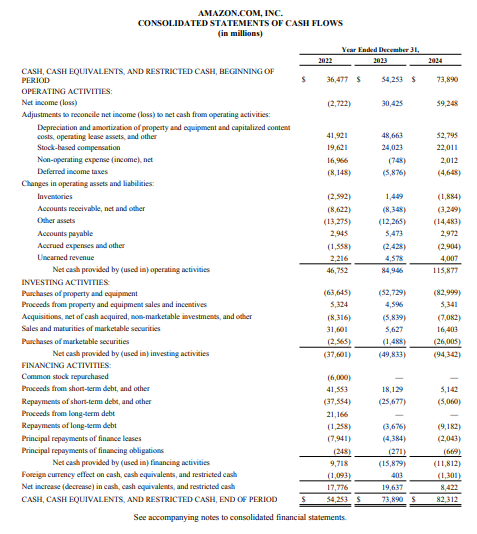
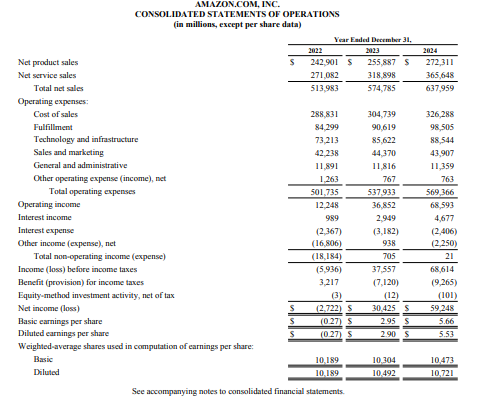
(Source: Amazon 2024 Annual report, 2025)
From the above statement, it has identified that organization is earning adequate amount of profits which ads in managing long term stability within industry. It has ascertained that firm’s cash balances are increasing over year indicating efficiency in paying out all the expenses and liability on timely basis (Perobelli, Cappellaro and Saporito, 2024). This situation indicates firm’s ability in facing all the uncertainties which ultimately enhances creditors’ trust.
Ratio analysis of Amazon for ear ended 2023 and 2024
|
Particulars |
Year |
|
|
PROFITABILITY RATIO |
||
|
2024 |
2023 |
|
|
GP ratio |
49% |
47% |
|
NP ratio |
9% |
5% |
|
LIQUIDITY RATIO ANALYSIS |
||
|
Current ratio |
1.06 |
1.05 |
|
Quick ratio |
0.87 |
0.81 |
|
SOLVENCY RATIO ANALYSIS |
||
|
Debt-equity ratio |
0.21 |
0.32 |
|
Debt to asset ratio |
0.10 |
0.12 |
|
EFFICIENCY RATIO ANALYSIS |
||
|
Stock turnover ratio (In times) |
8.58 |
9.00 |
|
Receivables or debtors turnover ratio (in days) |
34.73 |
29.44 |
Profitability: From the above analysis, it has identified that firm’s GP and NP ratio is increasing by 2% and 4% respectively indicating high growth potential of organization. This also denotes that firm is able to satisfy customer’s needs which ends up boosting overall sales and profits. In order to enhance overall profits, Amazon should build customer loyalty which increases their spending frequency and overall sales (Chakraborty et al, 2023). Moreover, organization should lay emphasis over up sell that aids in attaining the economies of scale and thereby reduces overall cost and expenses.
Liquidity: The above evaluation defines that Amazon’s liquidity position is increasing over the year’s that aids in timely paying out all bills & liabilities. However, firm is unable to attain ideal current & quick ratio which develops issue in managing liquidity position in upcoming time. In order to overcome this issue, organization accelerates receivables that enhance cash inflow. Furthermore, Amazon should delay all the capital purchase as it reduces cash in hand and thereby impact on liquidity position (Haralayya, 2021). Along with this, robust inventory management system should be adopted that reduces the scope of over stocking which facilitates towards managing quick ratio.
Solvency: It has been identified that Amazon has reduced debt in its capital structure which aids in managing overall risk of the business entity. However, Amazon should introduced some extent of debt that aids in gaining tax benefits which enhances shareholder’ earning (Wang et al, 2023). Further, firm has reduced debt investment towards assets that manages overall risk and boost solvency position.
Efficiency: There is reduction in demand for Amazon’s inventory turnover which indicates lower demand for organization product &services. In order to manage this situation, firm should optimize marketing strategy that creates awareness within wider market and boost sales. Moreover, organization should adapt strict policy for debtor receivable that assists in managing cash flow and overall efficiency.
2 M1 Ethical needs & stakeholder responsibility within third sector organization
- Short, medium & long terms are three differential size of third sector organizations. Following is the in-depth information related to ethical and corporate responsibility of each type of organization:
- Active Humber:
- This organization is offering sport resources to under privileged children that boost overall sport activity within country. The firm is involved towards preparing financial statement as to gain trust of all members by defining the manner in which donation are utilized (Jaibumrung et al, 2023).
- Global learning
- The firm is aiming at offering advances educational opportunity that promoters their growth & development. Financial statement promotes transparency by defining manner in which all public funds are utilised for others welfare.
- Save the children:
- This organization focus over intellectual, physical and mental well being of children. The firm prepare financial statement as to promote ethnicity by disclosing materialistic information related to their operations.
2 D1 Assessment of diverse measures by which organization accomplishing needs of diverse stakeholder
There are large number of institution and people that are interested in determining overall performance & financial position of Amazon. Financial statement plays a significant role in fulfilling all such needs which are described are as follows:
|
Stakeholder |
Role |
|
Customers |
Financial statement defines firm’s ability to fulfil its promises and obligations in long run based on which purchases decision is initiated (Bontempo et al, 2023). Amazon is earning sufficient profits which indicate firm’s efficiency in offering services for longer time frame. |
|
Employees |
This statement indicates organization’s ability to offer promotions and higher wages and salary in upcoming time. This aids employees in identifying their growth opportunity based on which retention decision are taken. |
|
Shareholder |
Financial statement defines overall profits of firm that clearly define growth and development potential (Treewaree, Lip and Krittayaphong, 2024). These ads in shareholder in identifying their returns which enhances satisfaction. |
|
Suppliers |
They are interest to explore overall liquidity position of firm based on which future credit decisions are taken (Tsiouni et al, 2023). |
|
Creditors |
Financial statements define total assets and labiality of organization which contributes towards determining firm’s ability in paying out all expenses (Sutrismi et al, 2024). This information assures creditors regarding their payment and eventually influences their overall relationship. |
References
Books and Journals
Ahmed, S., Alshater, M.M., El Ammari, A. and Hammami, H., 2022. Artificial intelligence and machine learning in finance: A bibliometric review. Research in International Business and Finance, 61, p.101646.
Tao, H., Zhuang, S., Xue, R., Cao, W., Tian, J. and Shan, Y., 2022. Environmental finance: an interdisciplinary review. Technological Forecasting and Social Change, 179, p.121639.
Rao, P., Kumar, S., Chavan, M. and Lim, W.M., 2023. A systematic literature review on SME financing: Trends and future directions. Journal of Small Business Management, 61(3), pp.1247-1277.
Lv, C., Bian, B., Lee, C.C. and He, Z., 2021. Regional gap and the trend of green finance development in China. Energy Economics, 102, p.105476.
Liu, X.Y., Wang, G., Yang, H. and Zha, D., 2023. Fingpt: Democratizing internet-scale data for financial large language models. arXiv preprint arXiv:2307.10485.
Miao, Y., Razzaq, A., Adebayo, T.S. and Awosusi, A.A., 2022. Do renewable energy consumption and financial globalisation contribute to ecological sustainability in newly industrialized countries?. Renewable Energy, 187, pp.688-697.
Li, C. and Umair, M., 2023. Does green finance development goals affects renewable energy in China. Renewable Energy, 203, pp.898-905.
Li, Z., Kuo, T.H., Siao-Yun, W. and Vinh, L.T., 2022. Role of green finance, volatility and risk in promoting the investments in Renewable Energy Resources in the post-covid-19. Resources Policy, 76, p.102563.
Hasan, M., Le, T. and Hoque, A., 2021. How does financial literacy impact on inclusive finance?. Financial innovation, 7(1), p.40.
Jackson, A.B., 2022. Financial statement analysis: a review and current issues. China Finance Review International, 12(1), pp.1-19.
Mandal, A. and S, A., 2025. Preventing financial statement fraud in the corporate sector: insights from auditors. Journal of Financial Reporting and Accounting, 23(1), pp.56-80.
Liu, C., Ryan, D., Lin, G. and Xu, C., 2023. No rose without a thorn: Corporate teamwork culture and financial statement misconduct. Journal of Behavioral and Experimental Finance, 37, p.100786.
Achakzai, M.A.K. and Peng, J., 2023. Detecting financial statement fraud using dynamic ensemble machine learning. International Review of Financial Analysis, 89, p.102827.
Squire, R., 2022. Third Sector Organisations: Multilevel Enactors of Widening Participation. In The Business of Widening Participation: Policy, Practice and Culture (pp. 101-122). Emerald Publishing Limited.
AlMarri, A. and Elayah, M., 2024. Financial sustainability of Qatar's third sector through direct public investment. Hikama, (8), pp.99-125.
Calvert, D., 2025. Supporting migrant inclusion: the role of linguistic diversity in community-led organisations. Journal of Ethnic and Migration Studies, 51(3), pp.547-564.
Маріуш, В., 2022. The Role of Non-Governmental Organisations in Public Services Delivery at the Local Level–the Case of Poland. Історико-політичні проблеми сучасного світу, (45), pp.176-185.
Davis, M., 2025. The Structure of the Organisation. In Third Sector Organisations, Asylum Seekers and Refugees: Support During Covid-19 and Post-Pandemic (pp. 19-27). Cham: Springer Nature Switzerland.
Droege, H., Raggi, A. and Ramos, T.B., 2021. Co‐development of a framework for circular economy assessment in organisations: Learnings from the public sector. Corporate Social Responsibility and Environmental Management, 28(6), pp.1715-1729.
Mehmood, K., Jabeen, F., Iftikhar, Y., Yan, M., Khan, A.N., AlNahyan, M.T., Alkindi, H.A. and Alhammadi, B.A., 2022. Elucidating the effects of organisational practices on innovative work behavior in UAE public sector organisations: the mediating role of employees’ wellbeing. Applied Psychology: Health and Well‐Being, 14(3), pp.715-733.
Karki, S.T., Bennett, A.C. and Mishra, J.L., 2021. Reducing food waste and food insecurity in the UK: The architecture of surplus food distribution supply chain in addressing the sustainable development goals (Goal 2 and Goal 12.3) at a city level. Industrial Marketing Management, 93, pp.563-577.
Perobelli, E., Cappellaro, G. and Saporito, R., 2024. Public–private hybrid organisations in the public sector: Evidence and future directions from a systematic literature review. Public Management Review, pp.1-28.
Chakraborty, S., Datta, H.N., Kalita, K. and Chakraborty, S., 2023. A narrative review of multi-objective optimization on the basis of ratio analysis (MOORA) method in decision making. Opsearch, 60(4), pp.1844-1887.
Haralayya, B., 2021. Ratio analysis at NSSK, Bidar. Iconic Research And Engineering Journals, 4(12), pp.170-182.
Wang, Z., Nie, F., Zhang, C., Wang, R. and Li, X., 2023. Worst-case discriminative feature learning via max-min ratio analysis. IEEE Transactions on Pattern Analysis and Machine Intelligence, 46(1), pp.641-658.
Syukur, A., Novianti, A.S. and Karim, A., 2021. Financial Ratio Analysis of Pt. Semen Tonasa before and After Joining the Semen Indonesia Group. International Journal of Engineering Technology Research & Management, 5(1), pp.11-17.
Bontempo, L., Perini, M., Pianezze, S., Horacek, M., Roßmann, A., Kelly, S.D., Thomas, F., Heinrich, K., Schlicht, C., Schellenberg, A. and Hoogewerff, J., 2023. Characterization of beef coming from different European countries through stable isotope (H, C, N, and S) ratio analysis. Molecules, 28(6), p.2856.
Treewaree, S., Lip, G.Y. and Krittayaphong, R., 2024. Non-vitamin K antagonist oral anticoagulant, warfarin, and ABC pathway adherence on hierarchical outcomes: win ratio analysis of the COOL-AF registry. Thrombosis and haemostasis, 124(01), pp.069-079.
Tsiouni, M., Kountios, G., Kousenidis, K., Kousenidis, D., Tzamaloukas, O. and Simitzis, P., 2023. Financial Ratio Analysis as an Advisory Tool for Sustainable Pig Farm Management in Greece. Sustainability, 15(21), p.15536.
Sutrismi, S., Rachman, R., Rusman, H., Khaddafi, M. and RoziqiFath, Z.F.M., 2024. Financial ratio analysis of financial distress in Indonesia stock exchange-listed customer goods corporations. Jurnal Ekonomi, 13(01), pp.1019-1024.
Jaibumrung, K., Nilsalab, P., Gheewala, S.H. and Musikavong, C., 2023. Ecological footprint, water scarcity footprint, and benefit to cost ratio analysis towards sustainable rice production in Thailand. Sustainable Production and Consumption, 39, pp.79-92.
Sanad, Z. and Al-Sartawi, A., 2021, March. Financial statements fraud and data mining: a review. In European, Asian, Middle Eastern, North African Conference on Management & Information Systems (pp. 407-414). Cham: Springer International Publishing.
Sanz, J.L. and Zhu, Y., 2021, September. Toward scalable artificial intelligence in finance. In 2021 IEEE International Conference on Services Computing (SCC) (pp. 460-469). IEEE.
Deshpande, A. and Sharp, H., 2022, July. Responsible ai systems: who are the stakeholders?. In Proceedings of the 2022 AAAI/ACM Conference on AI, Ethics, and Society (pp. 227-236).
Online
About US/ Amazon. 2024. Online. Available through: < https://www.aboutamazon.com/about-us>
Amazon 2024 Annual report. 2025. Online. Available through: < https://s2.q4cdn.com/299287126/files/doc_financials/2025/ar/Amazon-2024-Annual-Report.pdf>
Go Through the Best and FREE Samples Written by Our Academic Experts!
Native Assignment Help. (2026). Retrieved from:
https://www.nativeassignmenthelp.co.uk/unit-3-finance-for-managers-assignment-53931
Native Assignment Help, (2026),
https://www.nativeassignmenthelp.co.uk/unit-3-finance-for-managers-assignment-53931
Native Assignment Help (2026) [Online]. Retrieved from:
https://www.nativeassignmenthelp.co.uk/unit-3-finance-for-managers-assignment-53931
Native Assignment Help. (Native Assignment Help, 2026)
https://www.nativeassignmenthelp.co.uk/unit-3-finance-for-managers-assignment-53931
- FreeDownload - 41 TimesDocumentary Analysis With Descriptive Annotated Bibliography Assignment Sample
Documentary Analysis With Descriptive Annotated Citation Introduction...View or download
- FreeDownload - 40 TimesLD5014 Identity And Access Management (IAM) For Cyber Security
Introduction Properly setting up Identity and Access Management (IAM) is...View or download
- FreeDownload - 39 TimesHealth and Social Care Assignment Sample
Health and Social Care Assignment Sample Introduction - Health and Social...View or download
- FreeDownload - 38 TimesMarketing Analysis Assignment Sample
Marketing Analysis Assignment Sample 1. Introduction The global tourism...View or download
- FreeDownload - 45 TimesBMHP5023 - Introduction to Physiology
Introduction to Physiology Assignment INTRODUCTION The study of physiology is...View or download
- FreeDownload - 39 TimesStrategic Marketing Assignment Sample
Strategic Marketing Assignment 1. Introduction - Strategic Marketing...View or download
-
100% Confidential
Your personal details and order information are kept completely private with our strict confidentiality policy.
-
On-Time Delivery
Receive your assignment exactly within the promised deadline—no delays, ever.
-
Native British Writers
Get your work crafted by highly-skilled native UK writers with strong academic expertise.
-
A+ Quality Assignments
We deliver top-notch, well-researched, and perfectly structured assignments to help you secure the highest grades.