
Art Shop Web Application Report
Introduction
The Islington Art Shop Web Application is an electronic system to assist in the running of Islington Art Shop that deals mostly with sales of artworks and art supplies. It mimics e-commerce by providing an interface of purchasing artwork and ordering for numerous pieces with no DB connections. The customers’ data, sales of products and service, and orders of products in large quantities can be effectively managed in the system based on the module capacity distinguishing standard customers and staff. This is a learning sample for learning newly developed ASP.NET Web technology and for practicing basic concepts of Web development as well as Programming techniques.
Implementation
The focal conception of the utilized application programming interfaces is based on the .NET Framework utilizing ASP.NET. At the architectural level the MVC has been incorporated to keep simplicity and fit into standard ASP.NET Web Form architecture (Price, 2020). Such features could be achieved by using the web forms, session-based role management and handling of forms.

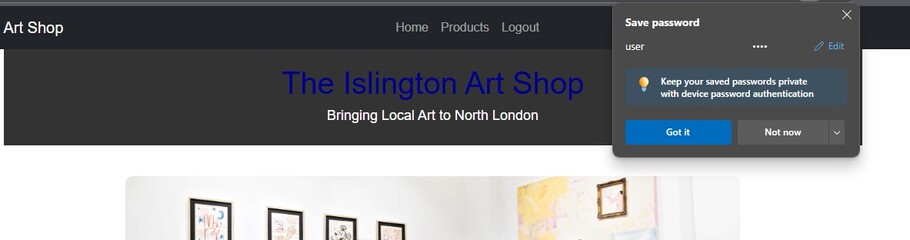
Figure 1: Session Management
(Source: Made by self in Visual Studio Community 2022)
Limited access to the features that only authorize the users having staff role to access the bulk order and mailing list features.
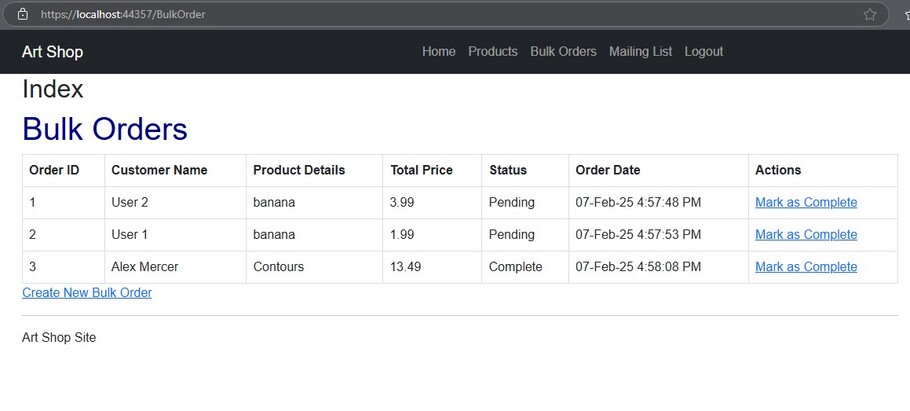
Figure 2: Server-Side Form Handling
(Source: Made by self in Visual Studio Community 2022)
Employed HTML’s form elements and form action to capture and process large orders and subscription orders while updating product and cost information.
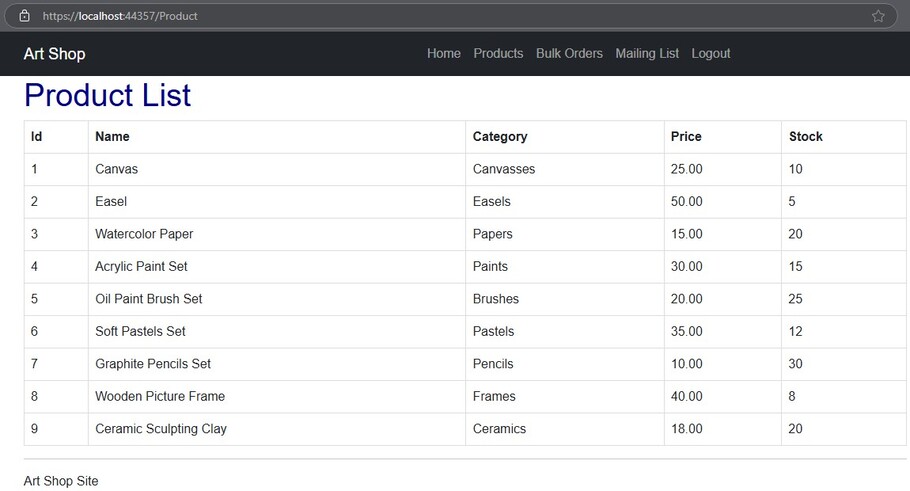
Figure 3: Data representation
(Source: Made by self in Visual Studio Community 2022)
Effective format of the dynamic pages for product listing and bulk orders using backend expertise.

Figure 4: Navigation Bar Integration
(Source: Made by self in Visual Studio Community 2022)
Implemented a navigation bar which changes dynamically depending on the role of the user logged in on the particular session.
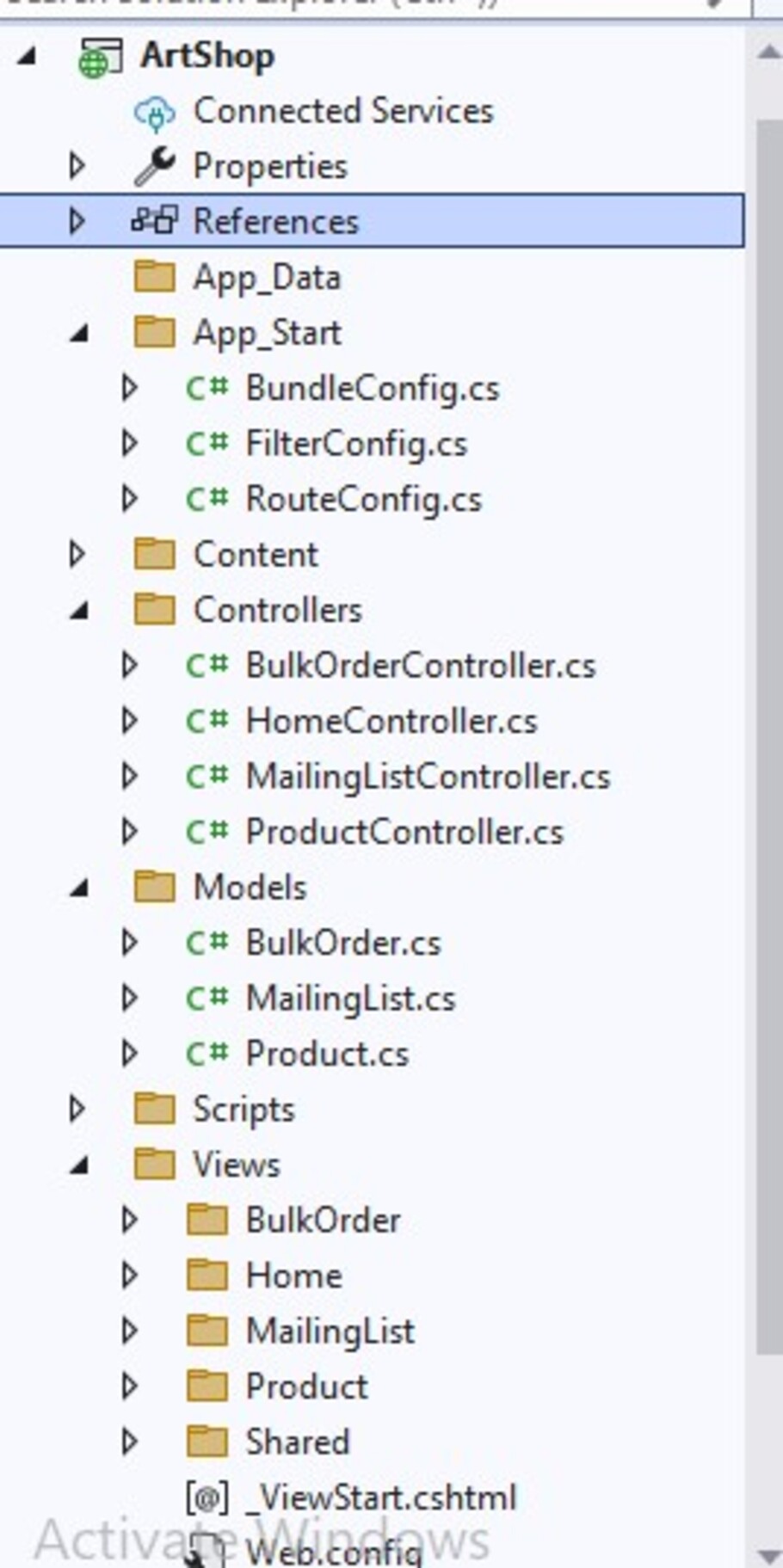
Figure 5: MVC Approach
(Source: Made by self in Visual Studio Community 2022)
Its design paid much attention to separating logic and structuring the data flow in order to make its navigation and interaction as smooth as possible (Marcotte, 2024).
Database
ERD
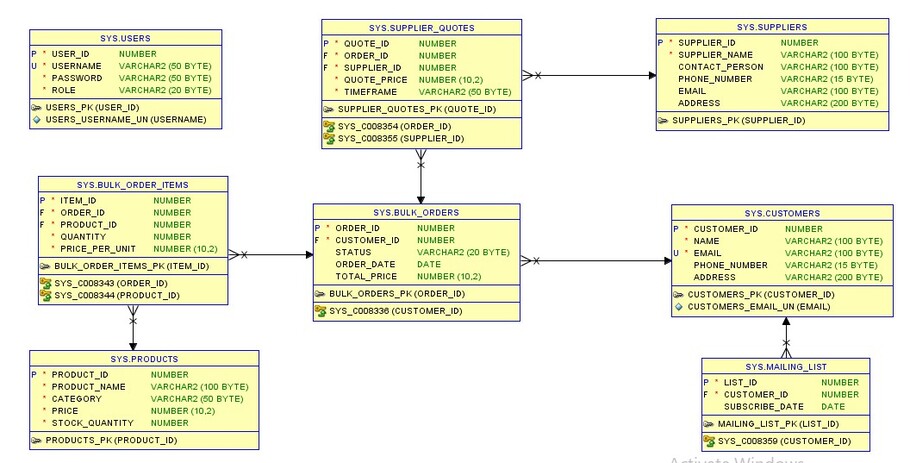
Figure 6: Entity Relationship Diagram
(Source: Made by self in Oracle SQL Developer)
Data Dictionary
- USERS Table
|
Column Name |
Data Type |
Description |
|
USER_ID |
NUMBER |
Unique identifier for each user |
|
USERNAME |
VARCHAR2(50) |
Unique username for the user |
|
PASSWORD |
VARCHAR2(50) |
User password |
|
ROLE |
VARCHAR2(20) |
User role (e.g., Staff, Customer) |
- PRODUCTS Table
|
Column Name |
Data Type |
Description |
|
PRODUCT_ID |
NUMBER |
Unique identifier for each product |
|
PRODUCT_NAME |
VARCHAR2(100) |
Name of the product |
|
CATEGORY |
VARCHAR2(50) |
Category of the product |
|
PRICE |
NUMBER(10, 2) |
Price of the product |
|
STOCK_QUANTITY |
NUMBER |
Available stock quantity |
- CUSTOMERS Table
|
Column Name |
Data Type |
Description |
|
CUSTOMER_ID |
NUMBER |
Unique identifier for each customer |
|
NAME |
VARCHAR2(100) |
Full name of the customer |
|
|
VARCHAR2(100) |
Email address of the customer |
|
PHONE_NUMBER |
VARCHAR2(15) |
Contact phone number |
|
ADDRESS |
VARCHAR2(200) |
Address of the customer |
- BULK_ORDERS Table
|
Column Name |
Data Type |
Description |
|
ORDER_ID |
NUMBER |
Unique identifier for each bulk order |
|
CUSTOMER_ID |
NUMBER |
Reference to the customer placing order |
|
STATUS |
VARCHAR2(20) |
Status (Pending/Complete) |
|
ORDER_DATE |
DATE |
Date the order was placed |
|
TOTAL_PRICE |
NUMBER(10, 2) |
Total price of the order |
- BULK_ORDER_ITEMS Table
|
Column Name |
Data Type |
Description |
|
ITEM_ID |
NUMBER |
Unique identifier for each order item |
|
ORDER_ID |
NUMBER |
Reference to the bulk order |
|
PRODUCT_ID |
NUMBER |
Reference to the product |
|
QUANTITY |
NUMBER |
Quantity of the product ordered |
|
PRICE_PER_UNIT |
NUMBER(10, 2) |
Price per unit of the product |
- SUPPLIERS Table
|
Column Name |
Data Type |
Description |
|
SUPPLIER_ID |
NUMBER |
Unique identifier for each supplier |
|
SUPPLIER_NAME |
VARCHAR2(100) |
Name of the supplier |
|
CONTACT_PERSON |
VARCHAR2(100) |
Name of the contact person |
|
PHONE_NUMBER |
VARCHAR2(15) |
Contact phone number |
|
|
VARCHAR2(100) |
Contact email |
|
ADDRESS |
VARCHAR2(200) |
Supplier address |
- SUPPLIER_QUOTES Table
|
Column Name |
Data Type |
Description |
|
QUOTE_ID |
NUMBER |
Unique identifier for each quote |
|
ORDER_ID |
NUMsBER |
Reference to the bulk order |
|
SUPPLIER_ID |
NUMBER |
Reference to the supplier |
|
QUOTE_PRICE |
NUMBER(10, 2) |
Quoted price from the supplier |
|
TIMEFRAME |
VARCHAR2(50) |
Delivery timeframe from the supplier |
- MAILING_LIST Table
|
Column Name |
Data Type |
Description |
|
LIST_ID |
NUMBER |
Unique identifier for each subscription |
|
CUSTOMER_ID |
NUMBER |
Reference to the customer |
|
SUBSCRIBE_DATE |
DATE |
Date of subscription |
Discussion
The successful passing of all the functional requirements pertinent to the Art Shop’s operation is the evidence that the software is effective. For example, they included session-based validation as a way of improving access to pages by restricting the access by role. Extended use of the server-side form handling was beneficial for processing of the number of orders altogether and for the mailing list. This aspect was not tested because the actual database connections were not used; rather, it was mimicked in terms of internal business logic as well as the flow of different pages involved in the application. In this particular project, I was able to learn various basic aspects of web development in ASP.net, and also the need to code properly so as to achieve better structure and maintainability of codes.
Conclusion
The Art Shop Web Application can effectively explain the basic principles of ASP.NET since it provides an e-business environment without using a database. Achieving the project, one identifies key basics such as the management of sessions, server-side processing of forms, and even structuring of the web pages. I found this work enlightening about web development of the web application and provided the basis for the next improvements, and database inclusion for a complete e-commerce site.
"Developing an ASP.NET web application like the Islington Art Shop requires understanding complex concepts such as MVC architecture, session management, and server-side processing. For students and professionals, online assignment help services can provide expert guidance, offering structured solutions, troubleshooting support, and coding best practices. Leveraging such support ensures accurate, high-quality reports while enhancing practical understanding of web development concepts, saving time, and boosting confidence in applying ASP.NET techniques effectively."
Reference List
Websites
W3schools.com. (2016). W3Schools.com. [online] Available at: https://www.w3schools.com/asp/default.ASP [Accessed 7 Feb. 2025].
www.javatpoint.com. (2025). ASP.NET Tutorial (50+). [online] Available at: https://www.javatpoint.com/asp-net-tutorial [Accessed 7 Feb. 2025].
Journals
Lock, A., 2023. ASP. NET core in Action. Simon and Schuster.
Marcotte, C.H., 2024. Architecting ASP. NET Core Applications: An atypical design patterns guide for. NET 8, C# 12, and beyond. Packt Publishing Ltd.
Price, M.J., 2020. C# 9 and. NET 5–Modern Cross-Platform Development: Build intelligent apps, websites, and services with Blazor, ASP. NET Core, and Entity Framework Core using Visual Studio Code. Packt Publishing Ltd.
Price, M.J., 2021. C# 10 and. NET 6–Modern Cross-Platform Development: Build apps, websites, and services with ASP. NET Core 6, Blazor, and EF Core 6 using Visual Studio 2022 and Visual Studio Code. Packt Publishing Ltd.
Go Through the Best and FREE Samples Written by Our Academic Experts!
Native Assignment Help. (2026). Retrieved from:
https://www.nativeassignmenthelp.co.uk/web-application-report-coursework-sample-46014
Native Assignment Help, (2026),
https://www.nativeassignmenthelp.co.uk/web-application-report-coursework-sample-46014
Native Assignment Help (2026) [Online]. Retrieved from:
https://www.nativeassignmenthelp.co.uk/web-application-report-coursework-sample-46014
Native Assignment Help. (Native Assignment Help, 2026)
https://www.nativeassignmenthelp.co.uk/web-application-report-coursework-sample-46014
- FreeDownload - 37 TimesSHN5023 Personalised Care and Social Prescribing Assignment
SHN:5023 Personalised Care and Social Prescribing INTRODUCTION Social...View or download
- FreeDownload - 39 TimesEvaluation of Strengths and Weaknesses in Learning Assignment
Evaluation of Strengths and Weaknesses in Learning Assignment...View or download
- FreeDownload - 45 TimesInternational Marketing Strategy Assignment Sample
Executive Summary Raymond is an Indian global fashion business that operates...View or download
- FreeDownload - 44 TimesOperation And Quality Management Issues In Zara Assignment Sample
Introduction - Operation And Quality Management Issues In Zara Are you...View or download
- FreeDownload - 39 TimesTourism Industry Workplace Ethics and Business Awareness Assignment Sample
Introduction Ethical principle refers to the values, moral and principles that...View or download
- FreeDownload - 40 TimesSales Management Assignment Sample
1.0 Introduction - Sales Management Assignment As suggested by...View or download
-
100% Confidential
Your personal details and order information are kept completely private with our strict confidentiality policy.
-
On-Time Delivery
Receive your assignment exactly within the promised deadline—no delays, ever.
-
Native British Writers
Get your work crafted by highly-skilled native UK writers with strong academic expertise.
-
A+ Quality Assignments
We deliver top-notch, well-researched, and perfectly structured assignments to help you secure the highest grades.