

- What Is a Bibliography?
- Bibliography vs reference list vs citation
- Which does my UK university require?
- When do you need a bibliography in university assignments?
- What sources can be included in a bibliography?
- How source quality affects bibliography marks
- How UK Universities Expect a Bibliography to Be Formatted
- Keep source ordering consistent throughout
- Apply one referencing style consistently
- Follow your department’s referencing requirements
- Different source types follow different formatting rules
- How to Write a Bibliography Step-by-Step for UK Universities
- Bibliography examples in different referencing styles
- Harvard bibliography example (UK standard)
- MHRA bibliography example (humanities)
- OSCOLA bibliography example (law)
- Vancouver bibliography example (medicine, nursing, and healthcare)
- APA bibliography example (psychology and social sciences)
- Common bibliography mistakes that weaken university assignments
- Final bibliography checklist before assignment submission
What Is a Bibliography?
A bibliography is the section at the end of an assignment. That lists the books, journal articles, websites, reports, and other material you used during your research. It shows your professor from where your information came from and gives proper credit to the original authors whose ideas, evidence or arguments helped shape your work.
Mainly in assignments, the bibliography appears on a separate page at the end of the work. However, students often confuse a bibliography with either a reference list or a citation because the terms are closely connected in academic referencing.
Bibliography vs reference list vs citation
Students often mix up 'bibliography', 'reference list', and 'citation', but UK universities treat them as different parts of the referencing system, and using them incorrectly can make your work look inconsistent in academic marking. The key difference is not terminology but function—what each one contains and how it is used in university assignments.
The comparison below shows how each one is used in UK university assignments.
| Term | What it is (in UK academic practice) | Common mistakes | When you actually use it | Marking impact |
|---|---|---|---|---|
| Reference list | The standard list of only the sources you have directly cited in your assignment | Adding extra reading or forgetting to include in-text sources creates inconsistencies | Default requirement for most UK undergraduate essays and coursework | Expected baseline. Missing or incorrect entries directly weaken academic structure and referencing criteria |
| Bibliography | A broader list that includes everything you consulted during research, even if not directly cited | Students treat it like a reference list and unintentionally restrict it to cited sources only | Used in dissertations, extended research projects, and many humanities-based submissions | Signals wider research engagement when used correctly, but incorrect use shows misunderstanding of source scope |
| Citation | The in-text link (Author–Year or footnote) that connects your writing to your source list | Confusing it with the final list or omitting it while only listing sources at the end | Required in all UK academic writing regardless of referencing style | Critical for traceability — errors break the link between argument and evidence and are quickly flagged |
Students searching “How to Write Bibliography?” should know that different UK subjects use different referencing systems. This is why bibliography rules can vary between assignments. However, in practice, what matters the most is using the required system consistently and making sources easy to check throughout the work. Still, the exact requirement depends on your assignment type and university guidelines.
Which does my UK university require?
In the UK, most undergraduate assignments just require a reference list (listing the sources directly cited in your work). Whereas the dissertations and extended research projects require a full bibliography, especially when the module brief clearly mentions it. Always remember that your assignment brief or module handbook should always be a priority over any general referencing rules.
When do you need a bibliography in university assignments?
The requirement clearly depends on the assignment brief, academic level, and referencing system used by your department. The table explains when you need a bibliography or a reference list and how to practise it.
| Assignment type | What is required | What this means in practice |
|---|---|---|
| Undergraduate essay | Reference list | Only include sources you directly cite in your writing |
| Dissertation / extended research | Bibliography or extended references | Include both cited sources and wider research material |
| Lab / science / technical reports | Structured reference list (Vancouver / APA) | Source list must match in-text citations exactly |
| Coursework / practical tasks | As specified in brief | Requirement varies by module and department rules |
| Literature review | Reference list | Only academically used and cited sources included |
| Reflective assignments | Reference list (if sources used) | Only required if external material is referenced |
| Annotated bibliography | Full bibliography | Includes sources plus commentary/notes |
At school level (GCSE, A-Level, EPQ), a bibliography is required whenever external sources are used, usually in a simplified Harvard format, with consistency in referencing being more important than exact stylistic variation. Once you understand when it is required, the next step is knowing how to actually structure and format it correctly in your work.
What sources can be included in a bibliography?
UK universities don’t treat all sources equally in a bibliography. Here each source type is evaluated based on academic credibility, reliability and how strongly it supports the arguments. Well, there are some sources that carry stronger academic value than others, especially in assessed university work.
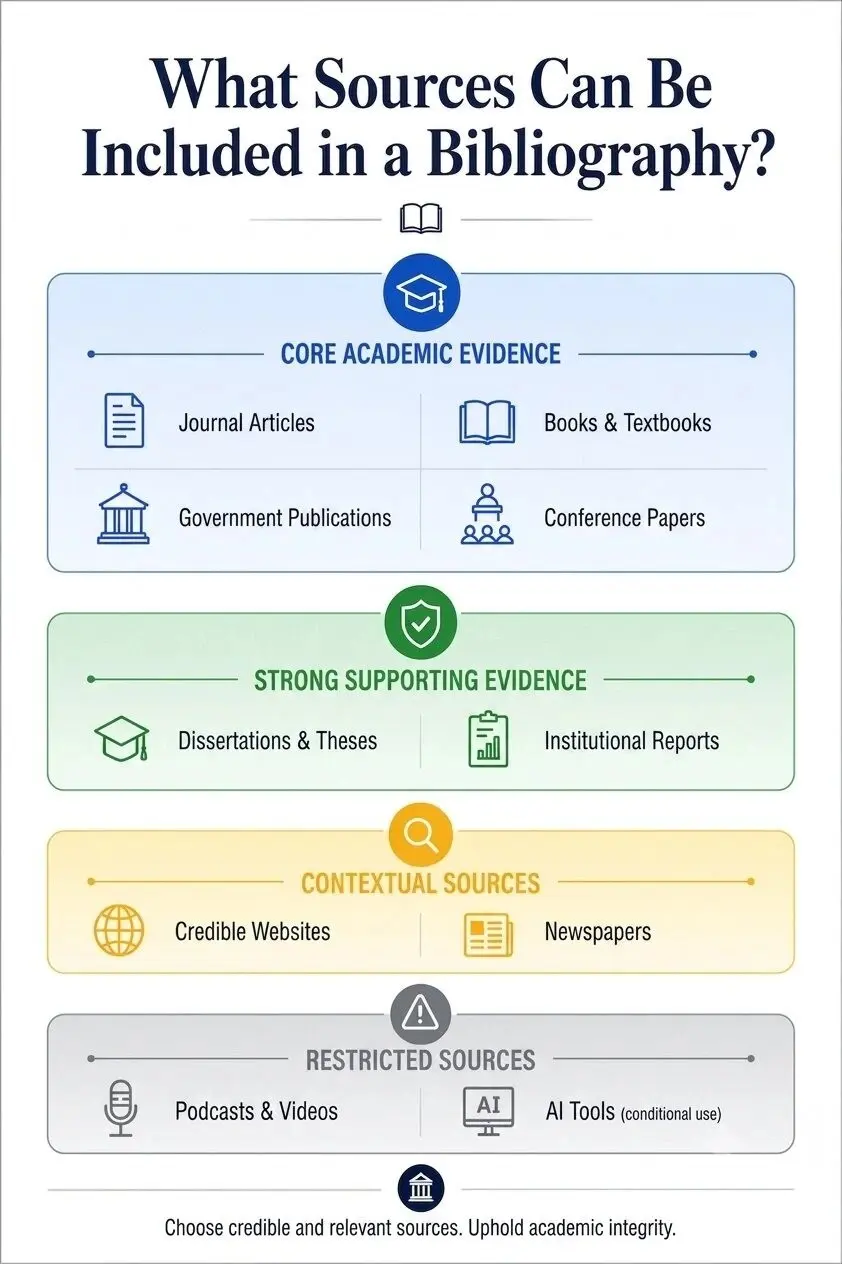
Source types ranked by academic weight and credibility for UK university bibliographies.
How source quality affects bibliography marks
In UK academic writing, source selection is judged on quality and academic relevance rather than availability. Strong bibliographies rely mainly on peer-reviewed and academically verified sources, while weaker sources are usually used only for context or supporting discussion
How UK Universities Expect a Bibliography to Be Formatted
In UK universities, bibliography quality is judged mainly through consistency. Mixed referencing styles, incorrect ordering, and missing source details quickly make academic work look poorly organised.
Keep source ordering consistent throughout
In most UK referencing styles, especially Harvard, bibliography entries are arranged alphabetically by the author’s surname to help markers locate sources quickly. If a source has no named author, use the title instead, but ignore words like “A”, “An”, and “The” when alphabetising. Where the same author appears more than once, list the oldest publication first. For example, Smith (2019) should appear before Smith (2023). OSCOLA is one of the few exceptions, as legal sources are organised differently.
Apply one referencing style consistently
In UK Harvard referencing, consistency is more important than memorising every small rule. Every entry must follow the same pattern for punctuation, italics, capitalisation, and spacing. For example, if you write a book as Smith (2020) Understanding Research, you should not switch later to a different format like commas or missing italics. Mixing Harvard with APA or changing structure halfway through is one of the fastest ways to lose bibliography marks because it signals poor control of the referencing system.
Follow your department’s referencing requirements
In UK universities, your assignment brief always decides the referencing style, not personal choice. Most subjects use Harvard, but humanities often require MHRA, law uses OSCOLA, and medicine or nursing follows Vancouver. Even if your bibliography is perfectly formatted, using the wrong system is still treated as incorrect because markers assess compliance with the required style, not just accuracy. For example, a well-written Harvard bibliography in a law assignment will still lose marks if OSCOLA was specified in the module guide. Always match the department’s required style exactly before formatting your references.
Explore more relatable blogs – A Complete Guide to Formatting Assignments for UK Universities
Different source types follow different formatting rules
In UK Harvard referencing, different sources follow different structures, and this is where most students lose marks. A book entry is written one way, a journal article another, and websites need extra details like access dates. For example, a book usually follows Author → Year → Title → Publisher, but a journal article adds journal name, volume, issue, and page numbers, which students often forget or mix up. Websites are even more error-prone because missing access dates or URLs immediately signals incomplete referencing. Legislation also follows a separate OSCOLA format in law assignments. The structure depends on the source type, not personal formatting choice.
How to Write a Bibliography Step-by-Step for UK Universities
A bibliography is best created as you write, not left until the end. In UK university marking, it is assessed on how consistently and correctly sources are collected, organised, and formatted, which is why following a clear step-by-step process is important.
- Collect source details as you use them: Note down full details (author, year, title, publisher, URL/DOI) at the time of reading/quoting . Missing metadata is one of the most common reasons for inaccurate or incomplete bibliography entries later.
- Check your required referencing style: Determine the exact system your subject or brief needs. Whether Harvard, MHRA, OSCOLA, APA or Vancouver, all decisions about formatting are based on the style.
- Create a dedicated bibliography page: Give a title to your last page as 'Bibliography' or 'References' in your assignment as required. It helps in signalling academic structure and separating source listing from the main content.
- Organise sources in the required order: List the entries in alphabetical order by the last name of the author (or the title if there is no author). Actually in Harvard and most UK styles, this way of ordering things is very important, but legal writing can have different rules.
- Format each entry consistently: Apply one referencing style without mixing rules. Pay attention to punctuation, italics, capitalisation, and spacing, as inconsistencies are immediately noticeable in marking.
- Verify before submission: Cross-check that every in-text citation appears in your bibliography, all URLs work, and formatting is consistent across entries. Small errors here often affect referencing marks more than content quality.
Next, see how correctly structured entries look across UK referencing styles and source types.
Bibliography examples in different referencing styles
Different referencing styles organise the same source in completely different ways. A Harvard book reference will not look the same as an OSCOLA legal source or a Vancouver journal entry, which is why students often lose marks through formatting confusion. The examples below show how major UK referencing styles are actually structured in university assignments.
Harvard bibliography example (UK standard)
Harvard is the default referencing style used across most UK universities, particularly in coursework-based subjects. Although universities apply slightly different Harvard variations, many follow guidance based on Cite Them Right. Some universities now follow updated Harvard variations, so students should always match their department guidelines.
| Source type | Harvard bibliography example |
|---|---|
| Book | Smith, J. (2020) Understanding Academic Writing. 3rd edn. London: Bloomsbury. |
| Journal article | Jones, A. (2022) ‘Referencing in UK higher education’, Journal of Academic Practice, 14(2), pp. 45–60. |
| Website | NHS (2024) Mental health services. Available at: https://www.nhs.uk/mental-health (Accessed: 12 January 2025). |
MHRA bibliography example (humanities)
MHRA referencing is commonly used in literature, history, philosophy, and arts-based subjects across UK universities. Unlike Harvard, MHRA relies on footnotes inside the writing and a separate bibliography at the end, which changes both the structure and punctuation of references. Entries are usually written in a denser format, with commas replacing many of the brackets used in author–date systems.
Book:Smith, John, Understanding Academic Writing, 3rd edn (London: Bloomsbury, 2020).
Journal article:Jones, Amanda, ‘Referencing in UK Higher Education’, Journal of Academic Practice, 14 (2022), 45–60.
OSCOLA bibliography example (law)
OSCOLA is the standard referencing system across most UK law degrees and is treated far more strictly than general author–date styles such as Harvard. Instead of combining all sources into one list, OSCOLA separates legal authorities into categories including cases, legislation, and secondary sources. The structure, punctuation, and abbreviations used in legal citations must follow recognised legal formatting conventions closely.
Cases: Donoghue v Stevenson [1932] AC 562 (HL)
Legislation: Human Rights Act 1998
Secondary sources: Slapper G and Kelly D, The English Legal System (17th edn, Routledge 2016).
Harlow C, ‘Global Administrative Law: The Quest for Principles and Values’ (2006) 17 EJIL 187.
Vancouver bibliography example (medicine, nursing, and healthcare)
Vancouver referencing is widely used in medicine, nursing, pharmacy, dentistry, and other healthcare-based degrees across UK universities. Unlike Harvard or MHRA, Vancouver organises sources numerically in the order they appear in the assignment rather than alphabetically, which makes numbering accuracy especially important in scientific and clinical writing.
- Smith J, Jones A. Antibiotic resistance in UK hospitals. Lancet. 2023;401(10375):456–62.
- NHS England. Long-term conditions overview [Internet]. London: NHS; 2024 [cited 2025 Jan 12]. Available from: https://www.england.nhs.uk
APA bibliography example (psychology and social sciences)
APA 7th edition is mainly used in psychology, education, social sciences, and some business programmes within UK universities. APA follows its own rules for punctuation, capitalisation, DOI formatting, and source layout.”
Book:
Smith, J. (2020). Understanding academic writing (3rd ed.). Bloomsbury.
Journal article:
Jones, A. (2022). Referencing in UK higher education. Journal of Academic Practice, 14(2), 45–60. https://doi.org/10.xxxx
Even when the correct referencing style is used, small formatting inconsistencies still cause avoidable bibliography errors in university assignments.
Common bibliography mistakes that weaken university assignments
Markers can usually tell within seconds whether a bibliography was prepared carefully or rushed at the end.
- Mixing Harvard and APA formatting → Makes the referencing look inconsistent and poorly controlled.
- Missing publication years → Breaks the connection between citations and bibliography entries.
- Wrong alphabetical order → Signals weak proofreading and rushed formatting.
- Broken website links → Stops sources from being checked properly.
- Missing access dates for websites → Leaves online references incomplete in most UK university styles.
- Inconsistent punctuation or spacing → Makes the bibliography look careless even when the research is strong.
- Adding sources not genuinely used → Looks like bibliography padding rather than real research.
- Weak source quality → A few strong academic journals usually carry more value than many low-quality websites.
- Leaving cited sources out of the bibliography → Creates obvious referencing inconsistencies markers notice quickly.
For most UK projects, the bibliographies are not just technical requirements. They look at it as a reflection of how carefully the research, referencing, and final submission have been handled overall. Withing that a pre-submission check can help you catch the smaller mistakes students mainly miss out on. This is one reason that most students using Native Assignment Help UK are told to complete a bibliography review of their paper before submitting it.
Final bibliography checklist before assignment submission
Before submitting your project, it is recommended to review this checklist carefully. Because a small mistake can affect your marks heavily.
- Use the referencing style required by your university or department.
- Keep formatting consistent across every source entry.
- Check that all cited sources appear in the bibliography.
- Remove sources you did not genuinely use in the assignment.
- Arrange entries in the correct alphabetical or numerical order.
- Make sure book and journal titles are formatted correctly.
- Check that all website links and access dates are included.
- Proofread punctuation, spacing, and author details before submission.
A consistent and clear bibliography presents an academic work as properly researched and professionally presented. But if you’re still confused about how to write a bibliography or feel unsure about referencing rules or formatting requirements, Native Assignment Help is there to provide clear guidance with their assignment editing service supporting UK academic referencing.
References and Referencing Style Sources
- American Psychological Association (2020) Publication manual of the American Psychological Association. 7th edn. Washington, DC: American Psychological Association.
- International Committee of Medical Journal Editors (2024) Recommendations for the conduct, reporting, editing, and publication of scholarly work in medical journals. Available at: https://www.icmje.org/recommendations/ (Accessed: 20 May 2026).
- Modern Humanities Research Association (2024) MHRA style guide: A handbook for authors, editors, and writers of theses. London: MHRA. Available at: https://www.mhra.org.uk/style/ (Accessed: 20 May 2026).
- Oxford University Faculty of Law (2021) OSCOLA: Oxford University standard for the citation of legal authorities. 4th edn. Oxford: University of Oxford. Available at: https://www.law.ox.ac.uk/oscola (Accessed: 20 May 2026).
- Pears, R. and Shields, G. (2022) Cite them right: The essential referencing guide. 12th edn. London: Red Globe Press.
- University of Leeds (2025) Guide to referencing styles used at the University. Available at: https://library.leeds.ac.uk/info/14011/referencing (Accessed: 20 May 2026).
- University of Manchester (2025) Referencing guides. Available at: https://www.library.manchester.ac.uk/using-the-library/students/referencing/ (Accessed: 20 May 2026).

 6 years Years | Ph.D.
Elton Watson produces practical academic writing resources focused on referencing and source management. His guides help students compile accurate bibliographies, cite academic sources correctly, and follow common UK university referencing standards.