
- 1. Introduction: Background of the study and Research problem or justification
- Description of the Research
- Research Context and Importance
- 2. Research aim, research objective and a research question
- Focus and Knowledge Generation
- Information Required and Sources
- Research Design and Methodology
- Correlation Between Objectives and Approach
- 3. Literature Review and Theoretical framework
- Theoretical Framework Model
- Key Topics in Literature Review
- 4. Gap in the literature or evidence of the problem from reports
- 5. Research method and methodology
- Research Design and Approach
- Data Collection Methods
- Sampling Techniques and Sample Size
- Data Analysis Procedures
- Ethics and Confidentiality
- 6. Data Collection
- Primary Data
- Secondary Data
- Process Overview
- 7. Data Analysis and Results/Findings
1. Introduction: Background of the study and Research problem or justification
Description of the Research
This research assesses the effects of leadership on motivation in the UK’s tourism sector with a focus on Hays Travel. In the quantitative cross-sectional study data will be collected using questionnaires and combining them with qualitative interviews to assess what leadership style impacts motivation at the workplace. This research is important to establish the leadership approaches that spearhead the level of employee commitment, job contentment, and productivity in a very sensitive and competitive industry such as tourism (Afsar, Badir, & Saeed, 2020).
Research Context and Importance
This work focuses on issues common to the tourism industry, including staff turnover and low employee motivation caused by the modern turbulent and post-COVID economic situation. About these challenges, motivation, and commitment become fundamental goals for leadership. Paying specificity to the Organizational Behaviour and Human resource management domain, this study helps in comprehending leadership and motivation links that are relevant to improving employee turnover and service delivery in the UK tourism sector (Bormann & Rowold, 2021).
2. Research aim, research objective and a research question
Focus and Knowledge Generation
The study seeks to contribute specific insights into organizational leadership about employee engagement at Hays Travel in the context of the UK tourism industry. It envisages identifying the relationship between leadership practice on one hand, and factors like satisfaction, involvement, and turnover intention on the other (Greetham, 2019).
Information Required and Sources
To answer the research question, it is essential to explore:
- The various leadership styles that are in practice at Hays Travel.
- Key motivational issues that may affect human resources in the tourism sector.
- Leading behaviours and employee responses: The common relationship.
- Self-developed questionnaires and interviews, as well as information from secondary sources, including industry and academic databases on leadership and motivation, will be used to collect data.
Research Design and Methodology
In this study, both quantitative and qualitative data will be collected. While survey data collected from the human resource department will compare motivation levels and leadership styles. Interviews will generate valuable qualitative data essential for understanding employees’ attitudes as well as the leadership approach applied in the organization (Hart, 2018).
Correlation Between Objectives and Approach
The study’s design is commensurate to detect objectively observable tendencies and subjectively rich stories. Hence, the holistic analysis of leadership on motivation advances a detailed understanding of the relationships as intended in the studies.
3. Literature Review and Theoretical framework
A brief literature review and theoretical framework would be relevant to distinguish the relationship between leadership with the motivation of the employees. This section consolidates prior work and main ideas regarding the study as well as offering a graphic depiction of the theoretical support. The framework identifies three key topics for exploration: leadership types, employees’ engagement, and the moderating factors between leadership and engagement.
Theoretical Framework Model
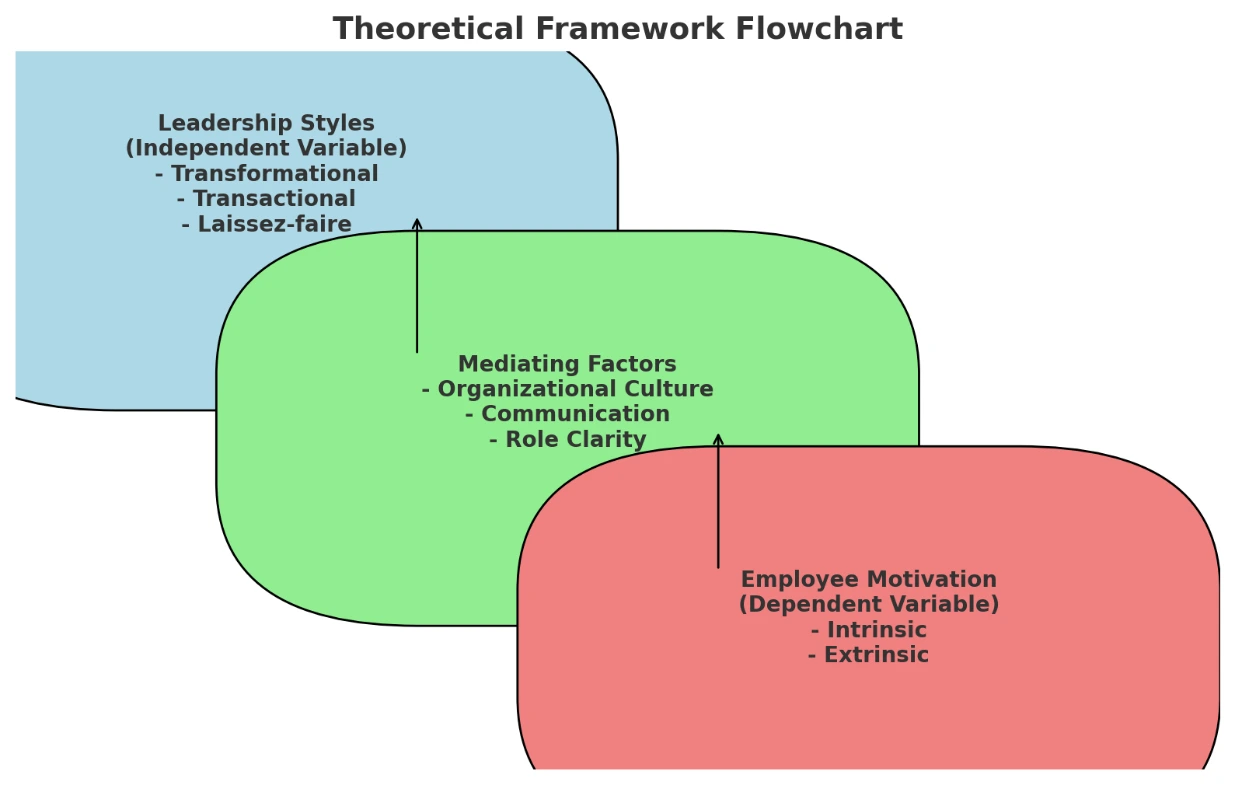
Leadership Styles as Independent Variables
Workplace relationships are influenced by leadership styles in that they determine how the employees perceive their responsibilities in their line of duty. For example, while transformational leadership creates commitment and change through the stimulus of self-interest motivation, transactional leadership might act on extrinsic rewards interest motivation (Jena & Khan, 2020).
Mediating Factors
The gap between leadership practices and motivation outcomes is closed by mediating variables, including organizational culture. A culturally supportive environment enhances the impact of positive leadership and communication can do it (Karatepe & Karadas, 2020).
Motivation as the Dependent Variable
Therefore, the research interest is in examining how each of the mediating variables affects intrinsic and extrinsic motivation. This framework of relationships describes a structured way through which the lens of leadership can be utilized to understand the motivation at Hays Travel (Mwesigwa & Nti, 2021).
Key Topics in Literature Review
Leadership Styles
Leadership styles are acknowledged as the key determinants of employee behaviour: transformational, transactional, and the lack of any calculated action, known as the laissez-faire style. While transformational leaders use communication to share a vision with the workers, transactional leaders concentrate on organizational performance and what the subordinates can get in return for following the direction provided. On the other hand, laissez-faire leadership provides few instructions and expectations resulting in decreased motivation. Qi, Liu, & Lu (2019), research demonstrates how various leadership behaviour affects workers’ motivation and commitment.
Employee Motivation
Intrinsic and extrinsic factors, as demonstrated in motivation theories which include; Maslow’s Hierarchy of Needs and Herzberg’s Two-Factor Theory, affect motivated employees. Especially in tourism where staff satisfaction means a lot to the level of service delivery, it is important to examine what influences workers— recognition, promotion, or money (Schaufeli, 2020).
Mediating Factors
Variables including culture, communication, and freedom control the effects of leadership on motivation within an organization. For instance, a study shows that a culture that promotes receptiveness improves the impact of TL on OC. Such variables as job role clarity and perceptions of support deepen leadership so that it becomes motivational (Saunders, Lewis, & Thornhill, 2019).
4. Gap in the literature or evidence of the problem from reports
In the selected literature, the following aspects of leadership and motivation are discussed in detail transformational leadership and Herzberg’s Two-Factor Theory. These studies reveal the influence of leadership on organizational commitment, job satisfaction, and productivity. However, there is a lack of such studies by sector, and more so UK tourism industry in which employee retention and motivation are some of the perennial issues. Prior literature has not adequately addressed the question of how leadership styles, and moderation by context factors such as organizational culture and communication impact motivation in such a setting. This study fills this gap by examining Hays Travel in an attempt to uncover real-life leadership motivation dynamics within the tourism industry (Van Tuin & Rikkert, 2020).
5. Research method and methodology
Research Design and Approach
This particular study takes an explorative research approach where both quantitative and qualitative data are collected to ensure the results are thorough, an approach suitable for the case of Hays Travel about leadership and its impact on motivation among employees. The quantitative part based on the surveys reveals characteristics of motivation associated with leadership types quantitatively; the qualitative part based on interviews describes the employee and managerial points of view on motivation. The mixed-methods enable the collection of statistical patterns as well as provide context to the results obtained (Wang, Alam, & Gul, 2022).
Data Collection Methods
Surveys: This form of questionnaire will be conducted among a number of employees at Hays Travel across the organizational department. These surveys will help in identifying various leadership practices as well as the motivational levels of the employees; These will inform the extent to which factors such as culture and communication mediate with the leadership practices and motivation of the workforce.
Interviews: Personal opinions about leadership behaviour and its motivational effects will be discussed using semi-structured interviews with managers and workers.
Document Analysis: Secondary data support primary data by presenting background information and tendencies of the UK tourism industry through analysing company data, performance reports, and industry studies (Walliman, 2019).
Sampling Techniques and Sample Size
The research will adopt stratified random sampling to obtain samples from different hierarchal levels, as well as the departments in the organization, Hays Travel. Employees will be divided into norms depending on their position (line, staff). The study will involve 100 employees and 10 managers as the sample size will be selected to ensure statistical reliability but will not be extended as it will make the study very large. Sampling makes a comparison achievable since it brings diversity in terms of viewpoints held by different employees in different jobs.
Data Analysis Procedures
Quantitative Analysis: Questionnaires will be adopted and statistical tests like regression and correlation analysis will be used to test the relationship between leadership style and motivation of employees. Descriptive and inferential analysis will be computed through statistical software such as SPSS or else Excel sheet.
Qualitative Analysis: Using thematic analysis of the interview transcripts, repeating patterns of meaning will be made, for instance, patterns of leadership behaviours that elicit motivation or demotivating behaviours. Coding and theme generation might also be done using NVivo software Efficient coding and theme generation might also be performed using the software (Walliman, 2019).
Ethics and Confidentiality
|
Aspect |
Details |
|
Involvement of People |
Yes, it is, employees and managers of the Hays Travel Ltd have been used as the participants of the research. |
|
Data Sufficiency |
With the kind of stratified sampling technique used, the sample population comprises of 100 employees and 10 managers. |
|
Confidentiality |
Information will be stripped off all IDs for anonymity and all files will be kept very secure, access to which will be limited to only aggregate analysis. |
|
Health and Safety |
It will reduce the risk of a person contracting an illness through face-to-face interview or filling an online survey. In-person sessions will take place consistently with COVID-19 guidelines. |
|
Ethical Approval |
Ethical clearance will be sought from the relevant ethical committee to ensure that we meet the standard set down by the required ethic (Walliman, 2019). |
6. Data Collection
Primary Data
- Surveys: Closed questionnaires will be used to collect quantitative data from 100 employees of different ranks. Participants will be asked questions concerning their leadership roles, amount of motivation, and variables such as communication and role definition.
- Interviews: Structured interviews with 10 managers and selected employees will be followed by semi-structured interviews to identify personal attitudes and experiences regarding leadership practices. This data will also be specific, which could be masked with other information when using surveys (Van Tuin & Rikkert, 2020).
Secondary Data
Document Analysis: There will be textual understanding from reports in the company, performance data from all the employees, and industrial reports. This data supports the evidence obtained from the primary data and positions it in an industry context.
Process Overview
The surveys will be available online so that employees do not attempt to be physically present in a designated place to access them. The interviews will be conducted via Web or face-to-face depending on the participants’ availability and convenience, and COVID-19 precautions. Secondary data will be collected from both internal and external sources in the form of records from the company as well as other sources.
7. Data Analysis and Results/Findings
The survey and interviews conducted showed useful information as to how leadership styles affect the motivation levels of employees in Hays Travel. According to the survey data, the quantitative data highlighted that the employees with full-fledged transformational leaders where motivated intrinsically to a greater extent. Organizational members subordinated to transformational leaders perceived they experienced more increase in psychological empowerment, organizational importance, and organizational obligation. Those under transactional leadership styles had moderate motivation mainly in the extrinsic stimuli as in the fantasied rewards (Mwesigwa & Nti, 2021).
Observations made from interviews supported these assertions with more rich qualitative information. Those who noted that they received much of the transformational leadership reported that their leaders encouraged them, motivated them, and were sensitive to their requirements. From the results, these leaders were seen to create a positive work environment which improved the engagement and motivation of workers. In contrast, the employees who interacted with the transactional leaders reported being motivated by the rewards that are outside the organizational setting, such as bonuses and promotions, and that their motivation focused on accomplishing set objectives or tasks (Van Tuin & Rikkert, 2020).
Different levels of mediators such as culture and interpersonal communication were explored; they showed that positive culture has a strong interactive influence on the leadership styles. Both the Study 3 and Study 4 findings suggested that the perceived level of leader communication and felt involvement in the decision-making process had a positive impact on employee motivation regardless of the type of leadership. This implies that; enhancing communication and a positive organizational culture can enhance both transformational leadership and transactional leadership in the motivation of employees (Bormann & Rowold, 2021).
It is established that in Hays Travel, leadership results in an impact on the motivation of employees. Desired performance outcomes are created when applied leadership behaviour is combined with a viable organizational culture and successful communication. By following these results, organizations' practices in the UK tourism sector can enhance the leadership practices of organizations and employee engagement.
8. Conclusion
The study focuses on the fact that an increase in motivation in Hays Travel is highly beneficial when adopting transformational leadership accompanied by an organizational culture supportive of such approaches and communication between employees on the job. As a form of extrinsic reward-based theory of work, motivation, and performance, transactional leadership is less influential. The present research provides development to the existing literature on leadership-motivation linkage in the context of the British tourism industry and provides practical recommendations for increasing occupational motivation. The anticipated result is to improve the understanding of how leadership behaviours affect motivation in this setting, which may inform HR and management practices. The concern here is with the reality of its application of the expectancies within the context of the tourism industry for the motivation and subsequent high performance of the workforce.
If you need guidance in crafting high-quality academic work on topics like leadership, motivation, or HR management, Native Assignment Help provides professional Assignment Help tailored to your requirements. Our experts ensure plagiarism-free, well-researched content with timely delivery, helping UK students achieve academic success.
9. References
Afsar, B., Badir, Y., & Saeed, B. (2020). Transformational leadership and employee creativity: The role of intrinsic motivation. Journal of Business Research, 116, 503–510.
Bormann, K. C., & Rowold, J. (2021). Engaging leadership and work engagement: A systematic review. Journal of Business and Psychology, 36(3), 357–371.
Greetham, B. (2019) How to Write Your Undergraduate Dissertation. 3rd edn. Basingstoke: Palgrave.
Hart, C. (2018) Doing a Literature Review: releasing the research imagination. 2nd edn. London: Sage.
Jena, S. K., & Khan, R. A. (2020). Exploring the impact of transformational leadership on employee engagement: A case study in the hotel industry. Tourism Management Perspectives, 34, 100654.
Karatepe, O. M., & Karadas, G. (2020). Transformational leadership, employee engagement, and organizational outcomes. International Journal of Hospitality Management, 87, 102463.
Mwesigwa, R., & Nti, A. K. (2021). The role of leadership styles in influencing employee motivation in the hospitality sector. African Journal of Business Management, 15(2), 124–136.
Qi, Q., Liu, X., & Lu, X. (2019). Leadership and employee performance: A comparative study across industries. Journal of Organizational Behavior, 40(1), 102–117.
Schaufeli, W. B. (2020). Engaging leadership: Motivating employees by fulfilling their basic needs. Journal of Applied Psychology, 105(5), 551–567.
Saunders, M., Lewis, P. and Thornhill, A. (2019) Research Methods for Business Students. 8th edn. Harlow: Prentice Hall.
Van Tuin, D., & Rikkert, A. (2020). Engaging leadership: Satisfaction of basic needs and work outcomes. Human Resource Management Review, 30(4), 100–110.
Wang, Z., Alam, M., & Gul, F. (2022). The impact of transformational leadership on affective organizational commitment and job performance: The mediating role of employee engagement. Frontiers in Psychology, 13, 831060.
Walliman, N. (2019) Your Research Project: Designing, Planning, and Getting Started. 4th edn. London: Sage.
Zhao, Y., & Zhou, M. (2019). Effects of leadership styles on employee performance: Evidence from China. Journal of Management Studies, 56(2), 211–227.
Go Through the Best and FREE Samples Written by Our Academic Experts!
Native Assignment Help. (2026). Retrieved from:
https://www.nativeassignmenthelp.co.uk/btm6dis-business-and-tourism-management-hays-travel-sample-43622
Native Assignment Help, (2026),
https://www.nativeassignmenthelp.co.uk/btm6dis-business-and-tourism-management-hays-travel-sample-43622
Native Assignment Help (2026) [Online]. Retrieved from:
https://www.nativeassignmenthelp.co.uk/btm6dis-business-and-tourism-management-hays-travel-sample-43622
Native Assignment Help. (Native Assignment Help, 2026)
https://www.nativeassignmenthelp.co.uk/btm6dis-business-and-tourism-management-hays-travel-sample-43622
- FreeDownload - 39 TimesProfessional Foundations of Health and Social Care Assignment Sample
1.Introduction Safeguarding is an important principle of health and social...View or download
- FreeDownload - 40 TimesInternational Human Resource Professional Assignment
Task 1 Knowledge An international HR professional needs to possess knowledge...View or download
- FreeDownload - 39 TimesUnderstanding and managing behaviours in learning environment Assignment Sample
Understanding and managing behaviours in learning environment...View or download
- FreeDownload - 41 TimesGlobal Supply Chain Management Assignment Example
Global Supply Chain Management If you want to be successful in your...View or download
- FreeDownload - 43 TimesReaction Time Analysis & Normality Testing Study Assignment Sample
Introduction Testing for normality is an important step in selecting the right...View or download
- FreeDownload - 40 TimesUnit 19 Health Care Reflective Logs Assignment Example
Unit 19 Health Care Reflective Logs Assignment 1. Introduction - Unit 19...View or download
-
100% Confidential
Your personal details and order information are kept completely private with our strict confidentiality policy.
-
On-Time Delivery
Receive your assignment exactly within the promised deadline—no delays, ever.
-
Native British Writers
Get your work crafted by highly-skilled native UK writers with strong academic expertise.
-
A+ Quality Assignments
We deliver top-notch, well-researched, and perfectly structured assignments to help you secure the highest grades.