
- Why Inflation Is a Time Problem, Not Just a Price Increase
- How Real Purchasing Power Breaks Under Inflation Pressure
- Wage Growth vs Price Acceleration
- Consumption Compression, Not Reduction
- Savings and Hidden Value Loss
- Why Inflation Affects Households Unequally
- The Economic Feedback Loop of Reduced Purchasing Power
- Real-World Scenario: How Purchasing Power Changes Over Time
Why Inflation Is a Time Problem, Not Just a Price Increase
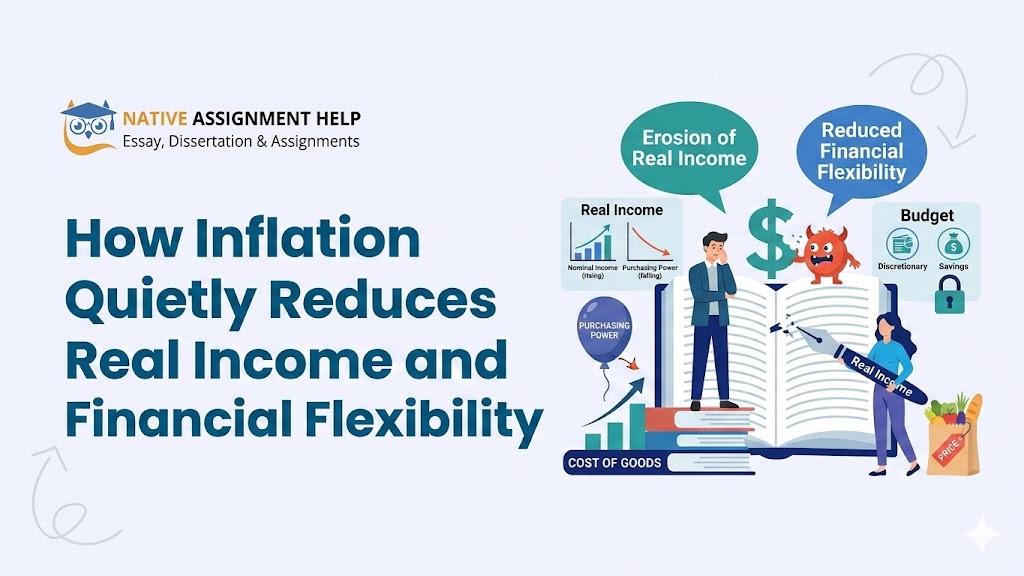
What most people actually see as inflation is prices going up. But the real issue is quieter; it changes the value of your money before you even notice that it is happening.
In reality the pressure builds silently. Your salary stays the same on paper, but month by month it covers less. This is the actual gap between a nominal income and real purchasing strength, and it is where inflation shows up as the actual damage.
Now, what makes it particularly difficult is the timing. By the time most households recognise the shift, the erosion has already been happening for months. Inflation does not announce itself, it just quietly shrinks the capability of what you earn and what you can actually afford.
How Real Purchasing Power Breaks Under Inflation Pressure
Let's understand it according to the finance assignment support lens, which means looking at three connected pressure points: wage lag, spending organisation, and saving erosion. Individually it is manageable, but when it comes together, they slowly disrupt the financial stability of households.
Wage Growth vs Price Acceleration
This gap opens when prices run faster than salaries. Here the earnings of a person look stable, but the strength of money weakens the consistency. And this effect shows up in many specific ways:
- Essentials absorb a growing share of monthly income
- Saving capacity tightens despite no pay cut
- Discretionary spending becomes harder to justify
- Financial flexibility shrinks without any obvious trigger
This is not a dramatic collapse. It is a slow narrowing of options that households often mistake for poor budgeting rather than structural economic pressure.
Consumption Compression, Not Reduction
Inflation rarely stops the spending of people. What it actually does is force a reorganisation of where that spending goes. In short, rent, grocery transport, and utilities consume a larger part of their income, and very little remains for everything else. As the budget
Spending on fun things, eating out, and things that aren't necessary is cut first. This isn't because people want to spend less, but because the budget stops growing. And then people start looking for cheaper options, putting off their savings goals, and making trade-offs they wouldn't have thought of a year ago.
Spending compresses, not disappears. As choices narrow, families and individuals adapt in ways that feel personal but are actually a response to inflation mechanics.
Savings and Hidden Value Loss
This is the area where inflation is quietly damaging the most. The amount in your savings account doesn’t change, but how you can use it or buy from it actually does. When the interest rates don’t grow with inflation, savings lose value, doesn’t matter if the balance stays the same.
Below are the practical consequences that double down with time:
- Living costs rise while savings grow slowly
- Future purchases cost more than they would today
- Long-term financial goals demand higher contributions
- Cash reserves lose buying strength without a single withdrawal
People who delay spending to save responsibly often find that the same financial goals require significantly more money later. Inflation effectively penalises patience.
Why Inflation Affects Households Unequally
Inflation doesn’t act the same for everyone, and the reason has very little to do with how much people earn. But it comes down to how a family’s finances are set up and how much room they have to move when prices start going up.
Income Rigidity and Inflation Pressure
Someone on a fixed salary or pension feels every price rise in real time because their income simply cannot move with it. Variable-income earners, such as freelancers or commission-based workers, can at least compensate partially through extra work or renegotiated rates. The inflation rate is identical for both, but the financial erosion it causes is not the same.
Housing Position and Cost Exposure
Housing is where the gap becomes most visible. In this, renters face direct, frequent exposure when costs rise, landlords adjust, and that increase hits the monthly budget immediately. Homeowners on fixed mortgages sit behind a wall that inflation cannot easily climb, however their core housing cost stays locked while everything else shifts around it.
Spending Flexibility and Financial Strain
When most of a pay cheque is already going toward essentials, there is nowhere to adjust when prices rise. Discretionary spending and savings get cut first because nothing else can give. Households with more breathing room in their budget can spread the pressure gradually across non-essentials instead.
Inflation hits hardest where financial flexibility is lowest, and that has far more to do with structure than the number on a payslip.
The Economic Feedback Loop of Reduced Purchasing Power
This section is particularly useful for anyone seeking economics assignment support because the feedback loop is one of the most misunderstood parts of inflation mechanics, also one of the most frequently examined.
Purchasing power decline is not limited to the household level. It hurts the whole economy and makes the main problem harder to get rid of.
- Real income drops: Essentials take priority and everything else gets cut, draining demand from consumer-driven sectors faster than most businesses can prepare for.
- Businesses turn cautious: Hiring freezes, expansion gets postponed, and investment decisions that looked sensible six months ago suddenly feel too risky.
- Prices stop responding: Margins get protected before consumers get relief, so prices hold even when demand has clearly softened.
- Expectations reset the cycle: Once people start budgeting around inflation rather than against it, that thinking alone is enough to keep the next round going.
It's not clear that the system fixes itself. Consumers and producers are still under pressure long after the initial shock has worn off. This is exactly what makes inflation so hard to get rid of once it starts.
Real-World Scenario: How Purchasing Power Changes Over Time
In year one, a household budget covers essentials and leaves room for lifestyle spending, savings, and flexibility. Nothing feels tight.
By year two, that same income faces a different cost environment. Housing, food, and utilities have each risen modestly, but together they now consume a noticeably larger share of earnings. The income has not changed. The room within it has.
The trade-offs become unavoidable. Savings contributions shrink, and that’s not from financial carelessness but because real capacity has tightened. Non-essential spending is trimmed. Financial planning shifts from building toward the future to managing the present.
This is the lived reality of inflation. It does not take money away directly. It takes away what money can do, and it does so gradually enough that many households only recognise it once the adjustment is already well underway.
Conclusion
Inflation does not need to take money out of your pocket to hurt you. It just needs prices to rise faster than wages, and the gap does the rest. Now what looks like a stable income on paper is actually losing its ability to cover the same ground it once did. Also, the pressure is not equal for everyone. Factors such as income type, spending requirements, and financial flexibility all decide how quickly it will affect households. For readers of Native Assignment Help, try to understand this matter beyond the classroom because inflation also shapes the real financial decisions; don’t look at it as an economic theory only. And it doesn’t just only move the prices but quietly shifts the value of money itself across every household and the broader economy.

 7 Years | MSc Economics
Edward Sinclair is a finance and economics content specialist with expertise in personal finance, macroeconomics, and financial planning. He writes practical, research-based articles that simplify complex economic concepts, helping students understand how inflation, monetary policy, and financial decision-making affect individuals and businesses.