
Fire/light In Environment Pedagogy: Learning Involvements For 3-5 Year Olds
Introduction
Nature as pedagogy provides the young children with immense procedural learning. As for the narrative elements that introduce fire and light into early childhood settings, it is possible to state that both of these aspects may be considered as rather fascinating and having great potential for development. These elements relate to human experience in the contemporary world as well as in the past and across cultures. With the age of 3-to-5 years, children’s exposure to fire/light is moderated to stir thoughts of interest. They promote learning in all the domains of learning. That gives a glimpse of how educators are pressured between safety and inclusion of meaningful interactions in the classroom. Consequently, the kind of risk assessment should be appropriate when it comes to children and their play.
1. Concepts and attitudes
Teaching fire and light within a nature pedagogy basis provides the young children with a highly educational experience. This enriches the exploration of natural occurrences, protection, and culture. There are several learnable concepts and attitudes that can be:
Concepts:
Science Concepts Applied: Fire/light, change through combustion and effects of light on shadows and reflection (Corni & Fuchs, 2021).
Environmental Education: Fire use in ecosystems such as the roles of fire in the regeneration of forests and other environmentally friendly utilization of natural resources.
Significance Category: Understanding how cultures employ fire on social events, festivals, and as a commonplace item (bonfires, Diwali lights, and campfire).
Fire Safety and Apex of Responsibility: Techniques how to use fire and prevent it, responding to the fire, and handling light sources correctly.
Attitudes:
Education: The use of curiosity and exploration when it comes to children exploring properties of fire and light phenomena.
Respecting the environment: In this case, the specific environmental ethic agrees with and encompasses the general ethic of respecting the environment as a natural setting that accommodates human life (Cole, 2021).
Sharing of knowledge: Social rules such as, using fire or light such as sharing a story around the bonfire or using lanterns while in group.
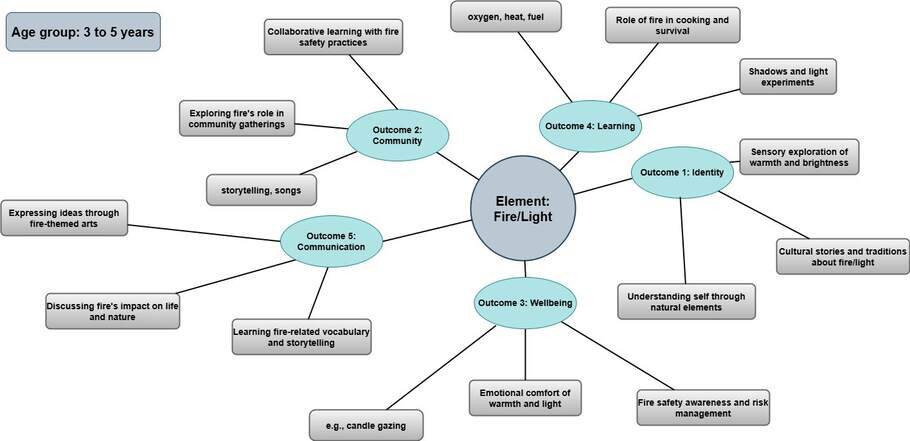
Figure 1: Mind map
2. Diverse learning and necessity
Inclusion of skills and knowledge modalities on that topic of fire and light also targets all students with a nature based approach.
Visual Learners: Observing shadows, reflections, and the effects of fire on different materials.
Auditory Learners: Feel, hear, listen to the sound of crackling fire, listen and try to tell stories around the campfires, analyze the cultural impact.
Kinesthetic Learners: Use of tangible things like when carrying out fire safety demonstrations, making shapes out of shadows, and exploration of heat from the source such as the sun (Fuchs & Corni, 2023).
Linguistic Learners: Discussing, telling/ retelling stories and role-playing in regards to fire and light.
Social learners: Students working in groups in order to comprehend the fire safety rules, learn more about cultural peculiarities, and contemplate the outcomes of various experiments.
Therefore, when they adopt and use the type of teaching that seeks to address students in more than one mode or style, it means that each child has equal opportunities to attain meaningful learning. Children have different needs during their learning and a one size fits all approach to education is usually not effective. While he always learns best hands on, some children learn best with hands, some learn best with visual or auditory, some learn best with verbal. By embracing the diversity, nature based learning utilizes the edge that hits all learners with multi sensorial learning experiences. The best things for the Visual Learner to see are seasonal changes, natural patterns, and ecosystems. Outdoor environments that allow kinesthetic learners to explore through movement, such as climbing, digging or collecting objects are the best place for them to learn.
3. Nature programs and social inclusion
Nature pedagogy enhances the social dimension of learning, meaning that minority groups, the marginalized, the less privileged, and all those discriminated against are allowed to learn with the rest with no discrimination.
Some of the samples of the teaching and assessment for all students are as follows:
Group work: For instance extenuated camp fires, engaging the children in making realistic fires while explaining on the disasters that may occur as well as who does what in the group enhances teamwork and accountability.
Culture Promotion: This makes children from all cultures exposed to stories, songs, and traditions of other cultures to improve their input (Goodenough et al. 2021).
Formal and Informal Assessment: Therefore, other than writing tests, teachers can use the children’s input, verbal contributions, and graphics like drawings or oral narratives.
In this way, the theoretical integration of the approaches brings nature-based learning environment closer to children of different abilities, language, and cultural backgrounds.
4. Implications for health, safety and wellbeing
Fire and light play a significant role in children's physical, emotional, and cognitive development. Incorporation of such elements of nature pedagogy improves health, wellbeing, and safety as follows:
Physical Wellbeing: Engaging with natural light and warmth from the sun supports children's circadian rhythms, vitamin D production, and overall energy levels. Fire related activities are one way of ensuring that children learn on how to handle some materials safely and also working on their fine motor skills. In further role, nature based learning helps build resilience because it helps children learn about their physical limits while taking risks in a healthy way. These kinds of activities, for instance moving over uneven terrain, balancing on logs and climbing trees, help to develop self confidence and problem solving skills.
Emotional Wellbeing: When it comes to a fire/light they are a way to calm down and find comfort (Neubauer, 2024). Oral tradition is also good in building friendship and assurance among peers when telling stories around a fire. Slow growing plants, seeing the seasons, interact with natural elements all teach the child to control their emotion and learn to love their surroundings. Sense of belonging, empathy and gratitude, all of which proved to have a strong impact on emotional development, was created as a result of a strong connection with nature.
Cognitive development: Factors that influence the development of cognitive ability: play that is related to fire and light helps children develop scientific reasoning, critical thinking and observation. Practical things such as creating shadows, making fire safety maps, experimenting in the dark are some of the activities that contribute to this domain.
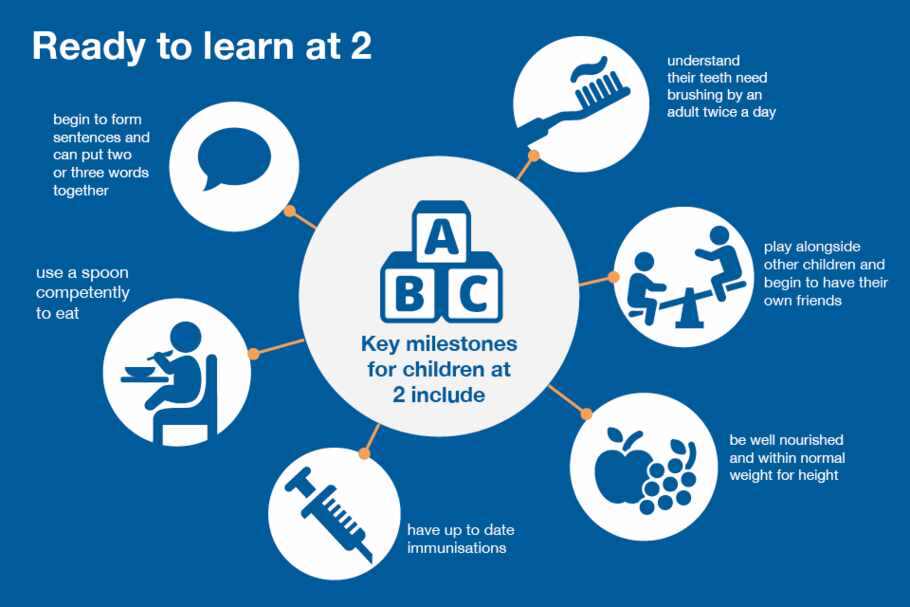
Figure 2: Implications for health, safety and wellbeing
5. Positive attitudes importance towards environment
Another important goal of nature pedagogy is to help people develop respect and curiosity towards nature. In the following ways teachers can emulate a positive disposition when nurturing attitudes towards science and nature:
Facilitating Explorations
Allowing the children to question and explore and make their findings on the issue of fire and light enables them to explore beliefs and knowledge in these regions (Sambol et al. 2024).
Real-world application
Explaining how fire/light can be used in everyday life such as in cooking, uses of light in celebrations or in cases of insecurity will make the children understand why these two aspects are deemed relevant in life.
Education on fire use, proper use of renewable energy such as solar energy, and conservation drilling into kids, make them be aware of the natural environment rights and wrongs at an early age.
It develops in children the responsibility to conserve the environment when he or she is taught how to love and care for the natural world. It establishes values of sustainability, waste reduction, and conservation of resources in human actions, thus planting seeds of values among people to grow up knowing how human actions influence the planet.
Enhancing Curiosity and Inquiry-Based Learning
A positive attitude toward the environment creates a sense of curiosity and playfulness that leads children to want to ask questions of the natural world and find out its answers. This is in line with how we think of science and critical inquiry developing problem solving skills as children develop an understanding of weather patterns, plant growth, animal action patterns, and ecosystems.
Conclusion
The fire/light exploration are very important and exciting activities which can be enjoyed by the young children. By engaging in such a type of learning, children are also able to gain all rounded development that cuts across the various domains of development. They gain the ability to respect and appreciate the forces of nature and be curious at the same time. Fire and light can be said to be incorporated into their thinking when it comes to safety consciousness. Teachers have a very important task of being able to connect the students with others and the world at large. It shall continue to explore the context that may prompt children’s interests and constant questioning. Naturally, there are much more extensive benefits from nature learning than academic: children’s mental balance is increased and they learn to deal with emotions more easily and acquire a very strong bond with nature. It also teaches children to be responsible and appreciative of the environment they live in and grow aware of the impact they generate in the world.
Struggling with your university assignments? Our professional online assignment help provides expertly researched, well-structured, and plagiarism-free work that meets academic standards. We help students tackle complex topics, meet deadlines, and achieve top grades while boosting confidence in their studies. Get reliable support and make your academic journey smoother with our trusted online assignment help.
Reference List
Journals
- Cole, D. R. (2021). Education, the anthropocene, and Deleuze/Guattari (Vol. 5). Brill. Retrieved From: https://books.google.com/books?hl=en&lr=&id=dsxKEAAAQBAJ&oi=fnd&pg=PP9&dq=FIRE/LIGHT+IN+ENVIRONMENT+PEDAGOGY:+LEARNING+INVOLVEMENTS+FOR+3-5+YEAR+OLDS&ots=EPxmpMbvgv&sig=T99iwrY_iSgwgbgKXn7b-IZFq_c [Retrieved On: 27.2.2025]
- Corni, F., & Fuchs, H. U. (2021). Primary physical science for student teachers at kindergarten and primary school levels: Part II—Implementation and evaluation of a course. Interchange, 52(2), 203-236. Retrieved From: https://link.springer.com/content/pdf/10.1007/s10780-021-09424-6.pdf [Retrieved On: 27.2.2025]
- Fuchs, H. U., & Corni, F. (2023). Primary physical science education: An imaginative approach to encounters with nature. Springer Nature. Retrieved From: https://books.google.com/books?hl=en&lr=&id=J1DcEAAAQBAJ&oi=fnd&pg=PR7&dq=FIRE/LIGHT+IN+ENVIRONMENT+PEDAGOGY:+LEARNING+INVOLVEMENTS+FOR+3-5+YEAR+OLDS&ots=XlsVOPlZ9g&sig=AXfj2OSYvn3XqbNwcspR8nTiOso [Retrieved On: 27.2.2025]
- Goodenough, A., Waite, S., & Wright, N. (2021). Place as partner: Material and affective intra-play between young people and trees. Children's Geographies, 19(2), 225-240. Retrieved From: https://eprints.glos.ac.uk/9654/8/9654-Goodenough-%282020%29-Place-as-partner-material-and-affective.pdf [Retrieved On: 27.2.2025]
- Neubauer, F. (2024). Fire-Cracked Rock analysis. Springer International Publishing, 10, 978-3. Retrieved From: https://link.springer.com/content/pdf/10.1007/978-3-031-64824-3.pdf [Retrieved On: 27.2.2025]
- Sambol, S., Dadswell, K., Collier, G.D.S., Jones, M., Pooley, K., Rehm, I., Sharples, J. and Ball, M., (2024). Systematic Review on the Effectiveness of Primary Prevention and Secondary Intervention Programs Aimed at Reducing Youth Misuse of Fire. Adolescent Research Review, pp.1-28. Retrieved From: https://link.springer.com/content/pdf/10.1007/s40894-024-00250-2.pdf [Retrieved On: 27.2.2025]
Go Through the Best and FREE Samples Written by Our Academic Experts!
Native Assignment Help. (2026). Retrieved from:
https://www.nativeassignmenthelp.co.uk/mind-map-environmental-pedagogy-assignment-47046
Native Assignment Help, (2026),
https://www.nativeassignmenthelp.co.uk/mind-map-environmental-pedagogy-assignment-47046
Native Assignment Help (2026) [Online]. Retrieved from:
https://www.nativeassignmenthelp.co.uk/mind-map-environmental-pedagogy-assignment-47046
Native Assignment Help. (Native Assignment Help, 2026)
https://www.nativeassignmenthelp.co.uk/mind-map-environmental-pedagogy-assignment-47046
- FreeDownload - 44 TimesBusiness Intelligence Assignment Sample
Introduction: Business Intelligence Assignment UK universities has been...View or download
- FreeDownload - 43 TimesMind Map Environmental Pedagogy Assignment
Fire/light In Environment Pedagogy: Learning Involvements For 3-5 Year...View or download
- FreeDownload - 39 TimesProfessional Values and Parameters of Practice Assignment Sample
Introduction This practice-focused portfolio of evidence aims to reflect on...View or download
- FreeDownload - 41 TimesBanking And Finance Assignment Sample
Banking And Finance Assignment Question 1 Introduction - Banking And...View or download
- FreeDownload - 40 TimesTesla's Manufacturing Process: A Comprehensive Analysis Assignment Sample
Tesla's Manufacturing Process: A Comprehensive Analysis Get free samples...View or download
- FreeDownload - 38 TimesNS622 Leadership and Collaborative Inter-professional Practice Assignment Sample
Introduction - NS622 Leadership and Collaborative Inter-professional...View or download
-
100% Confidential
Your personal details and order information are kept completely private with our strict confidentiality policy.
-
On-Time Delivery
Receive your assignment exactly within the promised deadline—no delays, ever.
-
Native British Writers
Get your work crafted by highly-skilled native UK writers with strong academic expertise.
-
A+ Quality Assignments
We deliver top-notch, well-researched, and perfectly structured assignments to help you secure the highest grades.