
Introduction
The Glasgow Trams project forms part of £250 million infrastructure development plan and is designed to encourage the movement of people within city more effectively to support economic growth. This innovative initiative has special relevance for Glasgow Caledonian University (GCU) because it Cardinal unlocks sustainable urban transport while meeting the needs of the growing city of Glasgow. On the indicator of the result, the project has been rapid and successful with the achievement beyond expectations on the observed milestones but financial risks insufficient guarantee systems remain a concern. £5.5 million remains unspent in a contingency fund, yet project directors have reservations about whether the money provided will mitigate the costs of risks. In managing risks in the context of projects, therefore, Quantitative Risk Analysis (QRA) has an important function in managing these types of uncertainty. QRA entails proactive recognition, estimation of, and ranking of threats that are likely to impact the duration and cost of the project. Using refined modeling, it offers recommendation on realizable possibilities, which can be valuable for proactively managing resources and planning risk management measures in projects. In the case of Glasgow Trams project, QRA is most valuable when used to establish if the contingency fund available is sufficient to handle such risks. To achieve this, QRA highlights areas likely to lead to cost overruns and their probability and severity so that the project team will have what is needed to develop viable risk management measures. It is a way of ensuring that, the financial part of project is well taken care of and at the same time even if there are some uncertainties the time line is well checked.
Methodology
The approach used in the development of the Glasgow Trams Project Risk Register was based on having the Quantitative Risk Analysis as a systematic approach intent on identifying, measuring, comparing and controlling the potential adverse effects of risks on the project. This approach employed probabilistic modeling via @Risk application, which facilitated risk evaluations derived from data within the project’s risk register. This process led to categorization of risks in relation to causes, impacts and likelihood; this made sure that a proper structure for handling analyses was in place. In assessing the identified risks, probability distributions were attached to enable quantitation of the variability in cost and time. Such distributions were triangular distributions for poor cable management risks with defined minimum, most likely, and maximum cost; and discrete distributions for risks with particular measures, such as the possession availability (Adie et al. 2022). After the allocation of distributions, Monte Carlo simulations for 10,000 iterations were used with objective probabilities identified based on the accumulation probability of all further risks. This simulation incorporated qualities of coupled risks; for instance, delay in statutory approvals and planning. The strengths derived from the probabilistic approach were the possibilities of quantifying the probability and the amount that is likely to go beyond the allocated contingency fund. Further, a mitigation measure was adopted alongside the analysis to determine the extent to which exposure could be lowered. Specific means were performed like preparatory investigations to avoid the extra spending and surveys to manage unidentified providers initiating a proper correction of the possible high likelihood, high risk situations (Taylor, 2020). This approach made it easy to have sound contingency measures in case of occurrence of the cited hazards as well as enhanced monitoring of the risks informing the project directors on the areas that required most attention. The use of statistical modeling in combination with real data offered a strong protection layer for the financial and operational goals and ambitions of the project and provided sufficient contingency fund guarantee under any circumstance.
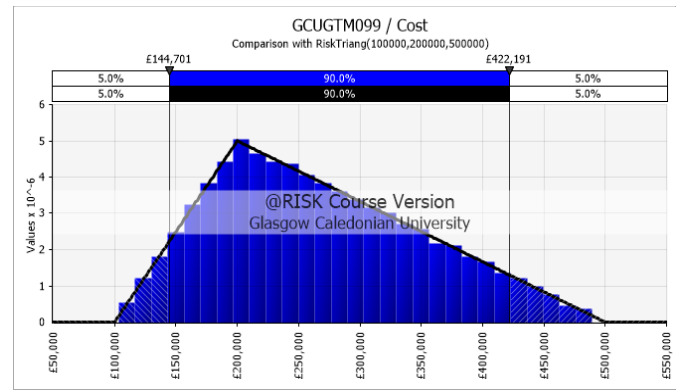
Figure 1: Comparison Graph between Theoretical and Simulated values
The sensitivity report shows the classification and cost volatility of critical risk factors of the Glasgow Trams project, particularly the volatility of the financial aspect of the factors. The risks enumerated totaled to 13, and the percentage of cost breakdown shows that GCUGTM033, GCUGTM007 and CUGTM023 rank as the three most risky of them all with cost estimate at £4.32 million to £6.45 million; £3.84 million to £ 5.88 million and £3.39 million to £ 5.38 million respectively. There are other risks, including GCUGTM094 and GCUGTM059, where risk impact has significant fluctuations in financial aspect. These effects suggest that often appropriate risk control measures such as sound forecasting and protective measures are main when controlling variability. By managing these high cost risks as the top priority the project will be more easily able to protect its financial and operations integrity while reducing the possibilities of disruption to its schedules and costs.

Figure 2: Sensitivity Report
Risk Identification and Modeling
Risk assessment entailed a systematic approach of analyzing and categorizing the risks according to their source, consequences, and likelihood Models for best assessment were developed and instituted from data in the risk register. The variability of each identified risk was then assessed and the risk was quantified with probability distributions that captured possible cost and schedule deviations. For instance, risks such as ineffective cable management were estimated using triangular distribution because there are approximate estimates of minimum, most likely and maximum cost of the risks while possession availability was estimated using discrete distribution because the variable has specific marginal outcomes. Thus, this classification and modelling was made in order to have a reasonable portrayal of the various risks that may affect the project (Wabuyele et al. 2022). The use of all these probability distributions enabled a clearer quantification of uncertainties which informed subsequent simulations. Monte Carlo simulations were used to study the combined impact of different risks on different probability distributions and their intercepts with each other under interaction risks such as statutory approval delays or unexpected planning problems. It also helped in defining precise risks and suggesting that suitable risk mitigation solutions should be used, as the costs and timing were optimized (Yin and Xiao, 2024). This process peroformed effective risk analysis and assessment using advanced modeling and detailed datasheet analysis to give project managers direct result on the exact potential financial or operational outcome of the risks and the appropriate ways and means that could be used in handling the risks.
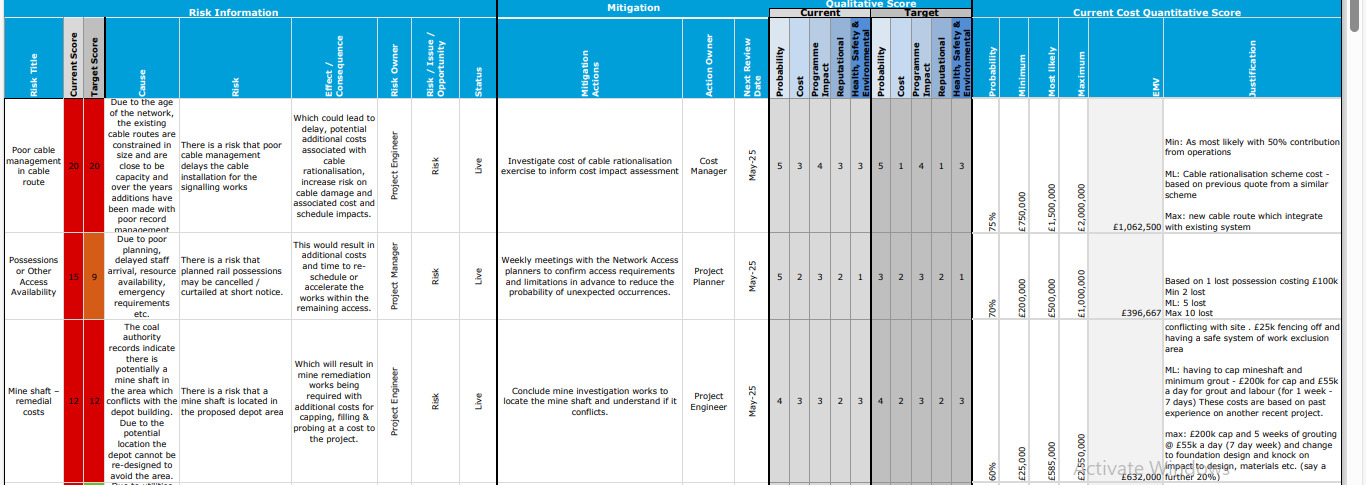
Figure 2: Risk Identification
Monte Carlo Simulation
With regards to the identified risks, Monte Carlo simulation was used to assess the overall exposure or impact of the risks and offered variability or probability significance on potential cost and schedule variations to the specific project. The 10,000 iterations of simulation recognized the interactions between these risks based on distribution that had been established during the risk identification activity. In addition, assuming a probability distribution of total project costs and construction time was carried out to establish the effects of different conditions on project result (Schofield, 2021). Coordinate dependencies between risks were employed to account for co-dependency features that exist in a project and that may include delays in statutory approvals or any other unexpected planning challenges (McQueenie, 2021). The contingency fund has also been given adequate attention so that its possible overexpenditure can be predicted as a means of aiding strategic planning. For example, the simulation resulted into particular situations which produced both high risk impact probability and magnified probability whereby sound contingency plans were deemed necessary. Also of note in the probabilistic analysis was the ability to establish the P50 and P80 risk values signifying approximate median and conservative figures for the total cost of a project. These outputs helped in identifying which areas needed to be funded and which risk had to be given priority for its remedial action. Monte Carlo simulation was used in the analysis done to provide a quantitative support to risk assessment so that the optimum balance between the needed financial and operation parameters could be designed and implemented while keeping in mind the risks attached to each scenario.
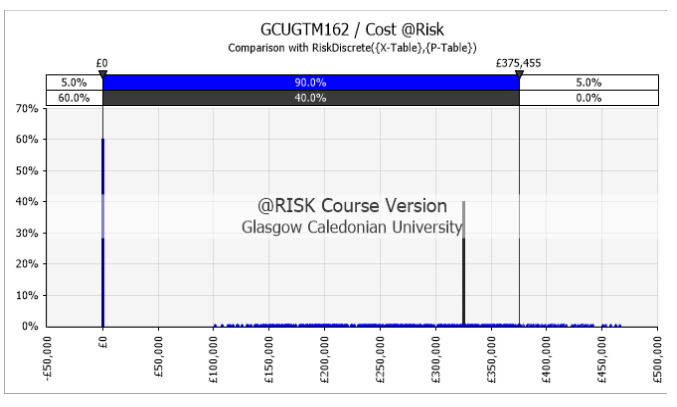
Figure 3: Probability distributions
Mitigation Actions and Analysis
The two areas of project work can be summarized as actions and analysis that involved the development of risk mitigation strategies to reduce the implications that were categorised during the risk assessment of the project in terms of their potential financial and operational implication all in an effort to address the probable, high-risk circumstances. This entailed addition of specific measures into the risk model comprising preparatory investigations and improved surveys for uncharted services; expenditure exceeding forecasts (Munuhwa, 2024). Major focus was achieved towards addressing some of the challenges of inadequate and proper cable management & improper mine shaft, which was costly. I especially ensured that the project incorporated a systematic approach to engage different stakeholders to allow early assessment of the risk of statutory approvals delays and early measures of risk management. To increase the identification of emergent risks as well as decision-making in moral dilemma in the VR environment, the use of microsurveys and detailed planning contingency analysis was used (Bennett, 2024). The risks that were being addressed here interdependent risks and the mitigation strategies being utilised including contingency planning sought to enhance the use of resources and time on projects (Wang et al. 2020). Further, these actions offered the project team a strong outline of where and how the risks could be measured and re-evaluated with flexibility to reflect organizational goals in regards to the budget and operations and the advancement of the project. Not only that, mitigation measures expanded the view across cost and schedule to improve efficiency, as well as offering directions for modifying the strategies in response to emerging threats, to ensure the project was delivered successfully.
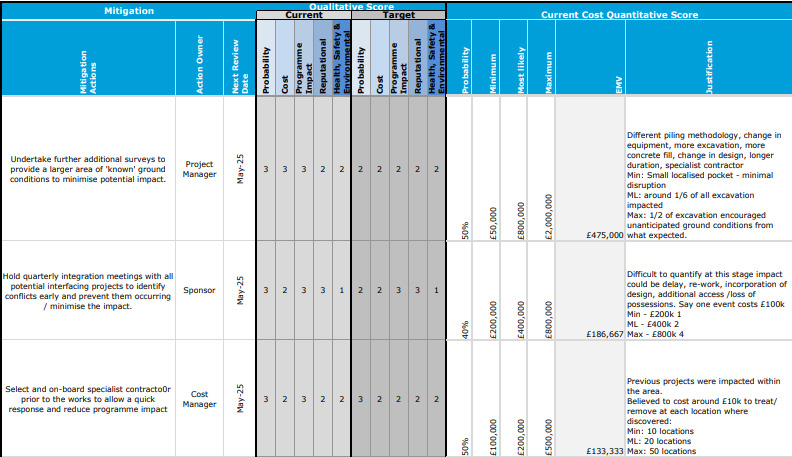
Figure 4: Mitigation Actions and Analysis
Outputs
The Glasgow Trams project Quantitative Risk Analysis part of the Outputs Result in the following: The £5.5m contingency fund is fundamental in the use of QRA (Sabo et al. 2023). The estimated total risk cost in this contingency plan is £5.49 million; however, in general conditions, the P50 value of £4.49 million suggests that the contingency is adequate when there is only 50 per cent chance that the total risk cost of £5.49 million will not be exceeded. These findings suggest that there is need to incorporate the public in policy making in order to consider the stakeholders and general development of efficiencies in each stage of a project (Berrie, 2024). Specifically, the P80 value carries probability of cost costing as much as £7.15m, £1.65m over the current contingency.
P50 and P80 Outputs
The P50 value reflects the expected central estimate of total risk exposure by indicating the 50 per cent likelihood that total risk costs will not be higher than £4.49m in the contingency fund, further affirming additional that OP’s contingency fund is generally adequate under normal operating circumstances. This is in contrast to the P80 which represents the 80% confidence level that costs will not rise above £7.15m thereby surpassing the £5.5m contingency and a likelihood of £1.65m deficiency in the worse-case scenarios (Earnest et al. 2021). Such results, argue the need for effective policies which involve risk management since adverse conditions involving varied risks could lead to escalated cost. The outputs underscore sustained vigilance on the risk levels and consequent permanent modification of the risk management interventions to counter multiple risks (Kuo et al. 2024). Consequently, there remains a need for proper measures of mitigating identified risks that are specific in nature like improper cable management as well as clash, so as to ensure that the contingency fund maintains adequacy (Olaniyi et al. 2024). Constant assessment of risk scenarios coupled with prior planning effectively supports the possible alterations of the project’s funding mechanism that would help preserve the project’s financial health on one hand and protect it from unbalanced and unpredictable cost fluctuations on the other hand. The Foundation of financial management in the context engages protection mechanisms and contingency plans to protect the project against the worse and provide a good foundation for the success of the project through properly designed and well-documented risk management strategies (Halimergün, 2024). These are the outputs which if targeted by other stakeholders, will mean that they are focusing on the the essentials that pose likely vulnerability and the potential consequences likely to affect the project finace.
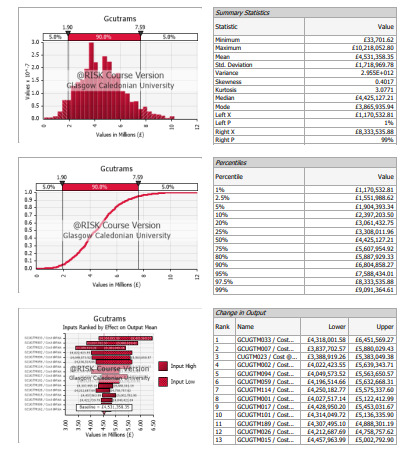
Figure 5: Graph Output
Key Influencing Risks
Most of the overall project costs are amenable to particular high-impact risks that need to be addressed categorically. The cost impact under GCU-GTM-023 is at £1.06m showing the benefit of early action to take prompt measures that can reduce the further increase of expenditures in the future (Berrie, 2024). Unknown utilities further complicate the effort, along with structural conflicts contributing an extra £632k for remediation of mine shafts (GCU-GTM-007) and £400k for responding to uncharted services (GCU-GTM-094). Where there are_flutter Legislative approvals (GCU-GTM-189) and which may lead to the extension of time by 31weeks and £83,000 will also be spent. Such risks requires associated protective measures such as, assessment, consultation and planning to minimize the negative effects to ensure that the project is not compromised and that the costs averted (Mac Domhnaill, 2024). Prescribed measures make contingency fund management efficient while still achieving financial stability. Sophisticated approaches to risk analysis improve the quality of decisions made as well as help solve new problems that arise on the way. The management of risks helps in fiscal discipline and makes progress while preventing the social project from having many financial risks and delays.
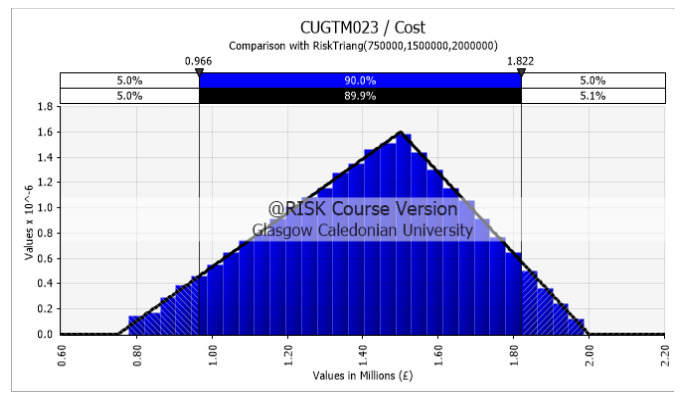
Figure 6: Financial Impact Graph
Implications and Recommendations
At £1.65m below the operating expenditure, the P80 output exemplifies suboptimal conditions of risk exposure beyond contingency funds that are available to the organisation (Murray, 2023). The high level priorities that would prevent further loss of assets and bring greater value to adequate Contingency Fund are elimination of high EMV risks including poor cable management, and mine shaft. These risks are best preventable if the mitigation strategies are well implemented in addition to proper resource management (Krückeberg, 2022). Since the project environment is constantly changing, a monitoring role becomes important as well as the assessment of risks very often in the context of monitoring the effective functioning of the contingency plan. Risk models and its update frequently and integrating new data will facilitate well-informed decisions and financial security (Joyce, 2023). Stable and active management, focus on the developing collaborative project plan, as well as maintaining the flexibility when it comes to the project execution will help it to minimize the exposure to the potential adverse effects generated by a certain type of scenario or situation thus preserving the viable and achievable financial and business goals and objectives of the project.
Conclusion
The Quantitative Cost Risk Analysis (QCRA) shows that the £5.5 million contingency is enough only under nominal conditions (P50), but under worse conditions (P80) the Glasgow Trams project is £1.65 million short . The current contingency does not afford full safeguard against the project’s financial threats arising from the above-stated uncertain variables should they occur together. Contrary to possible adverse outcomes of high-impact risks, such as poor cable management and mine shaft remediation, it is crucial to prioritize preventing them as otherwise the cost might skyrocket. Therefore, changes must be introduced in assessing and maintaining the contingency fund and the ongoing exposure to risks; adapting financial strategies to the new data and fluctuating project circumstances will be critical for achieving financial sustainability. However, successful cooperation in the studied areas and the ability to make changes during the project’s life-cycle will make it possible to eliminate high risks while making a project’s financial efficiency a priority. Since risks are managed proactively and risk responses implemented the probability that the project will be delivered on the project time frame and cost while adverse conditions exist are high. Hence technical issues will always form an important part of the project and the integration of dynamic risk management approaches will be crucial in sustainably taking the project forward and dealing with cases of financial vulnerability.
At Native Assignment Help, we offer professional Assignment Help for project management and construction risk analysis subjects in line with UK academic standards. Our experienced writers produce structured, evidence-based, and plagiarism-free assignments that help students achieve strong academic outcomes in quantitative risk and infrastructure project evaluations.
Reference List
Journals
Adie, M., Green, B., Charters, M., Lamburn, D., Lee, G. and Tobin, A., 2022. Enhancement-led Institutional Review of Abertay University: Technical Report.
Bennett, R.J. and Hannah, L., 2024. The sources of scale: Large employers in Britain in 1881. Business History, pp.1-23.
Berrie, L., Feng, Z., Rice, D., Clemens, T., Williamson, L. and Dibben, C., 2024. Does cycle commuting reduce the risk of mental ill-health? An instrumental variable analysis using distance to nearest cycle path. International journal of epidemiology, 53(1), p.dyad153.
Berrie, L., Feng, Z., Rice, D., Clemens, T., Williamson, L. and Dibben, C., 2024. IEA.
Earnest, A., Palmer, C., O'Reilly, G., Burrell, M., McKie, E., Rao, S., Curtis, K. and Cameron, P., 2021. Development and validation of a risk-adjustment model for mortality and hospital length of stay for trauma patients: a prospective registry-based study in Australia. BMJ open, 11(8), p.e050795.
Halimergün, Y., Özden, A., Şahin, S.N.A. and Kocaman, H., 2024. Will new tram lines enhance the connectivity and walkability? A case study of Sakarya. Sustainable Social Development. 2024; 2 (5): 2886 [online].
Joyce, E., 2023. The Challenge: Magazine for the Center for Gifted Studies (No. 55, Fall 2023).
Krückeberg, J., 2022. Assembled Remembering: Youth and Digital Memory Practices (Doctoral dissertation, Staats-und Universitätsbibliothek Hamburg Carl von Ossietzky).
Kuo, T.S., Chen, Q.Z., Zhang, A.X., Hsieh, J., Zhu, H. and Holstein, K., 2024. PolicyCraft: Supporting Collaborative and Participatory Policy Design through Case-Grounded Deliberation. arXiv preprint arXiv:2409.15644.
Mac Domhnaill, C., 2024. All hail? The impact of ride hailing platforms on the use of other transport modes (No. WP24/09). UCD Centre for Economic Research Working Paper Series.
McQueenie, J.M., 2021. Intermediation as practice: Joining the dots between community, culture and commerce (Doctoral dissertation, Queensland University of Technology).
Munuhwa, S., 2024. Driving towards emission-free urban centers: exploring Glasgow's sustainable road transport. In Contemporary Solutions for Sustainable Transportation Practices (pp. 186-206). IGI Global.
Murray, M., 2023, October. An autoethnography of becoming an innovative engineering academic: punk, pirate and guerilla pedagogy. In SEFI Conference 2023.
Olaniyi, T.K. and Ajayi, A.J., 2024. Building a Sustainable City in Lagos: Insight from the Transport Initiatives from Freiburg and London.
Sabo, M.C., Thuong, N.T., Chang, X., Ardiansyah, E., Tram, T.T., Hai, H.T., Nghia, H.D., Bang, N.D., Dian, S., Ganiem, A.R. and Shaporifar, S., 2023. MUC5AC genetic variation is associated with tuberculous meningitis cerebral spinal fluid cytokine responses and mortality. The Journal of Infectious Diseases, 228(3), pp.343-352.
Schofield, J., Steven, D., Foster, R., Matheson, C., Baldacchino, A., McAuley, A. and Parkes, T., 2021. Quantifying prescribed high dose opioids in the community and risk of overdose. BMC public health, 21, pp.1-11.
Taylor, D., 2020. The Sewer rats: homelessness, health and the Johannesburg subunit for displaced persons. Unpublished master’s thesis. Department of Anthropology, University of the Witwatersrand, Johannesburg, South Africa.
Wabuyele, C.K., Ajayi, C. and Kalu, L., 2022. Educational material: inserting and removing nasogastric tube for adults and children.
Wang, H., Boulougouris, E., Theotokatos, G., Priftis, A., Shi, G., Dahle, M. and Tolo, E., 2020. Risk assessment of a battery-powered high-speed ferry using formal safety assessment. Safety, 6(3), p.39.
Yin, M. and Xiao, R., 2024. How We See Changes How We Feel: Investigating the Effect of Visual Point-of-View on Decision-Making in VR Environments. Proceedings of the ACM on Human-Computer Interaction, 8(CSCW2), pp.1-27.
Go Through the Best and FREE Samples Written by Our Academic Experts!
Native Assignment Help. (2026). Retrieved from:
https://www.nativeassignmenthelp.co.uk/mmn330203-glasgow-trams-risk-analysis-assignment-43753
Native Assignment Help, (2026),
https://www.nativeassignmenthelp.co.uk/mmn330203-glasgow-trams-risk-analysis-assignment-43753
Native Assignment Help (2026) [Online]. Retrieved from:
https://www.nativeassignmenthelp.co.uk/mmn330203-glasgow-trams-risk-analysis-assignment-43753
Native Assignment Help. (Native Assignment Help, 2026)
https://www.nativeassignmenthelp.co.uk/mmn330203-glasgow-trams-risk-analysis-assignment-43753
- FreeDownload - 37 TimesSmoke Exposure And Children's Health Outcomes Assignment
Introduction Background of the study Maternal smoking and stress during...View or download
- FreeDownload - 39 TimesCyber Security Application Portfolio Assignment Sample
Introduction - Cyber Security Application Portfolio Cyber security is a...View or download
- FreeDownload - 35 TimesUnit 4: Leadership and Management Assignment Sample
Introduction: Leadership and Management Assignment This report discovers the...View or download
- FreeDownload - 41 TimesUnit- 506: Developing Using And Organizing Resources Within Specialist Area Assignment Sample
Unit- 506: Developing Using And Organizing Resources Within Specialist...View or download
- FreeDownload - 43 TimesPlagiarism in Academia and Business: Challenges and Best Practices
Introduction Plagiarism is representation of another person’s thoughts,...View or download
- FreeDownload - 42 TimesMG628 International Marketing Management Assignment Sample
Green Chef Expansion via E-Commerce in Denmark 1. Introduction...View or download
-
100% Confidential
Your personal details and order information are kept completely private with our strict confidentiality policy.
-
On-Time Delivery
Receive your assignment exactly within the promised deadline—no delays, ever.
-
Native British Writers
Get your work crafted by highly-skilled native UK writers with strong academic expertise.
-
A+ Quality Assignments
We deliver top-notch, well-researched, and perfectly structured assignments to help you secure the highest grades.