Task 1: Ungrouped Descriptive Statistics
a. Correct completed table
|
Expenditure (£) on Multi Mixers |
|
|
Mean |
217 |
|
Median |
230 |
|
Mode |
145 |
|
Standard Deviation |
67 |
|
Sample Variance |
4,489 |
|
Range |
300 |
|
Minimum |
50 |
|
Maximum |
350 |
|
Sum |
55,552 |
|
Count |
256 |
|
Lower Quartile |
140 |
|
Upper Quartile |
320 |
|
Inter Quartile Range (IQR) |
180 |
|
Coefficient of Variation (%) |
31 |
Table 1: Descriptive calculation
(Source: Self-created)
b) Count:
Using the formula sum divided by mean the total count value is 256. In this case, the mean value and sum value are provided which are 217 and 55552.
Count=sum/mean=55552/217=256
c) Lower quartile
In this case, the “upper quartile” is 320 and the internal “quartile range” is 180. After deducting the internal quartile range from the upper quartile value the lower quartile is 140 (Cardoso, et al, 2025).
Q1=Q3-IQR=320-180=140
d) Coefficient of variation
In this case, the SD value is 67 and the value of the mean is 217, after applying the proper formula the CV is 31%.
CV= Standard Deviation / Mean * 100= 67/217*100= 31%
e) Sample variance
The formula of the SV is the SD2 which means 672. In this case, the sample variance is 4489.
Sample Variance= Standard Devitaion2= 672= 4489
f) Distribution of the data
It gives an impression of “right-skewed” data as mean £217 is lesser than median of £230. This implies that, perhaps, one or two observations are distorting the mean in this case by making the value appear much lower than it should be. Finally, it is possible to observe a relatively high mean (£300) and a relatively high dispersion (£67) of the total expenses on multi-mixers (Sheng, et al, 2021). The existence of a low mode (£145) also contradicts this theory because if price distribution was normally distributed, the mode should also be at the mid-point of the distribution identified as the median.
g) Standard deviation as per scenario
Standard Deviation (£67) is the measure of variation of each expenditure up from expenditure of mean is £217. This indicates that the overall values usually lie between £67 ahead or below the mean value, thereby implying that the majority values in this case should be between £150 to £284 (Nivedhaa, 2024). Due to the high level of standard deviation there is also great variability regarding how much was spent on multi-mixer.
h) Interpretation of mode
Multi-mixers’ expenditure is most frequently bought at £145. This indicates that of all recorded purchases, £145 was the mode of spending even though the mean was £217, and the median was £230 (Quach, et al, 2022). This might mean that there was a high prevalence of items bought at a relatively cheap price range from discounts or low-cost options availed through the investors.
Task 2: Grouped Descriptive Statistics
2a. Frequency
|
Price Band (£) |
Number of Invoices (f) |
Percentage Frequency (%) |
Cumulative Frequency |
Cumulative Percentage Frequency (%) |
|
50 – 100 |
28 |
14 |
28 |
14 |
|
100 – 150 |
37 |
19 |
65 |
33 |
|
150 – 200 |
45 |
23 |
110 |
55 |
|
200 – 250 |
56 |
28 |
166 |
83 |
|
250 – 300 |
24 |
12 |
190 |
95 |
|
300 – 350 |
10 |
5 |
200 |
100 |
Table 2: Frequency
(Source: Self-created)
b. Stranded Deviation
|
Price Band (£) |
Number of Invoices (fi) |
Class Mark (xi) |
fi * xi |
|
50 – 100 |
28 |
75 |
2100 |
|
100 – 150 |
37 |
125 |
4625 |
|
150 – 200 |
45 |
175 |
7875 |
|
200 – 250 |
56 |
225 |
12600 |
|
250 – 300 |
24 |
275 |
6600 |
|
300 – 350 |
10 |
325 |
3250 |
|
200 |
37050 |
|
Mean calculation |
Formula |
values |
Total |
|
Mean |
∑fx/∑x |
(37050/200) |
185 |
|
Calculate the Standard Deviation |
|||
|
Midpoint (x) |
x-185 |
(x−185)2 |
f(x−185)2 |
|
75 |
-110 |
12100 |
338800 |
|
125 |
-60 |
3600 |
133200 |
|
175 |
-10 |
100 |
4500 |
|
225 |
40 |
1600 |
89600 |
|
275 |
90 |
8100 |
194400 |
|
325 |
140 |
19600 |
196000 |
|
956500 |
|||
|
Standard deviation |
69 |
Table 3: Standard deviation
(Source: Self-created)
2c. Median
|
The Median Class |
∑f/2 |
100 |
|
|
Price band (£): Lower- and Upper-class boundary |
Number of Invoices (f) |
Cumulative Frequency |
|
|
50 |
100 |
28 |
28 |
|
100 |
150 |
37 |
65 |
|
150 |
200 |
45 |
110 |
|
200 |
250 |
56 |
166 |
|
250 |
300 |
24 |
190 |
|
300 |
350 |
10 |
200 |
|
Apply the Median Formula |
|||
|
Median |
lower boundary of median class+(total frequency/2-cumulative frequency before median class/frequency of median class)*class width |
||
|
189 |
Table 4: Median
(Source: Self-created)
2d. Discussion
- >
- Applying this method, it is calculated that the average expenditure in Birmingham is 185 pounds, while in Manchester this indicator is 205 pounds, which proves the fact that customers in Manchester spend more money per visit.
- Indeed, the expenditure of Birmingham (£69) is slightly higher than Manchester (£65), indicating that distribution in Birmingham is comparatively wider, a good indication that there is more volatility in expenditure than is the case in Manchester (Bahuguna, et al, 2023).
Task 3: Data Types
a) Differences Between Cross-Sectional and Time Series Data
The data of “Cross-Sectional” includes only information drawn from the time of the survey and therefore fails to present the characteristics of consumers. For instance, when a questionnaire is constructed in a certain month, for instance July of the year 2024, the data that is collected could be cross-sectional if the data collected is customer aspects (Koohang, et al, 2023). On the other hand, the figures that change over a time interval form a time series data like sales for the past months or a change in the preferences of consumers over the years. It helps to analyze customer behavior and make a pattern of the same.
b) Data Type Recommendation
Secondary data including “time series” and “cross-sectional” data should be collected. While the “cross-sectional” data shows the profiles of customers as a main focus and thus the present population and acquisition tendencies, time series helps to determine how these trends are developing, which is helpful in long-term market planning (Mäkinen, et al, 2021).
Task 4: Networking
4a. Network diagram

Figure 1: Networking
(Source: Self-created)
4b. Critical path
- It will bring 38 weeks to complete the overall project.
- However, the “critical path” is the longest chain of activities that have no float or free time at all: A → C → D → F → H → I → J
4c. Non-critical activities
The “non-critical activities” and their durations are:
- Path 1: B → E → F → H → I → J (29 Weeks)
- Path 2: A → C → D → G → J (26 Weeks)
4d. Discussion about the diagram
The “critical path” indicates the string of activities that cannot be delayed if a project has to take the least amount of time it can. Any such delays manifest in any of these activities will culminate in success in the completion of the particular project (Mogaji and Nguyen, 2022). It is useful for planning, resource management, and activities that should be more closely monitored in terms of their progress. Through the critical chain, it will be easier for the project managers to identify key activities that require much attention in order to prevent delays when delivering the project. It aids in identifying critical activities or activities that may delay an organization from accomplishing its objectives and goals hence why it is an effective technique in project management and in accomplishing set projects.
Task 5: Sampling
The kitchen appliances retailer may have to consider a type of sampling technique referred to as stratified sampling to arrive at a choice of 250 invoices among the 2,500 total. First of all, the invoices have to be grouped into relative subsamples that would be more informative in terms of the features, such as price range, product type, or customer location (Del, et al, 2021). For instance, if invoices have been categorized as falling within a particular price bracket out of the total hundred, then out of the 250 selected invoices twenty of them should be from that category. Following this, the remaining population in each stratum can be taken at random by way of a drawlot in order to arrive at the required sample size for each stratum. This approach is diverse, makes a result more accurate, and helps to eliminate a sampling bias, which means that it is better for gaining an understanding of customer’s purchasing behavior.
Task 6: Correlation and Regression
a) Variables description
Sales value (£ millions) is independent unsuccessful Product because it is on the list that based on Value of the Average Order (£). The higher order values normally help in increasing the sales. In this regard, the retailer was evaluating this relationship in order to attempt to balance resources (Aldoseri, et al, 2023). Since the preceding plan manipulates the level of sales (£ millions), the classification of the latter as dependent results from it.
b) Creation of graph
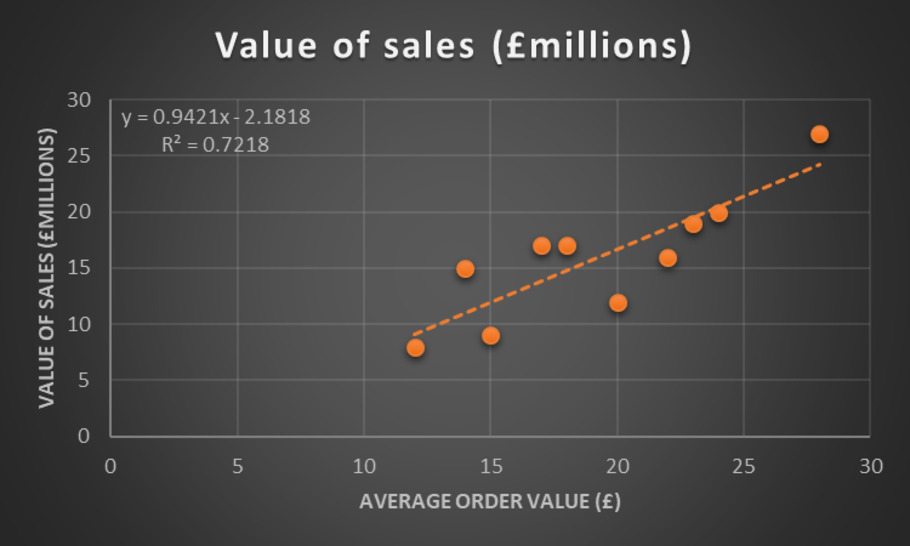
Figure 2: Scatter plot
(Source: Self-created)
c) Correlation coefficient
After applying the formula, the correlation coefficient in this case is 0.85. It determines whether the correlation coefficient is positive or strong which means there is a good relation between the variables.
|
Correlation coefficient |
√R2 |
√0.7218 |
0.85 |
d) Coefficient of Determination
72 percent of overall sales fluctuation can changes in the value of average order while 28 percent can be attributed to other factors that are not incorporated in the model (Polese, et al, 2023). This shows that sales performance depends on various variables but it also points to a possible existence of a very close relationship between price and sales.
e) Value of Sales
|
Value of Sales |
0.9421x-2.1818 |
The above equation shows the total number of sales based on the average value.
f) Interoperation of value of the intercept
This negative value -2.1818 means that if the avg order value is equal to 0, the predicted value of the sales will be almost - £ 2.18 million (Devineni, 2024). This is telling that in the absence of any order, the business will lose about 2.18 million of money.
g) Interpret the value of the gradient
The value of 0.9421 also suggests that, for every one pound increase in “average order value” there will be a corresponding 0.94 million pounds increase in sales. This has a positive coefficient of 0.7777 and is, therefore, quite high showing a direct positive correlation between the two variables.
Complex calculations, data interpretation, and academic structure can be challenging. Professional assignment help ensures accuracy, clarity, and confidence in submission.
Reference List
Journals
Cardoso, I., Nunes, S., Brás, P., Viegas, J.M., Antunes, M.M., Ferreira, A., Almeida, I., Custódio, I., Trigo, C., Laranjo, S. and Graça, R., 2025. The contribution of genetics to the understanding and management of cardiomyopathies: Part 1. Revista Portuguesa de Cardiologia.
Sheng, J., Amankwah‐Amoah, J., Khan, Z. and Wang, X., 2021. COVID‐19 pandemic in the new era of big data analytics: Methodological innovations and future research directions. British Journal of Management, 32(4), pp.1164-1183.
Nivedhaa, N., 2024. From raw data to actionable insights: A holistic survey of data science processes. International Journal of Data Science (IJDS), 1(1), pp.1-16.
Quach, S., Thaichon, P., Martin, K.D., Weaven, S. and Palmatier, R.W., 2022. Digital technologies: tensions in privacy and data. Journal of the Academy of Marketing Science, 50(6), pp.1299-1323.
Bahuguna, P.C., Srivastava, R. and Tiwari, S., 2023. Two-decade journey of green human resource management research: a bibliometric analysis. Benchmarking: An International Journal, 30(2), pp.585-602.
Koohang, A., Nord, J.H., Ooi, K.B., Tan, G.W.H., Al-Emran, M., Aw, E.C.X., Baabdullah, A.M., Buhalis, D., Cham, T.H., Dennis, C. and Dutot, V., 2023. Shaping the metaverse into reality: a holistic multidisciplinary understanding of opportunities, challenges, and avenues for future investigation. Journal of Computer Information Systems, 63(3), pp.735-765.
Mäkinen, S., Skogström, H., Laaksonen, E. and Mikkonen, T., 2021, May. Who needs MLOps: What data scientists seek to accomplish and how can MLOps help?. In 2021 IEEE/ACM 1st Workshop on AI Engineering-Software Engineering for AI (WAIN) (pp. 109-112). IEEE.
Mogaji, E. and Nguyen, N.P., 2022. Managers' understanding of artificial intelligence in relation to marketing financial services: insights from a cross-country study. International Journal of Bank Marketing, 40(6), pp.1272-1298.
Del Giudice, M., Chierici, R., Mazzucchelli, A. and Fiano, F., 2021. Supply chain management in the era of circular economy: the moderating effect of big data. The International Journal of Logistics Management, 32(2), pp.337-356.
Aldoseri, A., Al-Khalifa, K.N. and Hamouda, A.M., 2023. Re-thinking data strategy and integration for artificial intelligence: concepts, opportunities, and challenges. Applied Sciences, 13(12), p.7082.
Polese, M., Bonati, L., D’oro, S., Basagni, S. and Melodia, T., 2023. Understanding O-RAN: Architecture, interfaces, algorithms, security, and research challenges. IEEE Communications Surveys & Tutorials, 25(2), pp.1376-1411.
Devineni, S.K., 2024. AI in data privacy and security. International Journal of Artificial Intelligence & Machine Learning (IJAIML), 3(01), pp.35-49.
Go Through the Best and FREE Samples Written by Our Academic Experts!
Native Assignment Help. (2026). Retrieved from:
https://www.nativeassignmenthelp.co.uk/mn4063qa-understanding-managing-data-assignment-47239
Native Assignment Help, (2026),
https://www.nativeassignmenthelp.co.uk/mn4063qa-understanding-managing-data-assignment-47239
Native Assignment Help (2026) [Online]. Retrieved from:
https://www.nativeassignmenthelp.co.uk/mn4063qa-understanding-managing-data-assignment-47239
Native Assignment Help. (Native Assignment Help, 2026)
https://www.nativeassignmenthelp.co.uk/mn4063qa-understanding-managing-data-assignment-47239
- FreeDownload - 43 TimesUnit 5 Sales and Personal Selling Assignment Example
Unit 5 Sales and Personal Selling Assignment 1. Introduction - Sales and...View or download
- FreeDownload - 41 TimesUnit 12: Organisational Behaviour Assignment Sample
Introduction Of Organisational Behaviour Assignment Need an Assignment Helper...View or download
- FreeDownload - 39 TimesTesco's Digital Marketing Strategy and Digital Transformation Assignment Sample
Tesco's Digital Marketing Strategy and Digital Transformation Introduction...View or download
- FreeDownload - 42 TimesEffects Of Technological Approach Of The HRM In Tesco Assignment Sample
Effects Of the Technological Approach Of The HRM in Tesco Introduction-Effects...View or download
- FreeDownload - 38 TimesUnit 17 Understanding and Leading Change Assignment Example
Introduction Of Understanding and Leading Change Assignment It is a...View or download
- FreeDownload - 45 TimesENEB com NLP Assignment Sample
ENEB com NLP 1. Choice of subject/topic In my last NLP assignment, I decided...View or download
-
100% Confidential
Your personal details and order information are kept completely private with our strict confidentiality policy.
-
On-Time Delivery
Receive your assignment exactly within the promised deadline—no delays, ever.
-
Native British Writers
Get your work crafted by highly-skilled native UK writers with strong academic expertise.
-
A+ Quality Assignments
We deliver top-notch, well-researched, and perfectly structured assignments to help you secure the highest grades.