
- Introduction
- SECTION ONE: Force and Motion
- AC 11.1: Compare velocity and acceleration
- AC 11.2: Application of Newton’s Laws of Motion to examples
- SECTION TWO: Energy and Momentum
- AC 21.1: Describe different forms of energy
- AC 21.2: Explain the principle of energy conservation with reference to energy efficiency
- AC 21.3: Define the term “momentum”
- AC 21.4: Apply the law of conservation of momentum to examples
- SECTION THREE: Waves
- AC 31.1: Compare transverse and longitudinal waves with reference to waveform, frequency, and wavelength
- AC 31.2: Explain the reflection, refraction and diffraction of water waves and sound waves
- AC 41.1: Explain the laws of: (a) reflection (b) refraction
- AC 41.2: Describe a scientific application of the laws of reflection
- AC 41.3: Explain the conditions for internal reflection and refraction at the same point on the media boundary
- SECTION FOUR: Magnetism and Electricity
- AC 51.1: Explain magnetism and its laws
- AC 51.2: Illustrate in a diagram the directions of the magnetic field surrounding a bar magnet, a current carrying wire and a solenoid
- AC 51.3: Describe the behaviour of an electric current and potential difference in series and parallel circuits
Introduction
Physics explains how objects move, how energy is transferred, and how forces and waves influence the world around us. This assignment sample explores fundamental concepts, including Newton’s laws of motion, conservation of energy and momentum, wave behaviour, magnetism and electrical circuits.
Native Assignment Help provides academic guidance to help students understand complex physics concepts, organise scientific explanations and improve assignment structure. An experienced Assignment Helper UK can support students with understanding physics principles, applying relevant equations and presenting examples clearly in line with UK academic expectations.
SECTION ONE: Force and Motion
AC 11.1: Compare velocity and acceleration
Velocity is considered to be the rate of change of displacement over time which has both the direction and magnitude (Carr et al. 2022). Whereas, acceleration is the rate of change of velocity over time. For example, if a car moves at a constant velocity of 50 km/h, it has zero acceleration. But if the car accelerates to 80 km/h in 10 seconds, it gains positive acceleration.
The equation that represents velocity is,
v=t/d
The equation that represents acceleration is,
a= change in v/t
Velocity is a vector quantity by which the rate at which an object changes its position in a specific direction can be described. Both the direction and magnitude is considered in the concept of velocity. It has a significant important role in understanding motion in physics.
On the other hand, acceleration is also another vector quantity by which the rate of change of velocity over time can be measured. It indicates the speeding up, slowing down, or change of direction of an object. The standard unit of acceleration is meters per second squared (m/s²). During the slowing down of any object, negative acceleration can also occur. For the proper understanding of the forces and motion of physics, it is very important to understand the concept of acceleration.
AC 11.2: Application of Newton’s Laws of Motion to examples
First Law (Inertia):
An object at rest remains at rest or it can be in an uniform motion in a straight line and at a constant force unless acted upon by an external force. For example, a table stays in a table unless it has been pushed by an external force.
Second Law (F = ma):
The force which acts on an object is equal to the multiplication of the mass of the object and its acceleration.
For example, a 2 kg object which is moving and accelerating at 3 m/s², The force will be equal to, F= 2*3= 6 N.
Third Law (Action-Reaction):
For every action, there is an equal and opposite reaction.
For example, in rocket propulsion, exhaust gases descend downward and the rocket moves upward.
SECTION TWO: Energy and Momentum
AC 21.1: Describe different forms of energy
There are numerous forms of energy and while they can all change they can never be destroyed. Thermal chemical electrical nuclear kinetic potential light (radiant) and sound energy are the main types of energy.
Kinetic energy: The energy of motion is called kinetic energy. Kinetic energy is present in any moving object including rolling balls and flowing water.
Potential energy: Potential energy is stored energy that depends on the position or state of an object. Potential energy can be found in things like a raised object or a stretched rubber band.
Thermal energy: This type of energy originates from a substance's particle motion and is related to its temperature.
Chemical energy: Chemical bonds such as those found in food or batteries store chemical energy which is then released during chemical reactions.
Electric energy: Electric charge moving through a conductor produces electrical energy which is frequently used to power machinery and appliances.
Nuclear energy: As observed in nuclear power plants and the sun nuclear fission or fusion reactions release nuclear energy.
Radiant energy: X-rays radio waves and visible light are examples of radiant (light) energy that moves in waves. When an object vibrates and sends waves through a medium such as water or air sound energy is created. In both technological applications and natural processes each form is essential (Čáp et al. 2021).
AC 21.2: Explain the principle of energy conservation with reference to energy efficiency
As per the principle of energy conservation, creation or destruction of energy cannot be done and it can only be transformed from one form to another. In any closed system, there is a constant total amount of energy. However, during the transformation, not the transformation of energy can be done in the same amount as some energy can be lost during the transformation in the form of sound or heat. This is the context where the application of energy efficiency comes. The measurement of the amount of energy that has been converted is being measured by it. For example, an energy-efficient light bulb converts more electrical energy into light and less into heat compared to a traditional bulb (Zahan, 2021).
AC 21.3: Define the term “momentum”
Momentum is one of the most fundamental concepts of physics and by it, the quantity of motion an object can be described. It is a vector quantity and has both the direction and magnitude. There are mainly two factors upon which the momentum depends on and they are the mass of the object and its velocity. Mathematically, momentum can be described by the following equation:
Momentum (p)=mass (m)×velocity (v)
Momentum is directly proportional to both mass and velocity and hence, an object will have greater momentum if they possess a large mass or high velocity (or both). For understanding collisions and interactions between objects, it plays a significant important role. According to the law of conservation of momentum, the total momentum before a collision is equal to the total momentum after the collision in a closed system where there are no external forces (Sarapak and Kearns, 2022). This is the principle that is being used in many daily life activities and different domains of physics and engineering.
AC 21.4: Apply the law of conservation of momentum to examples
As per the principle of momentum that has been stated above, the momentum of an object remains the same in a closed system when no external force is applied. A proper example of it is such as:
A 1000 kg car traveling at 10 m/s collides with another 1000 kg car that is not moving. When they collide they adhere to one another and move as a single unit.
Total momentum before: 1000×10=10,000 kg\cdotpm/s
After: 2000×v=10,000 ⇒v=5 m/s
These examples show how momentum is redistributed but not lost.
SECTION THREE: Waves
AC 31.1: Compare transverse and longitudinal waves with reference to waveform, frequency, and wavelength
|
Feature |
Transverse Waves |
Longitudinal Waves |
|
Particle Motion |
Perpendicular to wave |
Parallel to wave |
|
Examples |
Light, water ripples |
Sound, spring compression |
|
Wavelength & Frequency |
Both apply |
Both apply |
Table 1: Comparison of waves
The direction of particle motion in relation to wave propagation is the primary difference between longitudinal and transverse waves. Light waves and surface water ripples are examples of transverse waves in which particles travel perpendicular to the waves direction. The particles in longitudinal waves which are found in sound waves and spring compressions are moving parallel to the wave direction. The length and rate of wave cycles are determined by fundamental properties like wavelength and frequency which are shared by both wave types despite this distinction. To analyze how energy moves through various media in physics one must be aware of these differences.
AC 31.2: Explain the reflection, refraction and diffraction of water waves and sound waves
Reflection, refraction and diffraction are the three main behaviors that sound and water waves display when they run into obstructions or changes in medium. When waves hit a surface and then bounce back this is called reflection. When ripples strike a tanks side and bounce back this is seen in water waves.
Echoes with sound waves are produced by reflection as in the case of a shout bouncing off a canyon wall. According to the law of reflection the angle of incidence is equal to the angle of reflection.
As waves move from one medium to another they bend and change speed, a phenomenon known as refraction (Yessenov et al. 2021). This happens with water waves when they slow down and change direction as they go from deep to shallow water. Refraction is the process by which sound waves bend toward cooler denser air as they pass through layers of air with varying temperatures.
Diffraction is the process by which waves propagate through openings or around obstructions. Circular wave patterns are created when water waves visibly diffract as they travel through small openings. Someone can hear sounds even when they are not in direct line of sight because sound waves with longer wavelengths allow them to diffract easily through doorways and around corners. Understanding wave propagation and technological uses like sonar and acoustics depend on these wave behaviors.
AC 41.1: Explain the laws of: (a) reflection (b) refraction
(a) Reflection Law:
The angle of incidence or the angle between the incoming wave and the normal is equal to the angle of reflection or the angle between the reflected wave and the normal when a wave like light or sound strikes a reflective surface according to the law of reflection. The mathematical equation that represents it is:
θi=θr
All forms of waves including light sound and water are subject to this law. In the same plane are the incident reflected and normal rays. Mirrors demonstrate this idea with the image appearing at an equal distance behind the reflective surface.
(b) Law of Refraction (Snell’s Law):
A change in speed causes waves to change direction when they move from one medium to another, a phenomenon known as the law of refraction. The Snell's Law governs it and the equation that represents it is:
n1sinθ1=n2sinθ2
Where n is the refractive index of the medium and θ\thetaθ is the angle from the normal. When light enters a denser medium such as air to glass it bends toward the normal when it enters a less dense medium it bends away. The appearance of a bent straw in water is explained by refraction.
AC 41.2: Describe a scientific application of the laws of reflection
The laws of reflection have numerous important scientific applications in practical contexts. The law of reflection has significant scientific applications in the form of periscopes used in submarines and military operations. An optical tool called a periscope allows users to see over or around obstructions such as the water's surface when submerged. A typical periscope consists of two plane mirrors at 45-degree angles at either end of a long tube. The law of reflection states that when light rays from an object strike the top mirror they reflect because the angle of incidence equals the angle of reflection (Osaigbovo, 2022).
The reflected light enters the tube and then strikes the second mirror where it is reflected again into the viewer's eye. This arrangement enables the user to view objects at a height or angle that is different from their natural line of sight. The accuracy of image formation is solely determined by the law of reflection. The picture would be distorted or obscured by incorrect angles. The same principle is applied to other optical devices such as reflecting telescopes which use concave mirrors to gather and focus light from distant celestial objects. Sharp enlarged images of galaxies, planets and stars are created when the light is directed to an eyepiece after reflecting off the mirror surfaces. In fields like astronomy navigation and surveillance the law of reflection is essential because it allows for clear images and precise light direction in both scenarios.
AC 41.3: Explain the conditions for internal reflection and refraction at the same point on the media boundary
Light is an example of a wave that moves from one medium to another such as from water to air. Refraction and internal reflection are two phenomena that may happen at the boundary between water and air (Yuan, 2024). Under certain circumstances both can occur concurrently at the same location on the media boundary. Refraction is the process by which a wave changes direction and speed as it passes through a medium with a different optical density. When light passes through a less dense material such as air after passing through a denser one such as water or glass it bends. Snell’s law provides a proper justification of this by the equation:
n1sinθ1=n2sinθ2
However refraction stops when the angle of incidence rises above a particular value referred to as the critical angle. Total internal reflection (TIR) occurs when all of the light is reflected back into the denser medium.
At angles slightly less than the critical angle the boundary is where both refraction and reflection take place. The second medium receives some of the light's refracted light. Internal reflection returns the remainder to the original medium. This dual behaviour occurs when light moves from a denser medium to a rarer one (Delette, 2023). The angle of incidence is less than the critical angle but greater than 0°. Refractive indices vary among the media. This idea is crucial for technologies like optical fibers which guide light through repeated internal reflections with little loss.
SECTION FOUR: Magnetism and Electricity
AC 51.1: Explain magnetism and its laws
The movement of electric charges creates the physical phenomenon known as magnetism which results in forces that are either repulsive or attractive between objects. Iron cobalt and nickel are among the magnetic materials where it is most frequently seen. Moving electrons, especially in atoms where electron spins align in the same direction produce magnetic forces (Wang et al. 2022). Field lines that run from a magnet's north pole to its south pole indicate the magnetic field which is the area surrounding a magnet where magnetic forces are felt.
There are some fundamental laws of magnetism based on which the principles have been created.
- Like poles repel and unlike poles attract. This means that a north and a south pole pull toward one another while two north or south poles push away from one another.
- There are no magnetic monopoles because a magnet splits in half to form two smaller magnets each with its own north and south poles.
- As someone gets farther away from a magnet the magnetic field's strength diminishes. There is no intersection of the magnetic lines and the field always points in the same direction with a uniform magnetic field.
The Earth's magnetic field facilitates navigation in a variety of devices such as electric motors generators, MRI scanners, and compasses.
AC 51.2: Illustrate in a diagram the directions of the magnetic field surrounding a bar magnet, a current carrying wire and a solenoid
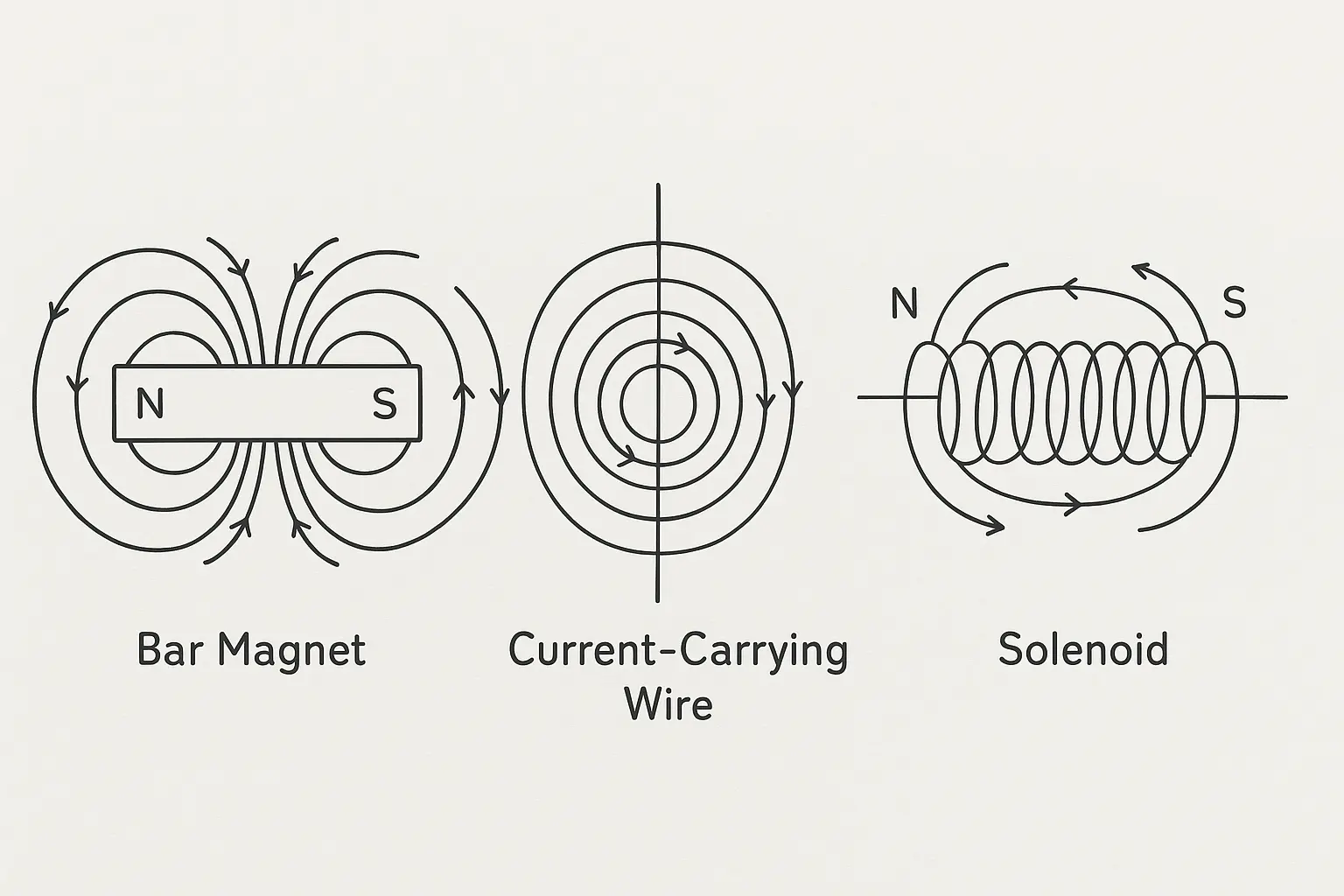
Figure 1: Directions of magnetic field
Three separate magnetic setups are there in the diagram where a bar magnet, a current-carrying wire and a solenoid are depicted along with the direction of their magnetic fields. Magnetic field lines in the bar magnet form closed loops as they emerge from the north pole and curve around to enter the south pole. The field lines inside the magnet complete the loop by moving from south to north. If positioned in the field these lines show which way a north magnetic pole would travel. Because the lines are concentrated at the poles the field is strongest there. The magnetic field revolves in concentric circles around the wire carrying the current. According to the right-hand rule, if one holds the wire in their right hand with your thumb pointing in the direction of the conventional current, their fingers will curl in the direction of the magnetic field (González-González, 2022). This indicates the direction of the field. The solenoid's magnetic field is similar to that of a bar magnet because it is made of a coil of wire. Field lines circle the coils exterior from north to south and pass through its center from south to north pole. In electromagnets and electric motors this creates a powerful consistent magnetic field inside the coil.
AC 51.3: Describe the behaviour of an electric current and potential difference in series and parallel circuits
The two primary configurations for electric circuits are series and parallel and each exhibits distinct behaviors with regard to electric current and potential difference (voltage). circuits in series.
Series Circuits:
Components in a series circuit are linked together in a single path from end to end. This indicates that the current passing through every part is the same. As more components (such as resistors or bulbs) are added the circuit's overall resistance rises lowering the total current in accordance with Ohm's Law.
I=R/VTotal
For instance, if two identical bulbs are connected in series with a 12V battery each bulb receives 6V. The circuit is damaged and all devices stop functioning if one part fails.
Parallel Circuits:
Circuits operating in parallel. Multiple paths for the current are created in a parallel circuit when components are connected across the same two points. The total voltage of the power supply is the same as the voltage across each branch. Thus every branch in a 12V parallel circuit receives 12V. In a parallel circuit the resistance of each path determines how the current divides among the branches. The sum of the currents flowing through all of the branches in the circuit is the total current. Consequently increasing the number of branches raises the total current and decreases the overall resistance. Parallel circuits allow the other paths to function normally even if one component fails which makes them perfect for home wiring systems.
Applications in engineering safety design and transportation are made possible by an understanding of force motion and energy (van Gelder et al. 2021). Innovation in communication and optics is facilitated by an understanding of wave behavior. Electrical and magnetic principles are fundamental to both industrial and household appliances. It is suggested that more research be done on practical uses to put learning in context.
References
Čáp, I., Čápová, K., Smetana, M. and Borik, Š., 2021. Mechanical waves. In Electromagnetic and acoustic waves in bioengineering applications. IntechOpen. https://www.intechopen.com/chapters/79653
Carr, A., Davis, T.M., Scolnic, D., Said, K., Brout, D., Peterson, E.R. and Kessler, R., 2022. The Pantheon+ analysis: Improving the redshifts and peculiar velocities of Type Ia supernovae used in cosmological analyses. Publications of the Astronomical Society of Australia, 39, p.e046. https://www.cambridge.org/core/services/aop-cambridge-core/content/view/04703793D11AF4039A59FF5D6BAC0B74/S1323358022000418a.pdf/pantheon_analysis_improving_the_redshifts_and_peculiar_velocities_of_type_ia_supernovae_used_in_cosmological_analyses.pdf
Delette, G., 2023. Nd2Fe14B permanent magnets substituted with non-critical light rare earth elements (Ce, La): A review. Journal of Magnetism and Magnetic Materials, 577, p.170768. https://cea.hal.science/cea-04119642/file/GDelette-CeReview-JMMM-Rev.pdf
González-González, J.M., 2022. Magnetic Monopoles and Lenz's Law in Hyperbolic Medicine. Heart, 21, p.22. https://www.ijscia.com/wp-content/uploads/2022/10/Volume3-Issue5-Sep-Oct-No.352-789-795.pdf
Osaigbovo, F., 2022. Light and the laws of reflection and refraction as they impact on photography. Yıldız Journal of Art and Design, 9(1), pp.49-59. https://dergipark.org.tr/en/download/article-file/2486263
Sarapak, C. and Kearns, K., 2022. Diagnosing Mental Models of Undergraduate Student and Physics Teachers: Study Case in the Momentum and Energy Conservation Principles Using Newton's Cradle. Jurnal Pendidikan IPA Indonesia, 11(4), pp.684-691. https://journal.unnes.ac.id/nju/jpii/article/viewFile/37695/13923
van Gelder, P., Klaassen, P., Taebi, B., Walhout, B., van Ommen, R., van de Poel, I., Robaey, Z., Asveld, L., Balkenende, R., Hollmann, F. and van Kampen, E.J., 2021. Safe-by-design in engineering: An overview and comparative analysis of engineering disciplines. International Journal of Environmental Research and Public Health, 18(12), p.6329. https://www.mdpi.com/1660-4601/18/12/6329
Yessenov, M., Bhaduri, B. and Abouraddy, A.F., 2021. Refraction of space-time wave packets: I. theoretical principles. Journal of the Optical Society of America A, 38(10), pp.1409-1422. https://opg.optica.org/viewmedia.cfm?uri=josaa-38-10-1409&am=y
Yuan, T., 2024. Reflection and Refraction of Light. https://preprints.opticaopen.org/articles/preprint/Reflection_and_Refraction_of_Light/25907671/2/files/46611895.pdf
Wang, Z., Li, Y., Wu, C. and Tsang, S.C.E., 2022. Electric-/magnetic-field-assisted photocatalysis: Mechanisms and design strategies. Joule, 6(8), pp.1798-1825. https://www.cell.com/joule/pdf/S2542-4351(22)00292-6.pdf
Zahan, M., 2021. Sustainable Strategy to Sustainable Business: An Empirical Analysis on Energy-Efficient Light Bulb. Sustainability, 13(24), p.13791. https://www.mdpi.com/2071-1050/13/24/13791
Go Through the Best and FREE Samples Written by Our Academic Experts!
Native Assignment Help. (2026). Retrieved from:
https://www.nativeassignmenthelp.co.uk/physics-report-force-motion-energy-waves-and-magnetism-assignment-54322
Native Assignment Help, (2026),
https://www.nativeassignmenthelp.co.uk/physics-report-force-motion-energy-waves-and-magnetism-assignment-54322
Native Assignment Help (2026) [Online]. Retrieved from:
https://www.nativeassignmenthelp.co.uk/physics-report-force-motion-energy-waves-and-magnetism-assignment-54322
Native Assignment Help. (Native Assignment Help, 2026)
https://www.nativeassignmenthelp.co.uk/physics-report-force-motion-energy-waves-and-magnetism-assignment-54322
- FreeDownload - 41 TimesEnvironmental & Sustainability Issues Component
1. Introduction Sustainability in the construction industry is currently a...View or download
- FreeDownload - 37 TimesUnderstanding Business Ethics Assignment Example
Understanding Business Ethics Assignment Introduction:...View or download
- FreeDownload - 38 TimesHX40 04 International Marketing Management Assignment Sample
1. Executive Summary This paper focuses on analyzing Exmar...View or download
- FreeDownload - 39 TimesCIPD - Talent Management And Workforce Planning Assignment Sample
Introduction- CIPD-Talent Management And Workforce Planning In its most basic...View or download
- FreeDownload - 42 TimesStudy Skills For Higher Education Assignment Example
Assignment 1 Introduction: Study Skills For Higher Education Need...View or download
- FreeDownload - 45 TimesBMHP5023 - Introduction to Physiology
Introduction to Physiology Assignment INTRODUCTION The study of physiology is...View or download
-
100% Confidential
Your personal details and order information are kept completely private with our strict confidentiality policy.
-
On-Time Delivery
Receive your assignment exactly within the promised deadline—no delays, ever.
-
Native British Writers
Get your work crafted by highly-skilled native UK writers with strong academic expertise.
-
A+ Quality Assignments
We deliver top-notch, well-researched, and perfectly structured assignments to help you secure the highest grades.