Introduction
Testing for normality is an important step in selecting the right statistical tests for data analysis (Mishra et al., 2019). Most tests, such as t-tests and ANOVAs, presuppose that a population of intervals is distributed in a normal fashion. If the above assumption is violated, the results produced may be misleading, and alternative methods of non-parametric tests may be called for.
Therefore, this study tests the normality of the reaction times (Recall_Deep_RT and Recall_Shallow_RT) and HVIC scores (HI, HC, VC, VI) to meet the assumptions for the parametric test. The reaction timer targets the levels of thinking that occur during the deep and shallow encoding tasks, while the HVIC score quantifies the participant's cultural and social background.
The Z-shaped normality of the above-mentioned variables would be checked by applying both Shapiro-Wilk and Kolmogorov-Smirnov tests which are used for examining the distribution of irregular value continuous variables (Lee, 2022). Also, the historical diagrams and the Q-Q diagrams will supplement the statistic tests to give a full view of the data distribution.
Hypothesis
RQ: Are words processed at a deep level during encoding retrieved more quickly compared to those processed at a shallow level?
H1: Words processed at a deep level will be processed more quickly than those at a shallow level during encoding.
H0: Words processed at a deep level will not be processed more quickly than those at a shallow level.
Methods
Participants
This study included 165 participants recruited from three campuses: Dubai, Edinburgh, and Malaysia. The age of participants was from 18 to 41 years and the majority of the participants were women. Before the experiment, all participants performed the memory recall task which involved the processing of words at different encoding levels. The research work was conducted under the ethical appraisal number 2024-1464-12521, and all the business aspects passed the standard ethical norms.
Materials
The other task adopted in the study was the memory recall task where the participants either deeply or systematically processed the words. In deep processings, the meaning of the stimulus items used was taken into consideration, while, in shallow processings, physical aspects such as looks were taken into consideration (Nieznański, 2020).
Response times were measured in milliseconds as the basic dependent measures. These were the reaction time (Recall_Deep_RT) and recall_shallow_rt for deep and shallow processing tasks respectively (Provazza et al., 2022). Cultural orientation was measured using self-report HI, HC, VI, and VC scores as independent variables, which were obtained using a validated HVIC questionnaire.
Design
The first research question in the main study looked at the effect of the deep versus shallow processing tasks on reaction times using a within-subject design (Peng et al., 2024). The other research question involved a multiple regression design examining whether the HVIC dimensions would classify reaction times in deep processing.
Procedure
Respondents have been instructed to memorize words using either deep or shallow processing (Pollack, 2022). The recall tasks measured response time, and in addition to memory, a culture orientation scale was included, which would ultimately help in calculating HVIC scores. Phase two data collection included obtaining the most accurate reaction times and fullest HVIC scores for all participants (Chen et al., 2021).
Data Analysis
Data on the deep and shallow processing reaction time were subjected to a paired sample t-test for the present analysis. For this, the hypothesis was that an input processed at a deeper level would recall faster than an input that had not been so deeply processed (Gaviria and Corredor, 2024). Multiple regression analysis was to be done to test the prediction of deep processing reaction times with regard to some of the HVIC dimensions (VI, HC, HI, VC). Shapiro-Wilk and Kolmogorov-Smirnov were undertaken to check for the meet of conditions for carrying out parametric tests on both reaction times and HVIC scores (Kanazawa, 2021).
Ethical Considerations
All participants had given their consent for the study prior to involving them in the research. Participants' anonymity was guaranteed through the use of completion codes, with all data collected being securely kept. The participants were given a debrief sheet to do after finishing up with the tasks which described the study, its aim, and possible repercussions. All the ethical factors were observed in the study conducted.
Results

The naturality of the reaction times and HVIC scores were checked by using Shapiro-Wilk and Kolmogorov-Smirnov Tests. The data collected depicted in the results section showed that the reaction time and HVIC scores violated the normality assumption (at p < 0.05 level) for most of the variables. In future analyses data transformations or non-parametric tests may be required; however, since the statistics selected are quite stringent, parametric tests were run (Uttley, 2019).
To answer the first research question, the paired samples t-test was used to compare the mean reaction time for the deep and shallow levels of processing. The mean reaction time obtained in deep processing conditions was significantly less than that in shallow processing conditions; deep processing mean = 719.44, and Shallow processing mean = 947.33. The overall mean difference was -227.89 milliseconds with an SD of 895.24. The result obtained was a statically significant difference in the reaction time (t = -3.27, df = 164, p = 0.001). These results show that participants recall the words that underwent a deep level of processing faster than words that underwent only a shallow level of processing (Marsh et al., 2024).
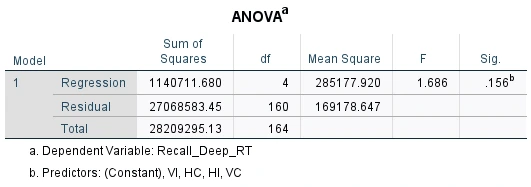
To answer the second research question of the study, a multiple regression analysis was used to analyse the extent to which the HVIC dimensions (VI, HC, HI, VC) predicted the reaction time for deep processing (Recall_Deep_RT). Again, the significance level of the regression model was .156, and F = 1.686, thus, collectively, the HVIC dimensions did not contribute a large amount of variance toward reaction time for deep processing conditions.
The model explained a total variation of 0.04 or 4 % for the HVIC dimensions for the reaction times for deep processing. Similarly, the main effects of VI, HC, HI and VC, which were individual predictor variables, were also not significant as revealed by p-values >0.05.
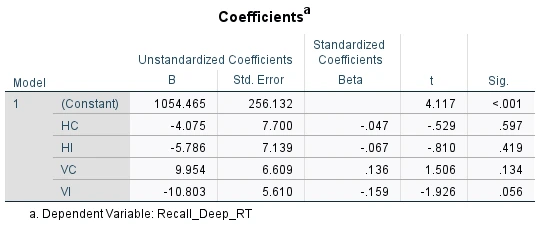
Fixed coefficients (B) represent quantifiable influence in terms of the scale of measurement. For instance, if the B value for Horizontal Individualism is 15.3 then at every one-unit increase in horizontal individualism score, reaction time increases by 15.3 milliseconds. This goes a long way in putting into measure the extent of the effect in a practical context. However, in this study, measures of the predictors did not Sort to achieve statistical significance as their p-values were greater than 0.05, meaning that such effects might have occurred through chance.
Scales of the predictors can be put on a common base by using the Beta coefficients to make the comparison possible. They indicate the magnitude of each independent variable about the dependent variable. For example, if Vertical Collectivism has the largest Beta value it would signify that it affects the reaction time more than any other dimension albeit with an insignificant difference (Schermer et al., 2023).
Discussion
The results of the study offer an understanding of the coding of words more at a deep or a shallow level of encoding, and culturally-susceptible data regarding reaction time. As shown in the following table and the paired-sample t-test, the words encoded at the deep level required a shorter reaction time when they were recalled than the words that were encoded at the shallow level (Caplan and Guitard, 2024). This affirms the first research hypothesis and is in concordance with the level of processing theory that ascribes deeper encoding to come up with an efficient manner of retrieving information fast.
However, the result of the multiple regression analysis shows no significant mediated predictive relationship between consumer cultural orientation dimensions: Horizontal Individualism, Horizontal Collectivism Vertical Individualism, Vertical Collectivism and the reaction time during deep processing (Booysen, Guvuriro and Campher, 2021). This result contradicts the presumption that cultural orientation could determine cognitive styles that are linked to memory activation, as mentioned. The statistical insignificance of this conclusion implies that, as assessed in the present research, dimensions of cultural orientation do not significantly influence reaction times in deep encoding retrieval tasks (Cui, Zeng and Jin, 2022). This may suggest that cultural orientation has truly negligible effects on the cognitive processes at work, or that such effects may be conditional on certain specific task contexts.
Explore our Humanities Assignment Help service for critical, research-based academic support across humanities disciplines.
Humanities Assignment Help UK MLAThe non-significant correlations between cultural orientation and reaction times may be attributed to the following: First, the authors recognise that the task design may not have been sufficiently sensitive to capture variations in cognitive processing of Cultural Orientations (Gutchess and Rajaram, 2022). On the other hand, HI-IC and VI-IC may only not necessarily modulate the speed of retrieval in memory-based tasks but can modulate other cognitive processes such as decision-making or perception. One could easily argue that a sample size or sample variability was not large enough to accommodate other statistically significant correlations (Gong et al., 2023).
The study has both theoretical and practical implications. The finding affirming highly variant reaction times for deep and shallow processing conditions underlines the potential effectiveness of deeper encoding techniques for optimizing memory storage and retrieval (Mundorf, Uitvlugt and Healey, 2022). This has implications in learning environments particularly in organizational and academic that require deeper processing than other forms of known processing strategies. However, the non-significant results on cultural orientation indicate that further research is needed to explore how cultural factors affect cognition.
If you are struggling to structure statistical analysis or interpret results clearly, professional Assignment Help can make a significant difference. Native Assignment Help offers expert guidance to help students present accurate, well-structured research assignments. Their support ensures better clarity, proper analysis, and improved academic performance.
References
Booysen, F., Guvuriro, S. and Campher, C. (2021). Horizontal and vertical individualism and collectivism and preferences for altruism: A social discounting study. Personality and Individual Differences, 178, p.110856. doi:https://doi.org/10.1016/j.paid.2021.110856.
Caplan, J.B. and Guitard, D. (2024). Stimulus duration and recognition memory: An attentional subsetting account. Journal of Memory and Language, 139, pp.104556–104556. doi:https://doi.org/10.1016/j.jml.2024.104556.
Chen, Y.-T., Hou, C.-J., Derek, N., Huang, S.-B., Huang, M.-W. and Wang, Y.-Y. (2021). Evaluation of the Reaction Time and Accuracy Rate in Normal Subjects, MCI, and Dementia Using Serious Games. Applied Sciences, 11(2), p.628. doi:https://doi.org/10.3390/app11020628.
Cui, G.-Q., Zeng, J.-Y. and Jin, C.-H. (2022). The Impact of Vertical/Horizontal Individualism and Collectivism on Ethical Consumption. Sustainability, 14(21), p.14254. doi:https://doi.org/10.3390/su142114254.
Gaviria, C. and Corredor, J. (2024). Understanding, fast and shallow: Individual differences in memory performance associated with cognitive load predict the illusion of explanatory depth. Memory & Cognition. doi:https://doi.org/10.3758/s13421-024-01616-6.
Gong, Z., Nanjappan, V., Lee, L.-H., Soomro, S.A. and Georgiev, G.V. (2023). Exploration of the Relationship Between Culture and Experience of Creativity at the Individual Level: A Case Study Based on Two Design Tasks. International Journal of Design Creativity and Innovation, 11(3), pp.1–24. doi:https://doi.org/10.1080/21650349.2022.2157889.
Gutchess, A. and Rajaram, S. (2022). Consideration of culture in cognition: How we can enrich methodology and theory. Psychonomic Bulletin & Review, 30(3), pp.914–931. doi:https://doi.org/10.3758/s13423-022-02227-5.
Kanazawa, Y. (2021). Do not (Just) Think, But (Also) Feel!: Empirical Corroboration of Emotion-Involved Processing Hypothesis on Foreign Language Lexical Retention. SAGE Open, 11(3), p.215824402110321. doi:https://doi.org/10.1177/21582440211032153.
Lee, S.W. (2022). Methods for testing statistical differences between groups in medical research: statistical standard and guideline of Life Cycle Committee. Life Cycle, 2. doi:https://doi.org/10.54724/lc.2022.e1.
Marsh, J.E., Maciej Hanczakowski, C. Philip Beaman, Meng, Z. and Jones, D.M. (2024). Thinking about meaning: level-of-processing modulates semantic auditory distraction. Journal of Cognitive Psychology, pp.1–13. doi:https://doi.org/10.1080/20445911.2024.2381279.
Mishra, P., Pandey, C.M., Singh, U., Sahu, C., Keshri, A. and Gupta, A. (2019). Descriptive Statistics and Normality Tests for Statistical Data. Annals of Cardiac Anaesthesia, 22(1), pp.67–72. doi:https://doi.org/10.4103/aca.ACA_157_18.
Mundorf, A.M.D., Uitvlugt, M.G. and Healey, M.K. (2022). Does depth of processing affect temporal contiguity? Psychonomic Bulletin & Review, 29(6). doi:https://doi.org/10.3758/s13423-022-02112-1.
Nieznański, M. (2020). Levels-of-processing effects on context and target recollection for words and pictures. Acta Psychologica, 209(103127), p.103127. doi:https://doi.org/10.1016/j.actpsy.2020.103127.
Peng, N., Logie, R.H. and Sergio Della Sala (2024). Effect of levels-of-processing on rates of forgetting. Memory & cognition. doi:https://doi.org/10.3758/s13421-024-01599-4.
Pollack, A. (2022). Deep versus Shallow Processing: A Learning and Memory Experiment for Asynchronous and Synchronous Online Platforms. The Journal of Undergraduate Neuroscience Education, [online] 20(2). doi:https://doi.org/10.59390/FEAP4736.
Provazza, S., Carretti, B., Giofrè, D., Adams, A.-M., Montesano, L. and Roberts, D. (2022). Shallow or deep? The impact of orthographic depth on visual processing impairments in developmental dyslexia. Annals of Dyslexia, 72(1). doi:https://doi.org/10.1007/s11881-021-00249-7.
Schermer, J.A., Branković, M., Čekrlija, Đ., MacDonald, K.B., Park, J., Papazova, E., Volkodav, T., Iliško, D., Wlodarczyk, A., Kwiatkowska, M.M., Rogoza, R., Oviedo-Trespalacios, O., Ha, T.T.K., Kowalski, C.M., Malik, S., Lins, S., Navarro-Carrillo, G., Aquino, S.D., Doroszuk, M. and Riđić, O. (2023). Loneliness and Vertical and Horizontal Collectivism and Individualism: A Multinational Study. Current Research in Behavioral Sciences, 4, p.100105. doi:https://doi.org/10.1016/j.crbeha.2023.100105.
Uttley, J. (2019). Power Analysis, Sample Size, and Assessment of Statistical Assumptions—Improving the Evidential Value of Lighting Research. LEUKOS, [online] 15(2-3), pp.143–162. doi:https://doi.org/10.1080/15502724.2018.1533851.
Go Through the Best and FREE Samples Written by Our Academic Experts!
Native Assignment Help. (2026). Retrieved from:
https://www.nativeassignmenthelp.co.uk/reaction-time-analysis-normality-testing-study-assignment-sample-43632
Native Assignment Help, (2026),
https://www.nativeassignmenthelp.co.uk/reaction-time-analysis-normality-testing-study-assignment-sample-43632
Native Assignment Help (2026) [Online]. Retrieved from:
https://www.nativeassignmenthelp.co.uk/reaction-time-analysis-normality-testing-study-assignment-sample-43632
Native Assignment Help. (Native Assignment Help, 2026)
https://www.nativeassignmenthelp.co.uk/reaction-time-analysis-normality-testing-study-assignment-sample-43632
- FreeDownload - 41 TimesPSY5003 Personality and Intelligence Assignment Example
PSY5003 Personality and Intelligence Assignment {{TEXT2}} Essay This...View or download
- FreeDownload - 42 TimesUnderstand How To Safeguard Individuals Assignment Sample
Understand How To Safeguard Individuals This table explains how the terms used...View or download
- FreeDownload - 43 TimesEMS623U Energy Analysis Assignment Sample
Part 1 Boiler Feedwater Preheater System Description A boiler feedwater...View or download
- FreeDownload - 42 TimesMG628 International Marketing Management Assignment Sample
Green Chef Expansion via E-Commerce in Denmark 1. Introduction...View or download
- FreeDownload - 43 TimesIntroduction To Sociology And Health
Introduction To Sociology And Health In this Assignment here discussion will...View or download
- FreeDownload - 39 TimesBusiness and Business Environment Assignment Sample
Business and Business Environment Assignment Sample Looking for Help With...View or download
-
100% Confidential
Your personal details and order information are kept completely private with our strict confidentiality policy.
-
On-Time Delivery
Receive your assignment exactly within the promised deadline—no delays, ever.
-
Native British Writers
Get your work crafted by highly-skilled native UK writers with strong academic expertise.
-
A+ Quality Assignments
We deliver top-notch, well-researched, and perfectly structured assignments to help you secure the highest grades.