
Introduction
This was a project that aimed at creating an automated system in which boxes were sorted using Programmable Logic Controller (PLC) methods. The system came up on an occasion of factory setting in which boxes of various sizes have undergone classification in the uses of individual crates depending on the sizes of these packages. It was aimed at developing a logic program with automatic control of moving, detecting and sorting boxes by using sensor feedbacks and commands to motors.
The essence of it was to have maximum efficiency in sorting with the least manual input and ensure safety mechanisms that are to be included include timed shutdowns and alarms. The logic of the PLC was implemented by program interpretation simulation machine on the FX Trainer platform of the most common educational programs in the field of teaching the ladder logic. The strip flowchart with a more detailed picture of the logic of the system steps was drawn with the help of draw.io to visualize the planning of the visualization (Khan et al. 2021). This was a fundamental PLC project with principles of input/output control, timers and steps sequenced together to ensure a complete comprehensive and dependable indus- trial sortation solution that is all about precision and safety.
Students looking for additional academic guidance can explore Native Assignment Help, a trusted assignment writer UK resource. Whether you need help understanding PLC programming, ladder logic, or technical report writing, the right support can make complex engineering assignments easier to manage.
System Overview
The automated system is designed on the basis of a conveyor that incessantly in feeds the boxes that are dropped randomly as far as two sorting points. The physical construction will comprise of a start button to fire up the system, two sensors to scan the box size, two cylinders (A and B) to move boxes up or down and an alarm system to inform of errors or isles (Maesschalck et al. 2023). Sensor A will be placed to receive big boxes and Sensor B to receive small boxes. Feedback sensors are provided on each cylinder to give a warning on extension and retraction.
Under manual operation, an employee would look at each box, and would manually activate a mechanism that would send the boxes to the appropriate bin. This method is inefficient, unreliable, and hazardous where there is high-speed operation such as in the industrial setting.
Under automation with PLC, the system is able to give quick detection and sorting without the help of man. Once a box has been detected, the right cylinder automatically locks to force the box in the right direction. Conveyor stops briefly in this operation and starts moving after (Antonsen 2021). There are also extra safety logic that prevents the system when 100 boxes are sorted and trigger signal a sound alarm when no signal is detected after 30s. Automation has many advantages that include speed, uniformity of performance, less labor requirement and improved safety through less manual intervention of moving equipments.
Flowchart Design
A logical flowchart was prepared to model the logic of the entire box sorting system in an easy to understand graphical manner. This diagram was used as a basis of transforming logical steps into ladder logic codes (Mohamed and Cheong 2023). Given automation actions in the cycle are denoted as process blocks or decision blocks with the paths being evident dependent on the state of the system.
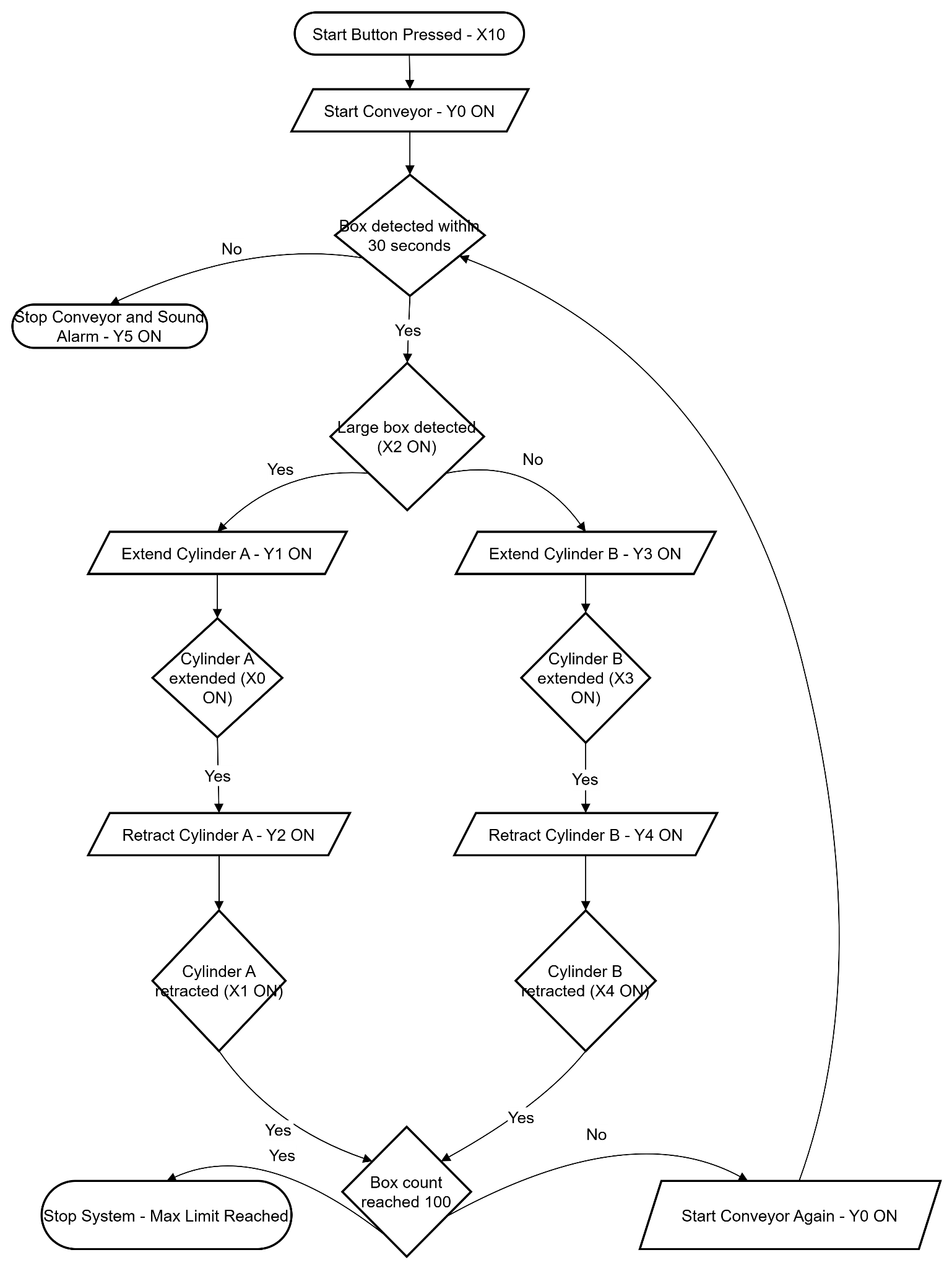
Figure 1: The Flowchart
This procedure starts by pressing the Start Button and this causes the conveyor to operate. Box Detection comes next- with no box detected in 30 seconds, the conveyor will stop and the alarm goes on. When the box is detected the system then analyses the size of the box with the aid of sensors. This has a decision branch which inquires whether the box is large or small. With the large boxes, Cylinder A reaches out to insert it into the the crate and draws away. Equally, cylinder B deals with little boxes (Lubongo and Alexandridis 2022). At the end of each push, the system runs the verification of the crate of boxes that has reached a 100-boxes limit. In that case the system is brought to a halt to manage safety and capacity.
The draw.io was used in developing the flowchart so that all the logic can be understandably and logically linked. In ladder logic design, flowcharts are also very necessary since this form of visual representation decomposes processes into a series of decision points and actions and simplifies the transition to the programmable component.
Ladder Logic Programming Approach
Ladder logic: PLC ladder logic is a graphical based programming language that is used to control an automated system. It is very similar to electrical relay logic and enables engineers to generate chains of operations that depend on the real-world inputs and outputs. The ladder logic was programmed and simulated in this project with the use of FX Trainer software, and other tests and visualization were carried out with the PLC Fiddle software, which has a browser interface.
The system employs seven inputs and six outputs that are digital. The inputs are identified as I0 to I6, of which:
- The start button is I0.
- I1, I2 are small and large box sensors.
- I3 and I6, I4 and I5 are cylinder extension and retraction feedback sensors.
Outputs are named as Q0 to Q5, and are:
- Q0: Motor on the conveyor.
- Q1-Q4: Cylinder A/B control (extend /retract).
- Q5: Output alarm.
The ladder logic has a well defined logic sequence of control. When a box is already identified the conveyor motion stops and the corresponding cylinder comes out and forces the box to go into the proper crate (Rajkumar et al. 2021). As soon as the extension sensor is checked as to the action, the cylinder retracts. A timer monitors idle status-when no box has been detected after 30 seconds an alarm occurs. This organised system guarantees security, productivity and an accurate, automatic process of sorting.
Rung-by-Rung Explanation of the Program
5.1 Start Button and Conveyor (I0 → Q0)
The start button (I0) enables the conveyor motor (Q0) via first rung. Once the start button is pressed the normally open contact I 0 will close and hence allow current to flow to energize the coil Q 0. This switches the conveyor ON and starts the sorting process (Tomar et al. 2023). Such logical solution makes sure that the conveyor will work when it has to be started by the operator directly, so there is a manual control over the system and there is no possibility of the inadvertent activation of the conveyor.
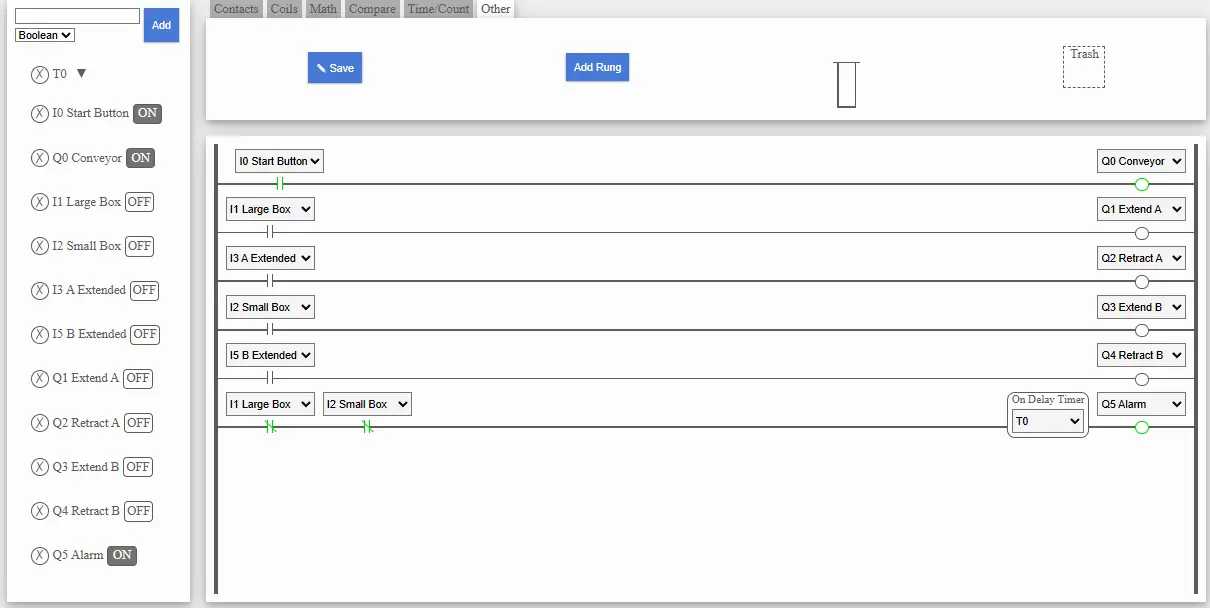
Figure 2: (I0 → Q0)
5.2 Detect Large Box and Push Right (I1 → Q1)
The second step senses the presence of a big box by sensor I1. When I 1 fires it makes a connection and turns on the output Q 1 which makes Cylinder A extend out and move the large box into the crate on the right. By doing such automatic decision making, it removes the manual sorting process, and large boxes can be easily and quickly diverted without the intervention of users. The sensor feedback approach used in actuating makes sure that only the right box type in position prompts the logic.
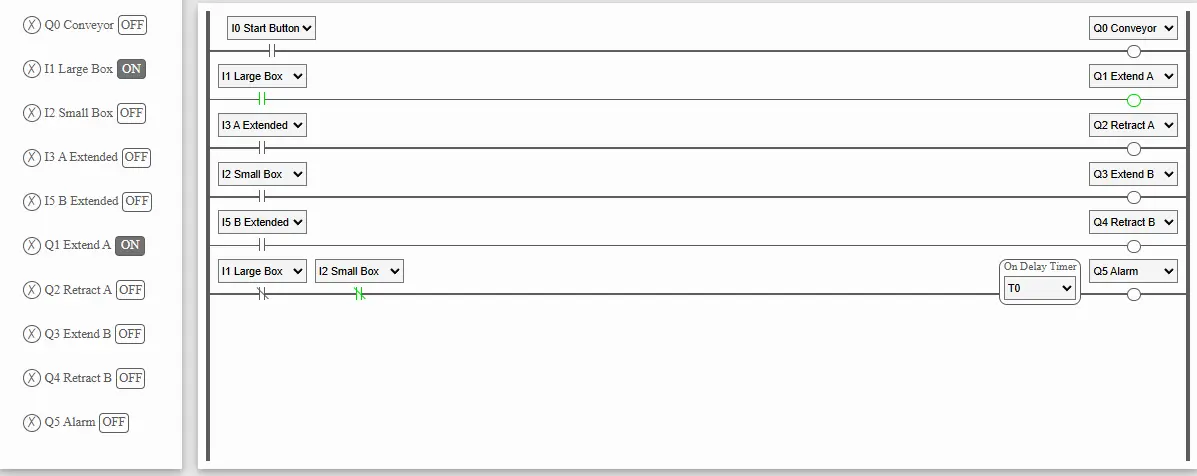
Figure 3: (I1 → Q1)
5.3 Retract Cylinder A When Fully Extended (I3 → Q2)
After Cylinder A has reached its full extension, sensor I3 reads its position. By causing this, there is a new rung reached at which contact I3 is also closed which brings in action of Q2 that retracts the cylinder (Al Fahim et al. 2023). This withdrawal readies the system to get the succeeding upcoming box. It also avoids keeping the cylinder extended without a need to cause mechanical task or interrupt the work of other working mechanisms. Addition of position feedback to the logic is not only more reliable but mechanically safer as well.
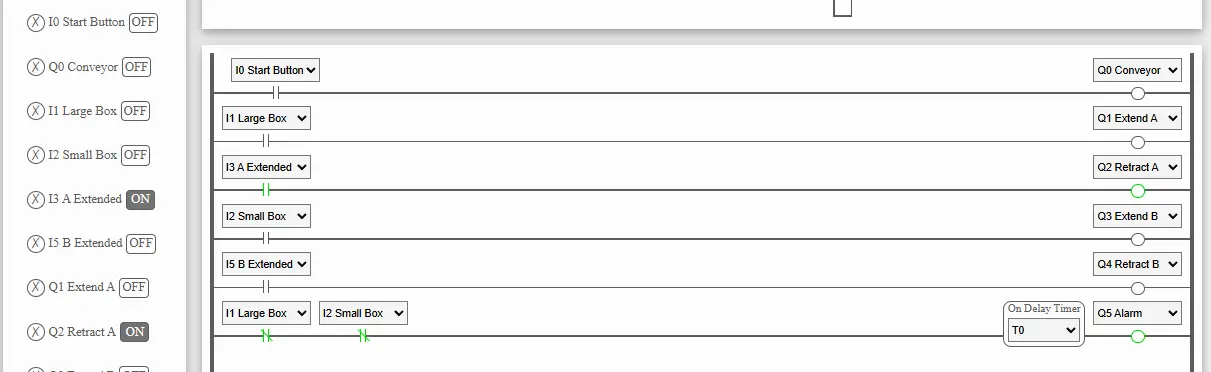
Figure 4: (I03 → Q02)
5.4 Detect Small Box and Push Left (I2 → Q3)
In small boxes, sensor I2 senses the object and drives output Q3 to energize the Cylinder B. This makes the box move to an isolated crate on the left hand side. This and the same as the large box logic but does not include human judgment and increases big-time sorting. The large box routine is independent of this rung so that whichever type of box is found its sort happens as soon as it is detected. The two types of size are equally automated in logic.
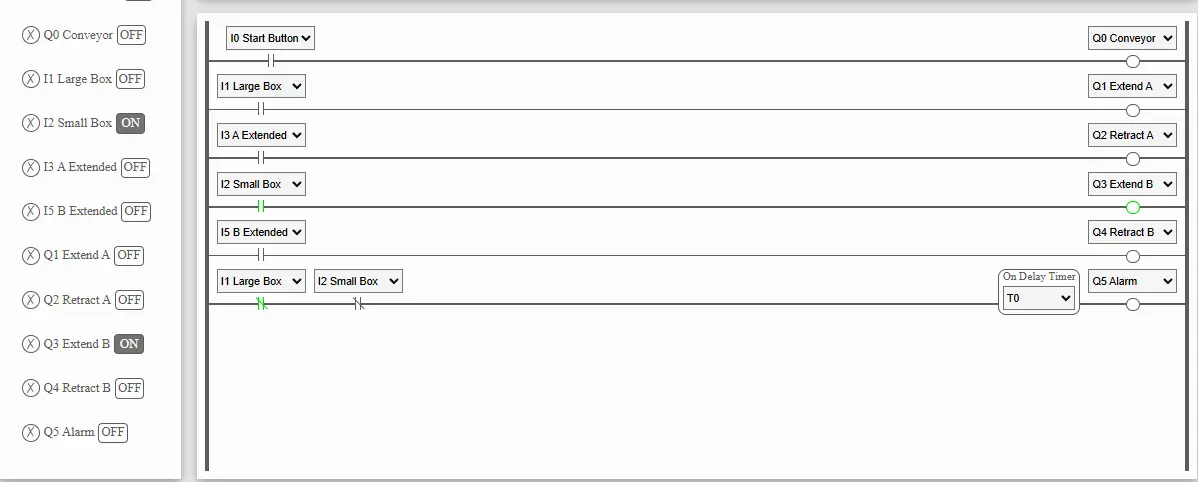
Figure 5: (I2 → Q3)
5.5 Retract Cylinder B When Fully Extended (I5 → Q4)
When Cylinder B has reached its extension, the sensor I5 feeds back. This brings up another rung in which I5 drives Q4, and Cylinder B retracts. As was the case with Cylinder A, this will verify that the actuator is reset prior to the processing of another item (Patel et al. 2021). By incorporating such logic, not only will the system be made to work in a cyclic way, but also it will stop blocking or collision problems as it leaves the conveyor clear to move the next box on. This feed back loop is critical to a secure automation.
5.6 30s No Detection Timer and Alarm (|/|I1 + |/|I2 → T0 → Q5)
The last rung makes use of two normally closed switches: |/ |I1 and | pieces. The rung is true in the case that a big box is not observed and a small box is not observed. Organized is an on-delay timer (TON) T0, which is switched on and starts to count. When 30 seconds have elapsed without a box being sensed, done bit in the timer turns ON, energising the Q5 transfer transistor which charges the alarm. This rung also incorporates a safety warning just to show that something might be going wrong with the supply or sensor system. It makes sure that the process does not fail silently and go off without alarming the operator.
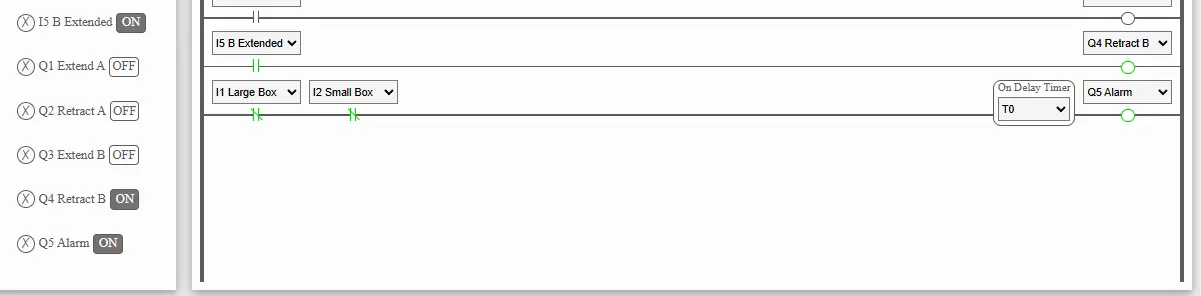
Figure 6: (|/|I1 + |/|I2 → T0 → Q5)
Testing and Observations
The ladder logic program was tested one rung at a time on PLC Fiddle simulation platform. The examination procedure started by pressuring the I0 input (Start Button) that appropriately powered ON the conveyor motor (Q0). Then the system was checked on whether it could detect and respond to box sizes (Berbesi and Vivas 2024). By toggling I1 (big box sensor), Cylinder A (Q1) extended as anticipated, and the restoration that went on in the Cylinder A during activity of sensor I3 occurred as promised. In the same way, when I2 (small box sensor) was activated, the Cylinder B (Q3) was extended and it is confirmed by the sensor I5 when it is reversed.
The rationale to halt the conveyor in the case of pushing succeeded in being incorporated by disabling the conveyor when Q1 was ON and disabling it also when Q3 was ON. The alarm was checked by leaving I1 and I2 OFF; after 30 s the timer went ON and this caused output Q5 to go ON showing a fault or idle state. A shortcoming which was faced during testing was the PLC Fiddle does not have a functional counter block which meant it was impossible to simulate the condition of the 100-box shutdown (Maesschalck et al. 2022). Nevertheless, this role has been included in the logic conceptually and can be introduced in the complete software such as FX Trainer. In general, the logic flow within the system has been correct and timely.
Conclusion
The automatic sorting system managed to reach sound detection, classification, and separation of the boxes depending on their size. It had a properly designed ladder logic whose flow of control, safety replies and less manual control were easy. Subsequent developments may involve inclusion of box tracking counters and other sensors to observe fault detection and better diagnosis of the system.
Reference List
Journals
Al Fahim, A., Rahman, M.M., Hridoy, M.W. and Uddin, K.R., 2023. Development of a PLC Based Automation Cell for Industry. Journal of Integrated and Advanced Engineering (JIAE), 3(2), pp.87-100.
Antonsen, T.M., 2021. PLC Controls with Ladder Diagram (LD), Monochrome: IEC 61131-3 and introduction to Ladder programming. BoD–Books on Demand.
Berbesi, T.V. and Vivas, J.A.P., 2024, September. Ladder Diagram Programming Systematization Through Active PBL Teaching. In 2024 IEEE ANDESCON (pp. 1-5). IEEE.
Khan, M.M., Shawareb, O.M.A., Palaniappan, R., Vijean, V., Nabi, F.G., Shawareb, A.H.A. and Khan, N.K., 2021, November. Simulation of PLC ladder logic programming for an automated glass bottle molding and refilling plant. In IET Conference Proceedings CP791 (Vol. 2021, No. 11, pp. 114-119). Stevenage, UK: The Institution of Engineering and Technology.
Lubongo, C. and Alexandridis, P., 2022. Assessment of performance and challenges in use of commercial automated sorting technology for plastic waste. Recycling, 7(2), p.11.
Maesschalck, S., Staves, A., Derbyshire, R., Green, B. and Hutchison, D., 2023. Walking under the ladder logic: PLC-VBS: a PLC control logic vulnerability scanning tool. Computers & Security, 127, p.103116.
Maesschalck, S., Staves, A., Derbyshire, R., Green, B. and HUTCHINSON, D., 2022. Snakes and ladder logic: Plc-vbs, a plc control logic vulnerability discovery tool. arXiv preprint arXiv:2206.06669.
Mohamed, A.U. and Cheong, A.C.H., 2023, July. Automated color sorting for material handling system. In AIP Conference Proceedings (Vol. 2788, No. 1). AIP Publishing.
Patel, K., Jogani, V., Bhajiyawala, P., Modi, A. and Panchal, P., 2021. Technological revolution in Industrial Automation using PLC.
Rajkumar, K., Thejaswini, K. and Yuvashri, P., 2021, August. Automation of sustainable industrial machine using PLC. In Journal of Physics: Conference Series (Vol. 1979, No. 1, p. 012049). IOP Publishing.
Tomar, B., Kumar, N. and Sreejeth, M., 2023. Real Time Automation and Ratio Control Using PLC & SCADA in Industry 4.0. Computer Systems Science & Engineering, 45(2).
Go Through the Best and FREE Samples Written by Our Academic Experts!
Native Assignment Help. (2026). Retrieved from:
https://www.nativeassignmenthelp.co.uk/smart-conveyor-sorting-system-using-ladder-logic-assignment-49232
Native Assignment Help, (2026),
https://www.nativeassignmenthelp.co.uk/smart-conveyor-sorting-system-using-ladder-logic-assignment-49232
Native Assignment Help (2026) [Online]. Retrieved from:
https://www.nativeassignmenthelp.co.uk/smart-conveyor-sorting-system-using-ladder-logic-assignment-49232
Native Assignment Help. (Native Assignment Help, 2026)
https://www.nativeassignmenthelp.co.uk/smart-conveyor-sorting-system-using-ladder-logic-assignment-49232
- FreeDownload - 43 Timesunit 46: social media practice Assignment Sample
unit 46: Social Media Assignment TASK 1 INTRODUCTION - Social Media...View or download
- FreeDownload - 37 TimesUnderstanding Business Ethics Assignment Example
Understanding Business Ethics Assignment Introduction:...View or download
- FreeDownload - 42 TimesDigital Marketing Assignment Sample
Digital Marketing Introduction - Digital Marketing Want the Best Assignment...View or download
- FreeDownload - 39 TimesDebate The Use Of Mass Surveillance Technology By Governments Assignment
DEBATE THE USE OF MASS SURVEILLANCE TECHNOLOGY BY GOVERNMENTS ASSIGNMENT The...View or download
- FreeDownload - 38 TimesDeveloping Operational Management Skills For Health Care Practice
Developing Operational Management Skills For Health Care Practice M1:...View or download
- FreeDownload - 43 TimesACCO1114 AMA and ACCO1115 AFA Sustainability Reporting in SMEs Analysis
1.0 Introduction Sustainability reporting (SR) has emerged as relevant mainly...View or download
-
100% Confidential
Your personal details and order information are kept completely private with our strict confidentiality policy.
-
On-Time Delivery
Receive your assignment exactly within the promised deadline—no delays, ever.
-
Native British Writers
Get your work crafted by highly-skilled native UK writers with strong academic expertise.
-
A+ Quality Assignments
We deliver top-notch, well-researched, and perfectly structured assignments to help you secure the highest grades.