
- Introduction
- Task 1: Observation of an interaction/counselling session
- Effective Techniques for Helpful Listening
- The Impact of External and Internal Distractions on a Helpful Listening Session
- Task 2: Explanation of Rogerian Counselling Principles
- Core Conditions of Rogerian Counselling and Their Role in Building Positive Relationships
- Skills for Demonstrating Rogerian Core Conditions
- Task 3: Reflective Account of Role Play and Observation
- The Use of Verbal and Non-Verbal Communication Skills
- How to Begin, Manage, and End a Helpful Listening Session Appropriately
- The Use of Immediacy in a Helpful Listening Situation
- The Role of the Observer in Counselling Training
- Listening Skills Goals and Action Plan
Introduction
This paper focuses on sheltered individuals and ways of expanding their ways of communicative gestures and questions. Facial movements, body posture, and especially facial expressions can be improved in the given way, and thus make expressiveness more concrete. In addition, it enhances the depth of the client’s replies through open-ended and reflective questions as much as possible. Practice with feedback and the analysis of such experiences enable the professionals to have better skills in developing more meaningful communication experiences.
Task 1: Observation of an interaction/counselling session
Effective Techniques for Helpful Listening
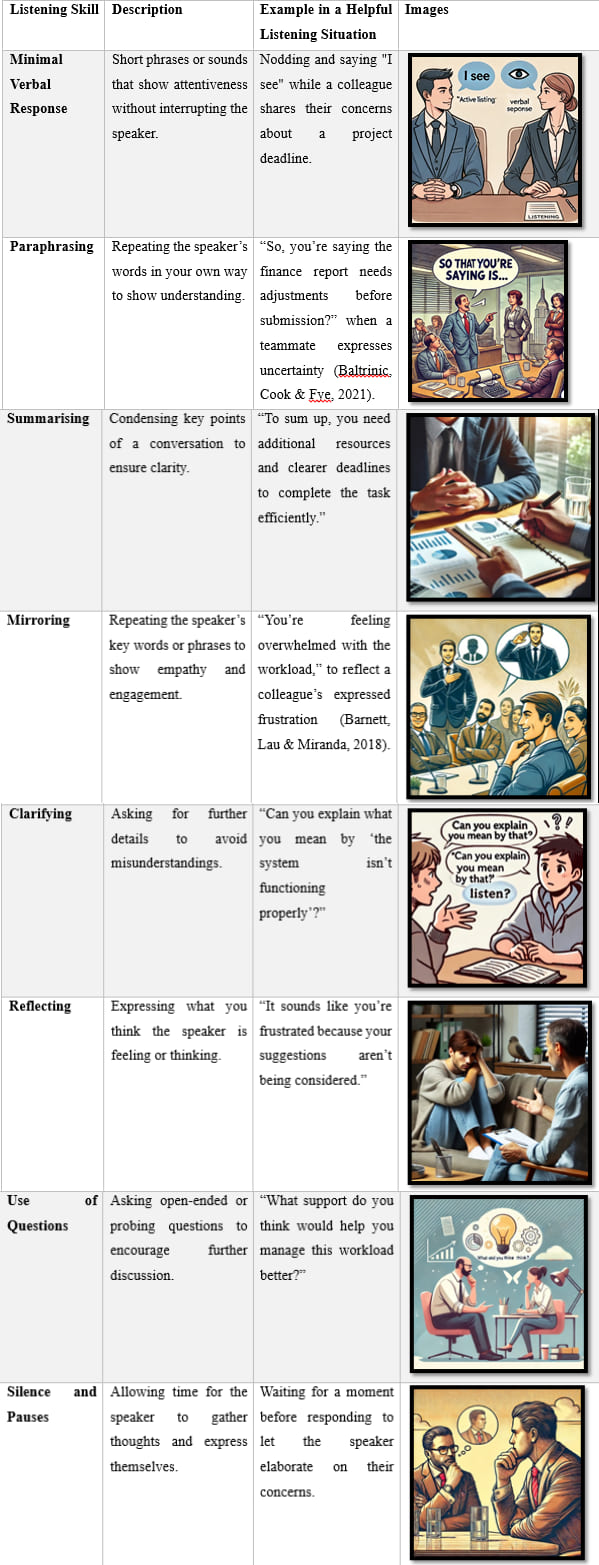
This approach provides knowledge, aids in the sharing of ideas and paved way to deep discussion.
The Impact of External and Internal Distractions on a Helpful Listening Session
Listening is an important component of the helping professions; nevertheless, there are several factors outside and within the helper that may interfere. This guide identifies the potential distractions that may arise in the course of support sessions and the ways of dealing with them to effectively ensure that the time spent in support sessions is utilized in a meaningful way.
External Distractions
Distractions are external and consist of objects, persons, and situations in the external environment that can hinder participants in the conversion process. Distractions, including loud talking or shouting, ringing telephone calls or any disturbance in a noisy environment hamper engagement. Lack of comfort in terms of either light or proper seating, or even temperature, may also lead to physical discomfort which will cause the attention of the people to shift from the speaker. Also, distraction in the form of receiving frequent notifications from a mobile device or owing to using a computer display contributes to distraction. For example, counsellor office during a counselling session with a client such as Hannah, the counsellor’s office might be adjacent to a busy road, hence full of noises such as honking, which makes it difficult for both participants to be fully involved in the discussion (Betancourt & Chambers, 2016).
Internal Distractions
These are distractions that originate from within, one’s mind and feelings, rendering it difficult for an individual to concentrate during the conversation. Interference, in this case, entails concern with other matters such as time constraints or personal matters may affect concentration and hinder attentiveness toward the speaker. Even emotions are involved because affection also becomes a barrier to active listening as a helper may get emotionally affected by the client’s narrative. Further, stress or, more specifically, weariness of the mind may ensue, and the capacity to retain what is being taught is decreased, thus creating confusion or overlooking a certain point (Caulfield et al., 2019). For instance, when, as a support provider, Hannah tells a particular event that the listener has gone through and that has a direct impact on them, the listener may experience an overwhelming feeling that hinders them from being able to support Hannah effectively.
Strategies for Managing Distractions
- >
- Managing External Distractions:
- Maintain a Noise-Free Environment: Organize the sessions in a secluded area free from loud sounds. In cases where an employee is placed in an open space, the use of noise-reducing headphones or white noise machines might be useful.
- Clear Boundaries established: Make it known to other workers and anyone else that the sessions are going on so that they don’t disturb you.
- Reduced Use of Technology: Switch off your phone and use a pen and paper to take some notes instead of having to type on your gadget or laptop (Connor & Leahy, 2016).
- >
- Managing Internal Distractions:
- During any intervention: Mindfulness; and breathing exercises before any session will assist in refocusing.
- Self-awareness: Acknowledging that you have feelings and then leaving them at the door when having a session helps you become more objective.
- Time Management: There are time gaps between the different sessions, this helps to avoid fatigue thus enabling one to be more active during each session (Gockel et al., 2013).
In a recorded interaction with Hannah, a social worker observed that the stress levels among the workers increased during the session. Thus, they were able to remain fully present; it only took a few seconds but being able to take a deep breath helps. Hence, by following the above strategies, helping professionals can work to avoid such interferences affecting their listening, thus improving the state of individuals who require assistance.
Task 2: Explanation of Rogerian Counselling Principles
Core Conditions of Rogerian Counselling and Their Role in Building Positive Relationships
The ideas proposed by Carl Rogers in his Person-Centred Therapy include three fundamental aspects named also as basic attitudes of regard; namely, unconditional positive regard, empathetic understanding, and genuineness.
Unconditional Positive Regard (UPR):
This is the process of embracing the client without prejudice or discriminating against them in any way. This is because when a helper provides UPR, the person feels protected, valued, and supported to give out their opinions and feelings as well. For instance, if a client discloses some issue of a personal lifestyle, then in UPR, a counsellor comforts them that they deserve to be supported whatever their situation is (Grant, 2006).
Congruence (Genuineness):
The word congruence encompasses the concept of being genuine in social interaction. Out of all these reactions, it is softer and more natural, which makes the client trust the helper since they do not feel like they are being ‘perched on’. For example, if a counsellor can recognize his or her feelings properly, it sets the mood and improves the bond between the counsellor and the counselee (Ivey & Daniels, 2016) (Karayigit et al., 2023).
Empathy:
Empathy is an acknowledgment of the client’s feelings besides having to put that into consideration. It gives the individual the human touch and a feeling that he or she has been understood. For instance, active listening includes paraphrasing a client’s emotions in a statement such as “It appears that you are overwhelmed.”
Thus, using these fundamental conditions these people and professionals can develop the safety of discussion, and restore faith and confidence in each other thus enhancing the therapeutic relationship for change (Kola, 2020).
Skills for Demonstrating Rogerian Core Conditions
|
Core Condition |
Skills to Demonstrate It |
|
Unconditional Positive Regard (UPR) |
- Active listening to show acceptance (e.g., nodding, open body language). |
|
Congruence (Genuineness) |
- Being open and honest in communication without being overly directive. |
|
Empathy |
- Reflecting and paraphrasing the client’s emotions (e.g., “It sounds like you’re feeling frustrated about this situation.”). |
That way, the professionals would be able to foster an environment where people feel they are being listened to and appreciated.
Task 3: Reflective Account of Role Play and Observation
The Use of Verbal and Non-Verbal Communication Skills
In the process of the helping interaction, I paid special attention to the use of verbal and non-verbal communication. I made sure that my questions were specific and understandable, I repeated the main ideas and asked further questions to the client. When it came to questioning, I was clear and answered without any delay. I was able to include elements of head bobbing, tilting of head, and the use of hand signs when answering my companion. There were also instances where I lingered idly or was not so active on the website. This made me realize that it is necessary to use many gestures to remain with the child and to ensure that you interact with him/her in a more friendly manner.(Singla et al., 2017).
How to Begin, Manage, and End a Helpful Listening Session Appropriately
To ensure my listening sessions were effective, I had to ensure that I observed structure. My intention in the introduction was to make the client feel comfortable, thus gaining their trust from the start of the session. But I did not mean to be brief with her, so I immediately saw that it was necessary to make a warmer welcome. To regulate the session, I paid attention to the matters we were discussing and was equally involved in responding to the client by using some of the interactional moves that might make the client feel that there is systematic guidance. The use of review at the end of the discussion was beneficial in summarizing the main points as they were captured while responding. Finally, for receipt and appreciation of the client’s input, I provided empty lines wherein the client can comment as desired. This was practiced appropriately, going by the right format of how any kind of discussion should end, it left the session well-rounded.
The Use of Immediacy in a Helpful Listening Situation
The concept of immediacy is a proactive approach to dealing with issues that relate to students currently to increase engagement and address undesirable behaviours. In my interaction, I used this concept in deeper knowledge areas, like what may set off a client in a domestic violence situation. It enabled me to achieve the second level of concern which is active listening. This way I addressed the matters as they occurred, which in turn led to more effective conversation with the client. The use of this approach made the conversation more productive and effective and also made the session productive in terms of the participant’s personal growth and self-actualisation (Singla et al., 2017).
The Role of the Observer in Counselling Training
When in counseling training, I was able to have observer to give me an overview of the communication, interaction, and management of the session. This gave me the chance to determine my strong and weak side that I was not aware of before. It also covers a few weaknesses, as, for example, failure to explain unclear information and overall disorganization of the sessions. Nevertheless, I wanted to make better intonational changes and elaborate my answers for further interactivity. This was very helpful in helping me to improve on my listening and counselling skills. Thus, I was able to enrich the approach, due to which I am now able to address clients in a better and more comprehensive manner and achieve a time when the environment will be much more friendly. (Stark, 2017).
Listening Skills Goals and Action Plan
|
Focus Area |
Action Plan |
|
Enhancing Expressiveness in Non-Verbal Communication |
- Practice maintaining an engaging posture and using expressive gestures. |
|
- Engage in role-play exercises focusing on eye contact and facial expressions. |
|
|
- Seek peer feedback on non-verbal engagement in sessions. |
|
|
Expanding Upon Questioning Techniques |
- Develop open-ended questioning techniques to encourage deeper client responses. |
|
- Use reflective questioning in practice sessions. |
|
|
- Review recorded sessions to analyse and improve questioning styles (Stark, 2017). |
Conclusion
Assimilation of the results shows that facial expressions, gestures, and proper ask questions are instrumental in enhancing interaction to a higher level. These include elements, such as posture and gesture eye contact and the use of open and reflective questions. The use of role-play, peer feedback, and analysis of sessions can help professionals hone their performance to the best on matters concerning communication.
Students often find it challenging to structure reflective and counselling-based assignments clearly and academically. Native Assignment Help provides expert Assignment Help by supporting students with well-structured content, proper referencing, and critical reflection aligned with academic standards. This guidance ensures clarity, coherence, and improved academic performance.
References
Baltrinic, E.R., Cook, R.M., & Fye, H.J. (2021) 'A Q Methodology Study of Supervisee Roles Within a Counseling Practicum Course', The Professional Counselor, 11(1).
Barnett, M.L., Lau, A.S., & Miranda, J. (2018) 'Lay health worker involvement in evidence-based treatment delivery: a conceptual model to address disparities in care', Annual Review of Clinical Psychology, 14, pp. 185–208.
Betancourt, T.S., & Chambers, D.A. (2016) 'Optimizing an era of global mental health implementation science', JAMA Psychiatry, 73(2), pp. 99–100.
Caulfield, A., Vatansever, D., Lambert, G., & Van Bortel, T. (2019) 'Mental health and psychosocial support training for humanitarian aid workers in low- and middle-income countries: a systematic review', Journal of Mental Health, 28(5), pp. 489–500.
Connor, M., & Leahy, M.J. (2016) Microcounseling: Applications of Counseling Skills Training. Springfield, IL: Charles C Thomas Publisher.
Gockel, A., Burton, D., James, S., & Bryer, E. (2013) 'Introducing mindfulness as a self-care and clinical training strategy for beginning social work students', Mindfulness, 4, pp. 343–353.
Grant, A.M. (2006) 'A personal perspective on professional coaching and the development of coaching psychology', International Coaching Psychology Review, 1(1), pp. 12–22.
Ivey, A.E., & Daniels, T. (2016) Essential Interviewing: A Programmed Approach to Effective Communication. 9th edn. Boston, MA: Cengage Learning.
Karayigit, C., Bloom, A., Rodriguez, M., Parlade, J., & Ozier, M. (2023) 'Teaching Counseling Microskills Through the Use of Reflective Practice in Helping Professions', Journal of Counselor Preparation and Supervision, 17(3).
Kola, L. (2020) 'Global mental health and COVID-19', The Lancet Psychiatry, 7(8), pp. 655–657.
Rosenbaum, L., & Axelson, D. (2023) 'Third-Party Observation in Psychotherapy: Playing to the Audience', American Journal of Psychotherapy, 76(1), pp. 1–8.
Singla, D.R., Kohrt, B.A., Murray, L.K., Anand, A., Chorpita, B.F., & Patel, V. (2017) 'Psychological treatments for the world: lessons from low- and middle-income countries', Annual Review of Clinical Psychology, 13, pp. 149–181.
Stark, M.D. (2017) 'Supervisee perspectives on supervision: a Q methodology study', The Clinical Supervisor, 36(2), pp. 223–240.
Go Through the Best and FREE Samples Written by Our Academic Experts!
Native Assignment Help. (2026). Retrieved from:
https://www.nativeassignmenthelp.co.uk/wjg904-listening-skills-in-the-helping-professions-assignment-47098
Native Assignment Help, (2026),
https://www.nativeassignmenthelp.co.uk/wjg904-listening-skills-in-the-helping-professions-assignment-47098
Native Assignment Help (2026) [Online]. Retrieved from:
https://www.nativeassignmenthelp.co.uk/wjg904-listening-skills-in-the-helping-professions-assignment-47098
Native Assignment Help. (Native Assignment Help, 2026)
https://www.nativeassignmenthelp.co.uk/wjg904-listening-skills-in-the-helping-professions-assignment-47098
- FreeDownload - 46 TimesCYP 6092: A Critical Review of Child Poverty Difficulties in the UK Assignment
Introduction Poverty is defined as the state within which a person is not...View or download
- FreeDownload - 39 TimesProject Management for Healthcare: Theories, Processes, and Models Assignment Sample
Introduction -Applying Project Management to Improve Healthcare Services The...View or download
- FreeDownload - 39 TimesStrategic Marketing Assignment Sample
Strategic Marketing Assignment 1. Introduction - Strategic Marketing...View or download
- FreeDownload - 39 Times5006MKT Consumer Behaviour Assignment Example
Introduction - 5006MKT Consumer Behaviour For every business, consumers are...View or download
- FreeDownload - 40 TimesFlight Operation Management Assignment Sample
Flight Operation Management Assignment INTRODUCTION Operation management is...View or download
- FreeDownload - 43 TimesProject Management For Civil Engineers Assignment Example
Project Management For Civil Engineers 1.0 Ensuring Health & Safety...View or download
-
100% Confidential
Your personal details and order information are kept completely private with our strict confidentiality policy.
-
On-Time Delivery
Receive your assignment exactly within the promised deadline—no delays, ever.
-
Native British Writers
Get your work crafted by highly-skilled native UK writers with strong academic expertise.
-
A+ Quality Assignments
We deliver top-notch, well-researched, and perfectly structured assignments to help you secure the highest grades.