
Strategic Marketing Analysis and Consumer Insights for LifeTime Smartwatch Launch
a. Project Scope
Marketing Plan and Launch Strategy
Occasion Ltd.'s management set the strategic intention to enter the smartwatch market and provide a competitive model in a very competitive market. To this end, the following twelve-week marketing plan, which will aim at enhancing brand visibility and attracting new customers will be implemented. The plan is to put into work a smart marketing strategy that includes the use of specific social media platforms, engaging with key opinion leaders, and organizing branded events. The key targets should be to reach more than 3% of the market share and have £7 million of revenue in the first quarter. This will be accompanied by a strong content strategy to promote the selling points of the smartwatch and classify it in the technology-friendly consumer market (Barnes, 2020).
Marketing Channels
In our opinion, it is effective to use both web and offline advertising tools. The primary focus will be:
- New media advertising: Instagram, Facebook, and TikTok for engagement and lead generation. The ads will concern those groups that might have an interest in wearable technology.
- Leveraging Existing Relationships: It will also be a good strategy to build awareness and attain legitimization by working with tech influencers.
- Using the E-Mail System: The use of E-mail communication in marketing will focus on an already segmented prospect list to transform leads into customers (Chan & Ng, 2021).
Launch Cost Breakdown
|
Expense Category |
Amount (£) |
|
Digital Advertising |
30,000 |
|
Influencer Partnerships |
20,000 |
|
Experiential Marketing |
15,000 |
|
Email Marketing Campaign |
10,000 |
|
Content Creation & Design |
10,000 |
|
Miscellaneous |
15,000 |
|
Total |
100,000 |
b. Project Plan
The promotional mix for the LifeTime smartwatch will cover 12 weeks to facilitate activities that will help in creating awareness and creating a market for the product. The project shall commence in 1-2 weeks for defining goals and objectives, identifying target clients, and firming up the final content. In the period between the third and fourth week let’s advertise, work on influencer collaborations, and some email marketing. Social media activity will be increased during Weeks 5 and 6 along with planning for arranging the experience marketing activities. Week 7 to week 9 will entail the posting of influencer content with additional email marketing of the products to potential consumers (Chen & Zhang, 2022). By the final week of the campaign, we will assess the performance of the advertisement and likely make modifications to constantly improve the campaign, and customers will be engaged in the follow-up activities as well. These will be evident from the GANTT chart to help in the coordination of all the marketing functions for the successful completion of the project objectives.
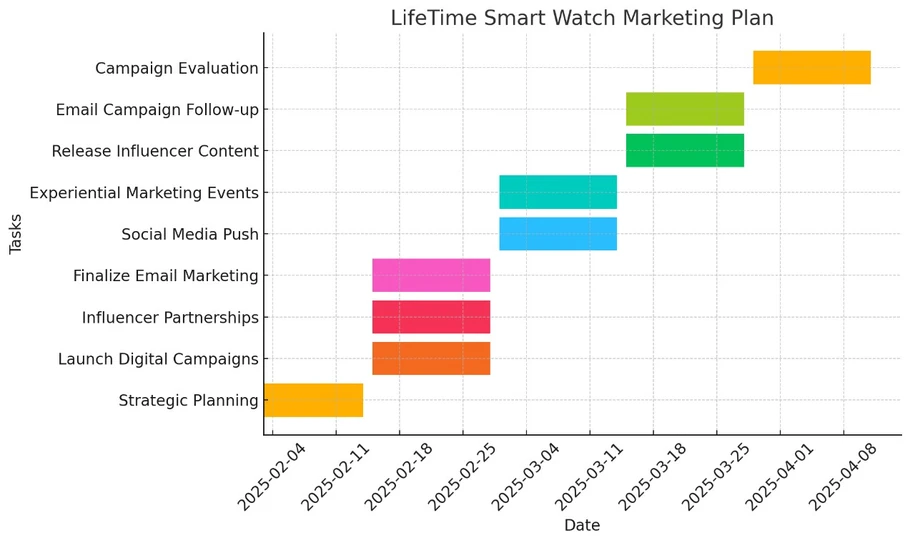
(Cook & Brown, 2021)
c. Project Risk
Numerous challenges may affect the LifeTime smartwatch, including financial factors and competition.
- Budgeting issues: A big risk of this project is going over the set budget of £100,000. Finding and building communications with the right influencers, or unexpected expenses that come with digital ads or experiential marketing can stress out the budget. This may lead to the postponement or a decrease in the marketing initiatives that were earlier agreed upon. Due to these issues, proper financial monitoring and elaboration of contingencies will be required.
- Specific Task Delays: Time is one of the fundamentals in this plan which is supposed to be implemented in 12 weeks. Some of them are restrictions in influencer collaborations, content production, or planning of experiential marketing events that might slow down or even hinder the launch or its efficiency. It would be beneficial to establish a healthy relationship with the partners and suppliers to keep updating them on time (Denny & Patel, 2019).
- Marketing Channel Effectiveness: Instagram, Facebook, as well as TikTok platforms, remain a core part of the plan; however, there is a possibility that target audiences may not be receptive enough. They express that algorithm alterations, saturation of advertisements or lack of synchronization of content with consumers’ needs may reduce the reach and impact of the campaign. Among these risks, perhaps the biggest one is the absence of monitoring, the constant control of the engagement metrics, and the possibility of making necessary changes to the campaigns immediately (Zhang & Xu, 2019).
- Presence of Other Smartwatches: The smartwatch market segment has other tough competitors in the same industrial segment such as Apple and Samsung. The modern entrants may suffer from the problem of industry oversaturation and position themselves unsuccessfully or fail to gain a share of the market. The United States is chosen as The LifeTime smartwatch should effectively use its competitive advantage, and different factors must be conveyed to consumers (Forbes, 2023).
- Business Risk: Factors affecting demand for wearable technology include, fluctuating economic factors, customer behaviour changes, or any other reason that affects the market (such as a pandemic). Such changes are inevitable, and therefore, market research will be continuous, and constant amendments in strategic development will be significant (Smith & Thompson, 2020).
d. Project Success
Measuring the effectiveness of the LifeTime smartwatch’s marketing campaign can be done effectively using the following KPIs: ROI and revenue generation, social media engagement and reach, and User engagement.
- Growth: A company's market share is to capture 3% of the market and the revenue within the first quarter is to be £ 7 million. The achievement of these goals will be reflected in the sales and comparing them to such targets, will point to the company’s financial performance (Miller, 2022).
- Customer Engagement: Every stake shall maintain social media pages active through trackable engagement with targets such as the number of likes and followers on Instagram, the number of shares, likes, and comments on Facebook, and the number of views on TikTok. The high engagement levels are an indication of effective delivery and popularity of the message being passed (Green & White, 2020).
- Conversion Measurement: It is a fact that the effectiveness of the influencers can be determined by the number of leads or conversions that the content shares from the influencers. Using referral links or codes will give information on their impact on purchase decisions (Liu & Wang, 2021).
- Measures of Communication Effectiveness: The open rate and click-through rate from the emails sent during a marketing campaign would determine the level of communication success in making individuals become clientele.
- Consumer feedback and satisfaction: Reviews, feedback shared on the social media platform, and follow-up consumer surveys shall create an understanding of the level of satisfaction that customers have with the products (Kim & Lee, 2024).
Launching a product as innovative and competitive as the LifeTime smartwatch requires not only a well-structured marketing plan but also a deep understanding of consumer behaviour, industry trends, and strategic implementation. Developing such comprehensive analyses can be challenging for many students and professionals who must balance complex research with clear, outcome-driven reporting. To support individuals in producing high-quality, analytically strong academic work, reliable assignment help resources can play a valuable role in enhancing clarity, organisation, and strategic insight. Access to expert guidance ensures that marketing strategies, risk assessments, and KPI evaluations are presented with accuracy and professionalism—essential components for achieving excellence in both academic and real-world business contexts.
References
Barnes, J. (2020). The evolution of wearable technology: Understanding the smartwatch market. Journal of Consumer Technology, 15(2), 55-67.
Chan, H. K., & Ng, Y. L. (2021). Smartwatch technology and market trends: A strategic perspective. International Journal of Technology and Market Research, 12(3), 111-124.
Chen, S., & Zhang, L. (2022). Smartwatch industry growth and consumer behavior: A review. Journal of Marketing Trends, 18(4), 123-138.
Cook, L., & Brown, D. (2021). Apple Watch vs. Garmin: A competitive analysis of smartwatch brands. Technology and Innovation Review, 7(1), 45-58.
Denny, R., & Patel, A. (2019). Factors driving the growth of the global smartwatch market. Journal of Global Technology Management, 10(2), 72-85.
Forbes, S. (2023). Emerging technologies in wearable devices and smartwatches. Journal of Emerging Technologies, 28(1), 40-54.
Green, A., & White, M. (2020). Consumer purchasing behavior in wearable technology. Journal of Digital Marketing, 11(3), 98-112.
Kim, D., & Lee, J. (2024). Market trends in wearable tech and smartwatch competition. International Journal of Smart Devices, 22(1), 14-27.
Liu, Y., & Wang, X. (2021). Smartwatch marketing strategies and consumer preferences. Journal of Marketing Strategy, 17(2), 55-69.
Miller, C. (2022). The rise of fitness-focused smartwatches: A market shift. Journal of Health and Technology, 13(4), 78-91.
Smith, R., & Thompson, M. (2020). Influencer marketing in the tech industry: A case study of smartwatches. Journal of Social Media Marketing, 9(5), 133-147.
Zhang, F., & Xu, Q. (2019). The competitive landscape of smartwatches: A review of key players. International Journal of Technology Business, 19(6), 210-225.
Go Through the Best and FREE Samples Written by Our Academic Experts!
Native Assignment Help. (2026). Retrieved from:
https://www.nativeassignmenthelp.co.uk/project-fy002-board-report-45973
Native Assignment Help, (2026),
https://www.nativeassignmenthelp.co.uk/project-fy002-board-report-45973
Native Assignment Help (2026) [Online]. Retrieved from:
https://www.nativeassignmenthelp.co.uk/project-fy002-board-report-45973
Native Assignment Help. (Native Assignment Help, 2026)
https://www.nativeassignmenthelp.co.uk/project-fy002-board-report-45973
- FreeDownload - 40 TimesFlight Operation Management Assignment Sample
Flight Operation Management Assignment INTRODUCTION Operation management is...View or download
- FreeDownload - 42 TimesHuman Cell Biology Assignment Sample
HUMAN CELL BIOLOGY ASSIGNMENT SAMPLE Introduction - Human Cell Biology...View or download
- FreeDownload - 40 TimesBusiness And Business Environment Assignment
Introduction - Business And The Business Environment Admiral Sportswear is a...View or download
- FreeDownload - 41 Times5OS01 Specialist Employment Law Assignment Example
Introduction - 5OS01 Specialist Employment Law Assignment This is identified...View or download
- FreeDownload - 38 TimesSH4007QA Introduction to Health and Social Care Assignment Sample
Introduction to Health and Social Care Assignment Sample Health outcomes are...View or download
- FreeDownload - 39 TimesStrategic Marketing Assignment Sample
Strategic Marketing Assignment 1. Introduction - Strategic Marketing...View or download
-
100% Confidential
Your personal details and order information are kept completely private with our strict confidentiality policy.
-
On-Time Delivery
Receive your assignment exactly within the promised deadline—no delays, ever.
-
Native British Writers
Get your work crafted by highly-skilled native UK writers with strong academic expertise.
-
A+ Quality Assignments
We deliver top-notch, well-researched, and perfectly structured assignments to help you secure the highest grades.