
An Analysis Of The Impact Of Foreign Investments On The Evolution Of Business Practices In The Manufacturing Sector In China
Introduction
Foreign direct investment (FDI) plays a crucial role in enhancing the productivity and modernization of the forest products industry, driving significant growth and innovation within this sector.
The transformative impact of FDI is particularly evident in China, which attracted over US$403.98 billion in foreign investment by the end of 1999, becoming the top destination for such investments among developing countries (MOFTEC, 2000). This trend continued as FDI surged past $2 trillion by the mid-2010s, largely due to government initiatives like the "Open Door Policy" that encouraged foreign capital influx (World Bank, 2017). Research indicates that FDI not only stimulates economic growth but also leads to the adoption of advanced manufacturing techniques and modern business practices by domestic firms (Chen et al., 2015). Furthermore, studies show that FDI has a cascading effect throughout supply chains, fostering the development of industry clusters in various manufacturing sectors (Harrison Rodriguez-Clare, 2010).
In the forest products sector specifically, the increase in foreign investment has prompted local companies to modernize their technologies, improve operational efficiencies, and adopt sustainable practices that meet contemporary environmental standards. This modernization boosts individual business productivity and enhances overall competitiveness within the forest products industry. Additionally, the interconnected nature of FDI promotes collaborative initiatives across supply chains, leading to the emergence of integrated industry clusters that drive innovation and bolster economic resilience.
Given these findings, it is vital to investigate the specific impacts of FDI on different sectors, including the forest products industry. Understanding these dynamics can help in formulating targeted policies that maximize the benefits of foreign investment while addressing potential challenges. Recognizing the unique effects of FDI across various industries highlights the necessity for tailored strategies that fully leverage its potential for fostering growth and sustainability in China’s manufacturing landscape. This study aims to delve into the intricate relationship between foreign investments and evolving business practices within this critical sector, identifying both opportunities and challenges presented by FDI. This study explores the complex connection between foreign investments and the changing business practices within China's manufacturing industry. It highlights the various opportunities and challenges that foreign direct investment (FDI) brings to this vital sector of the economy. It does it by answering these questions:
Research Question 1: How have foreign investment patterns in the manufacturing sector in China changed between 2015 and 2023
From 2015 to 2023, the landscape of foreign investment in China’s manufacturing sector has changed dramatically, influenced by new global economic trends, policy changes, and evolving investor interests. A key development during this period has been the diversification of investment sources. While the United States and Europe were once the main contributors, we've seen a notable increase in investments from emerging economies, especially in Asia. Countries like Japan, South Korea, and those from the ASEAN region have been boosting their investments across various manufacturing industries, drawn by China's significant role as a vital center for production and supply chain efficiency (Wu, 2020). Additionally, data from the Ministry of Commerce of the People's Republic of China indicates an increasing emphasis on advanced technology and high-tech industries within foreign investment.
Investment allocations have shifted toward sectors such as electronics, pharmaceuticals, and green technology as foreign companies seek to capitalize on China's commitment to innovation and technological advancement (Chen & Zhang, 2021). This shift corresponds with China's "Made in China 2025" initiative, which is focused on improving the nation's manufacturing strengths and promoting upgrades within various industries. The goal is to elevate China's position in the global manufacturing landscape (State Council, 2015). A notable change can be seen as a result of geopolitical dynamics, especially the trade disputes between China and the U.S. As a consequence, numerous foreign businesses are rethinking their investment plans in China or looking into other options in Southeast Asia. This growing trend is often referred to as "China+1"(Huang, 2022).
Additionally, the Chinese government has introduced several reforms aimed at making the investment landscape more appealing. These changes include simplifying the procedures for foreign investors and strengthening protections for intellectual property rights. (Li & Wang, 2021). These reforms have significantly boosted investor confidence and attracted more foreign investment in China's manufacturing sector. Between 2015 and 2023, the changes in foreign investment trends in this sector illustrate a complex interaction of global market dynamics, technological progress, and strategic policy efforts designed to enhance China's competitiveness in manufacturing and draw in a variety of foreign capital.
In 2022, FDI flowed in each Province of China differently. I am going to provide a graph that shows the flow of FDI in Chinese Provinces in 2022.
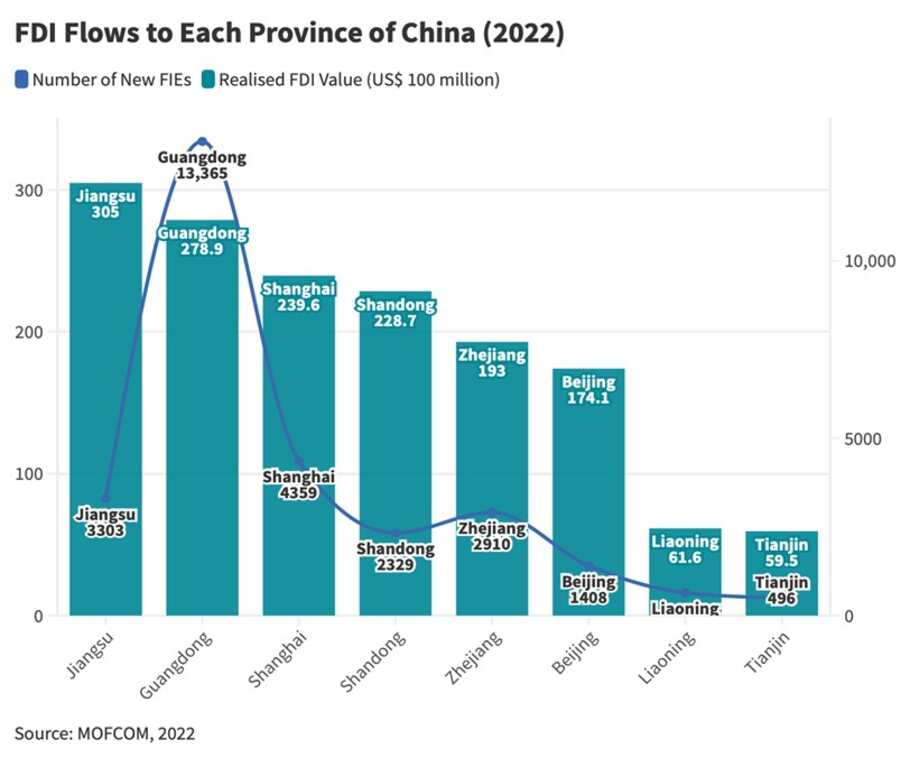
Figure 1: This graph shows the flow of FDI in each province of China in the year 2022. As for provincial distribution, Guangdong, Shanghai, and Jiangsu accounted for the highest share of newly established FIEs in 2022, with 13,365, 4,359, and 3,303, respectively. They were also the regions with the highest concentration of realized FDI value, as shown in the figure below.
Research Question 2: What factors contributed to changes in the manufacturing sector in China between 2015 and 2023?
Claim: From the year 2015 and up to 2023, there were various transformations in the Chinese manufacturing sector caused by both internal policies and external factors.
Evidence: One of the major domestic factors was that, to be independent of foreign technology firms in the high-tech segment, China started shifting towards domestic technology. Even though attempts to increase the sector’s efficiency began in 2007, and continued with the government’s more ambitious goal of developing China into a technology powerhouse by 2025 (Atkinson & Atkinson, 2024). China could not even meet its target to become fully self-sufficient in the high end machine tool sector that is currently dominated by Siemens of Germany and Fanuc of Japan (Rauf, Ma & Jalil, 2023). The main predicaments involved strong domestic rivalry, revenue dips, and instability of key firms thus entailing further reliance on foreign technology in this hydrogen area.
More Evidence: Externally, the pressure also came from other fronts like the trade tensions that were witnessed between the United States and China especially during the Trump administration (Murea, Nica and Georgescu, 2022). The American government imposed a 10% tariff on Chinese imports that forced producers to shift operations to countries such as Malaysia, Vietnam, and Cambodia in order to keep costs low in relation to the tariffs.
Moreover, China’s manufacturing industry experienced a slowdown of demand both within the domestic market, as a result of a decline in the property market and questions regarding the stability of China’s export-based economy.
Interpretation: Although, the impulse towards improving technological experience which is seamlessly interwoven with the external factors like trade tensions and fluctuating demand domestically affected the dynamics of the manufacturing in China between the years 2015 as well as 2023 (Yin et al. 2022). These forces enticed Chinese manufacturers into looking for new places to manufacture goods and reconsider the reliance on foreign technologies as well as export-oriented development strategies.
There are some parameters that have dominated the transformation of China’s manufacturing sector from 2015 to 2023, both internally and externally because of its policies and the global market trends. There are certain constraints examined: They included challenges in the attempt to reduce foreign technology dependence, trade tensions and the problem of low demand. These issues made manufacturers adopt certain strategies, search for new markets, and reconsider the use of exports which affected the industry development.
Research Question 3: Which business practices in China's manufacturing industry have changed due to foreign investments?
Claim: Chinese manufacture has greatly benefited from foreign involvement mainly in adoption of technology and practices that do not harm the environment.
Evidence: Low carbon development has become an important development strategy for the manufacturing industry in China, FDI is a direct catalyst for such development. The paper states that FDI plays a big role in the sustainability of firms as they are able to bring in better technologies and production methodologies with them (Yi, Hou & Zhang, 2023). Most of the foreign investors pay attention to the reduction of carbon emission hence a pressure on china manufacturers to adopt international environmental environment compliance. Consequently, many companies in China are now taking an increasing measure of accountability in producing their products.
More Evidence: With regard to the outward FDI, it is seen that it has helped in restructuring China's manufacturing industry in a broad sense. They provide evidence that cooperation with foreign markets and investors has influenced the increase of the usage of new technologies and efficient business models for Chinese companies (Dong & Han, 2023). This has made it possible for favorable competition to be achieved in the global market by fostering efficiency in productivity, cutting on cost of production and attaining qualitative production.
Interpretation: The two pieces of work suggest that FDI has impacted business in several ways. First, technology has advanced in organizations, and there is better production technology in factories (Song et al. 2021). Second, for environmental concerns, companies source energy from cleaner sources and handle wastes appropriately. They also come in management techniques, from which Chinese firms have borrowed from overseas organizations to enhance the rate of efficiency and customer satisfaction.
Therefore, FDI has been instrumental in the process of upgrading the manufacturing sector in China. Moreover, it has brought better technologies, efficient methods in production, sustainable business models, and methodologies. These changes also contribute towards the long-term factors of advancement with the company or these Chinese entities competitive on the international market and at the same time offer reasonable solutions for the improvement of the economy and the ecosystem.
Conclusion
This research has presented a discussion on how FDI affected the Chinese manufacturing segment between the years 2015 and 2023. This was an affirmation of the emerging FDI patterns towards Asia countries and that high-tech industries such as electronics and green technology have received more investment. These investments have been dictated by China's industrialization and modernization plan commonly referred to as “Made in China 2025”. The report also looked at potential causes relating to the transformation that is taking hold in manufacturing industries. The paper established that foreign investment trends have been influenced by trading policies, government reformation, and economic change. Moreover, FDI has contributed to better business practices such as upgrading technology, increased operational efficiency and enhancing environmental sustainability in China.
As China continues to promote advanced manufacturing and sustainability, so do the foreign investors change their strategies of investing in the country. Thus, this interaction assists in enabling China to remain competitive in the international markets. In order to further enhance, China might improve the stances for foreign investors and maintain the long-term policies to remain constant for investment. More research could be conducted as to how digitalization and automation will affect the foreign investment of manufacturing industries. In summary, FDI continues to be an important factor to China’s development of its economy and industry.
Need help completing an extended project or FDI-based business assignment like this? Our business assignment help experts support students with research-heavy projects, data analysis, critical evaluation, and structured academic writing—ensuring high-quality submissions that meet assessment criteria and deadlines.
Reference List
Journals
Atkinson, R. D., & Atkinson, R. D. (2024). China is rapidly becoming a leading innovator in advanced industries. Information Technology and Innovation Foundation: Washington, DC, USA. Retrieved on https://files.reportify.cn/media/production/s_7253a745_7253a745662a54c173c6372216b53c72.pdf [Retrieved on 21-03-2025]
Murea, M. M., Nica, L. E., & Georgescu, A. A. T. (2022). How Smart Power Influences Economic Power–A Brief Overview on the Sino-American Tariff War from 2018 to 2021. Romanian Economic Journal, 25(83), 46-56. Retrieved from: https://www.researchgate.net/profile/Maria-Murea/publication/361792136_How_Smart_Power_Influences_Economic_Power_-_A_Brief_Overview_on_the_Sino-American_Tariff_War_from_2018_to_2021/links/65ae590f6c7ad06ab417eeff/How-Smart-Power-Influences-Economic-Power-A-Brief-Overview-on-the-Sino-American-Tariff-War-from-2018-to-2021.pdf [Retrieved on on 21-03-2025]
Rauf, A., Ma, Y., & Jalil, A. (2023). Change in factor endowment, technological innovation and export: evidence from China’s manufacturing sector. European Journal of Innovation Management, 26(1), 134-156. Retrieved from: https://www.researchgate.net/profile/Abdul-Rauf-17/publication/363365391_Change_in_factor_endowment_technological_innovation_and_export_evidence_from_China's_manufacturing_sector/links/6482ff1bd702370600de3cfe/Change-in-factor-endowment-technological-innovation-and-export-evidence-from-Chinas-manufacturing-sector.pdf [Retrieved on 21-03-2025]
Song, Y., Hao, F., Hao, X. and Gozgor, G., 2021. Economic policy uncertainty, outward foreign direct investments, and green total factor productivity: Evidence from firm-level data in China. Sustainability, 13(4), p.2339. Retrieved from: https://www.mdpi.com/2071-1050/13/4/2339 [Retrieved on 21-03-2025]
Yi, J., Hou, Y., & Zhang, Z. Z. (2023). The impact of foreign direct investment (FDI) on China's manufacturing carbon emissions. Innovation and Green Development, 2(4), 100086. Retrieved from: https://www.sciencedirect.com/science/article/pii/S2949753123000541 [Retrieved on 21-03-2025]
Yin, S., Zhang, N., Ullah, K., & Gao, S. (2022). Enhancing digital innovation for the sustainable transformation of manufacturing industry: a pressure-state-response system framework to perceptions of digital green innovation and its performance for green and intelligent manufacturing. Systems, 10(3), 72.Retrieved from: https://www.mdpi.com/2079-8954/10/3/72 [Retrieved on 21-03-2025]
Harrison, A., & Rodríguez-Clare, A. (2010). Trade, foreign investment, and industrial policy for developing countries. Handbook of development economics, 5, 4039-4214.
Laaksonen-Craig, S. (2004). Foreign direct investments in the forest sector: implications for sustainable forest management in developed and developing countries. Forest Policy and Economics, 6(3-4), 359-370.
Li, M., & Wang, J. (2023). The productivity effects of two-way FDI in China’s logistics industry based on system GMM and GWR model. Journal of Ambient Intelligence and Humanized Computing, 14(1), 581-595.
Wu, W., Yuan, L., Wang, X., Cao, X., & Zhou, S. (2020). Does FDI drive economic growth? Evidence from city data in China. Emerging Markets Finance and Trade, 56(11), 2594-2607.
Poncet, S. (2010). Inward and outward FDI in China. In China and the World Economy (pp. 112-134). London: Palgrave Macmillan UK.
Huang, Y., Chen, F., Wei, H., Xiang, J., Xu, Z., & Akram, R. (2022). The impacts of FDI inflows on carbon emissions: Economic development and regulatory quality as moderators. Frontiers in Energy Research, 9, 820596.
Dong, J., & Han, Y. (2023, September). The Impact of Outward Foreign Direct Investment on the Upgrading of China’s Manufacturing Industry Structure. In 3rd International Conference on Economic Development and Business Culture (ICEDBC 2023) (pp. 784-797). Atlantis Press. Retrieved from: https://www.atlantis-press.com/article/125991296.pdf [Retrieved on 21-03-2025]
Go Through the Best and FREE Samples Written by Our Academic Experts!
Native Assignment Help. (2026). Retrieved from:
https://www.nativeassignmenthelp.co.uk/fc300-extended-project-assessment-sample-47437
Native Assignment Help, (2026),
https://www.nativeassignmenthelp.co.uk/fc300-extended-project-assessment-sample-47437
Native Assignment Help (2026) [Online]. Retrieved from:
https://www.nativeassignmenthelp.co.uk/fc300-extended-project-assessment-sample-47437
Native Assignment Help. (Native Assignment Help, 2026)
https://www.nativeassignmenthelp.co.uk/fc300-extended-project-assessment-sample-47437
- FreeDownload - 38 TimesCritical Analysis of BDO’s Non-Financial Reporting and Sustainability
Introduction to BDO BDO LLP is an international professional services company...View or download
- FreeDownload - 39 TimesProfessional Values and Parameters of Practice Assignment Sample
Introduction This practice-focused portfolio of evidence aims to reflect on...View or download
- FreeDownload - 46 TimesEquity and Trusts Assignment Sample
Introduction Of Equity and Trusts OPERATION OF TRUSTEE ACTS 1925 The...View or download
- FreeDownload - 37 TimesCommunication Skills Assignment Sample
Introduction- Communication Skills Assignment Communication is one of the...View or download
- FreeDownload - 42 TimesMarketing Report Of Unilever Assignment Sample
Marketing Report Of Unilever Introduction - Marketing Report Of...View or download
- FreeDownload - 38 Times3CO03 Core Behaviours for People Professionals Assignment Sample
INTRODUCTION: 3CO03 Core Behaviours for People Professionals Assignment Core...View or download
-
100% Confidential
Your personal details and order information are kept completely private with our strict confidentiality policy.
-
On-Time Delivery
Receive your assignment exactly within the promised deadline—no delays, ever.
-
Native British Writers
Get your work crafted by highly-skilled native UK writers with strong academic expertise.
-
A+ Quality Assignments
We deliver top-notch, well-researched, and perfectly structured assignments to help you secure the highest grades.