Introduction
The primary purpose of this portfolio is to review a behaviour change model and its application to Hasan’s case study. In addition, Hasan has Type 2 diabetes, obesity, high blood pressure and smoking dependence on top of social and financial stressors. Addressing his health risks and enhancing his well-being requires effective behaviour change interventions.
The Transtheoretical Model (TTM) is chosen as this portfolio's preferred behaviour change framework. There is extensive use of TTM, or the Stages of Change model, in healthcare settings, primarily to test an individual’s readiness to change in addition to implementing tailored interventions. This model is perfect for Hasan, as it recognizes the complexity of behaviour modification while providing specific, outlined steps to engage in improved and sustainable lifestyles.
Three key sections will make up the portfolio. It will then briefly review the Transtheoretical Model since its theoretical foundation and practical application. It will then look into the advantages and disadvantages of the model and its ability to work in practical situations.
Review of Chosen Models
Description of the Model/Theory
The Transtheoretical Model (TTM), invented in the late 1970s by Prochaska and DiClemente, is a prevalent psychological model for explaining behaviour change. According to the model, people do not undergo sudden, severe changes in behaviour (Department of Health, 2014). Instead, they go through stages that precede the entire behaviour change process. The applicability of this model is pertinent in health and social care because it permits the practitioner to tailor interventions to an individual's readiness to alter (Javaid et al., 2024).
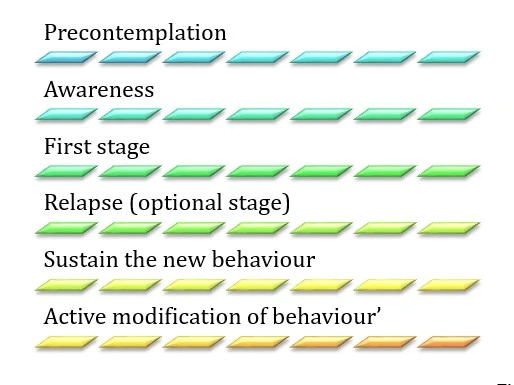
Figure 1: The six stages of the TTM
The six stages of the TTM are:
- Precontemplation – The individual has no intention of changing the behaviour and may not necessarily even recognize that there is an issue.
- Awareness – The awareness of the problem comes along first, and the person starts to consider the pros and cons of his change (Raihan & Cogburn, 2023).
- First stage – Preparation: The person starts preparing for change, develops goals, and performs some small acts.
- ‘Active modification of behaviour’ Action means healthily modifying behaviour.
- Sustain the new behaviour – It is the maintenance; the person will work to maintain the new behaviour and prevent relapse.
- Relapse (optional stage) – A return to previous unhealthy behaviours, requiring re-engagement with earlier stages (Raihan & Cogburn, 2023).
TTM is compressed by processes of change, which are strategies that assist people in moving from one stage to another. The methods include self-efficacy, decisional balance and consciousness-raising.
Explanation of Each Stage/Component
1. Pre-contemplation Stage
People at this point do not consider their behaviour a problem and will resist change. For example, Hasan may not have initially known how severe his diabetes was or how much his smoking potentially hurt him. Social and environmental factors drive these unhealthy habits, such as a stressful lifestyle in tune with cultural norms (Abdoli et al., 2024).
2. Contemplation Stage
The individual is in this phase where he or she is even thinking of change and is still ambivalent (Todd-Kvam et al., 2019). Hasan knows it is harming him, and it will ultimately hurt his family, too, but refuses to take action. In this case, the decisional balance concept is theory because here, the man assessed change's pros and the downsides of the transformation.
3. Preparation Stage
When it comes to change, someone first decides to start making minor adjustments slowly (Beshears & Kosowsky, 2020). If it has been a year already, Hasan may be visiting healthcare professionals who may provide him with advice on healthier eating practices or using techniques of nicotine replacement therapy to stop smoking.
4. Action Stage
This is when active behaviour change takes place. The bulking of Hasan into a structured meal plan, light physical activity, and attending diabetes education programs would be possible (Jones et al., 2021). This is where self-efficacy we believe, we can succeed becomes vital.
5. Maintenance Stage
The prevention of relapse depends on long-term sustainability. To support Hasan going forward, he would also need peer groups, professional counselling and lifestyle changes (Jones et al., 2021). ADHD could be hampered by barriers like shift work and financial stress or caregiving responsibilities that require continuous intervention.
6. Relapse Stage (if applicable)
If setbacks occur, the individual may return to old habits. Relapse is common in smoking cessation and weight management. Relapse is part of the process. Hasan may occasionally go back to unhealthy eating or high smoking because of stress. The aim is to return to the cycle with a renewed desire (Cook et al., 2022).
Real-Life Examples of Usage
1. Smoking Cessation Programs
TTM is widely applied in many public health initiatives about smoking cessation. Interventions target moving individuals through the stages by increasing awareness (from pre-contemplation to contemplation), offering nicotine replacement (from preparation to action), and counselling (maintenance) (Chang et al., 2024).
2. Diabetes Management Interventions
TTM is used in healthcare providers’ Diabetes Prevention and Management Programs. Some strategies include educational workshops, goal setting and digital health tools designed to get patients like Hasan from contemplation to sustained action (Chang et al., 2024).
3. Physical Activity Promotion
The use of TTM is directed to encourage physical activities among sedentary people. Gradual changes are the basis of the campaigns, beginning with daily walks and later with structured workouts (Jiménez-Zazo et al., 2020). The Transtheoretical Model is valuable for how and when to intervene to change health and social care behaviour. The staged approach suits Hasan’s case because it can carry out personalized interventions in which many social and environmental factors affect the ability to change (Alzoubi et al., 2023). Support strategies can be aligned to his current stage of readiness so that healthcare professionals can assist Hasan in increasing his preparedness stage for healthier behaviours and better overall well-being.
Compare and Contrast of The Transtheoretical Model and Theory of Planned Behaviour
The Transtheoretical Model (TTM) and the Theory of Planned Behaviour (TPB) are commonly used in health behaviour change interventions; however, they have not come to the same conclusion (Strielkowski et al., 2024).
Similarities:
The common focus of the two models is on behaviour change and key factors that contribute to such an individual's capacity to change behaviour. These include decision-making processes and involve realising that motivation, awareness, and external influences affect our behaviours (Strielkowski et al., 2024). Public health interventions are each applied to smoking cessation, weight management and diabetes control using each model.
Differences:
TTM considers that the behaviour change follows stages (Pre-contemplating, thinking, applying, persevering, and recovery), although not necessarily in that sequence (Liu et al., 2018). However, TPB concentrates on intention as the most important predictor of behaviour, which is determined by attitudes, subjective norms and perceived behavioural control. Whereas TTM accounts for relapse and is therefore appropriate for long-term behavioural interventions, TPB assumes rational decision-making and explicitly does not discuss relapse or setbacks (Liu et al., 2018). There is a greater emphasis on social influences for TPB, while TTM focuses on internal readiness and self-efficacy.
Application to Hasan’s Case Study
Introduction to Hasan’s Lifestyle Behaviour
Hasan, 48, is a taxi driver with multiple lifestyle-related health issues, including Type 2 diabetes, obesity (BMI 32), high blood pressure and smoking dependence. A problematic situation in managing his health is his poor dietary habits, lack of physical activity, and financial stress (Department of health, 2014). Hasan also acts as the primary caregiver for his wife, who has been in a condition of a persistent mental health ailment, as well as his four kids, which makes things even more complex. Hasan has the idea of how risky it is for him to have his health conditions but doesn’t have the motivation to change his lifestyle because his work is so heavy and the environment is also not conducive (Department of health, 2014).
Justification for the Chosen Model
Hasan is appropriate for The Transtheoretical Model (TTM) because this model recognizes behaviour change as a process and allows tailored interventions according to his readiness to change. Concerning lifestyle changes, TTM presents a structure that will locate him at the current stage of ambivalence and guide him forward (Hashemzadeh et al., 2019). In addition, it can deal with relapse and external barriers because chronic disease management is definitely full of setbacks.
Application of the Model
- Pre-contemplation: Hasan now realizes the severity of his situation and takes small steps towards adjusting his life.
- Contemplation: He is aware of his health risks, but cannot do anything in light of stress and responsibilities. Motivational interviewing and education can help increase his readiness in this context (Hashemzadeh et al., 2019).
- The preparation: Hasan agrees to the small, manageable changes: going for a smoking cessation program or a meeting with a dietitian.
- Structured support: He actively reduces smoking, makes healthier food choices, and increases physical activity.
- Ongoing support – Maintenance ensures that he keeps up on new habits to avoid falling back into old habits called relapse (DiClemente & Crisafulli, 2022).
Conclusion
Behaviour change models are essential in helping people such as Hasan adopt healthier lifestyles. The Transtheoretical Model (TTM) is a stage-based, structured approach to gradual and sustainable change of health behaviours in the face of external barriers and relapse risks. Hasan can receive intervention-based tailored interventions to the TTM level to further long-term success. While the model is theoretically viable, it requires active support, motivation, and recalibration to accommodate the nature of Hasan’s socio-economic and psychological influences. TTM is a helpful guide for achieving incremental but meaningful health improvements.
If you’re working on behaviour change models or case-study-based assignments and find the theory overwhelming, structured academic support can make the process far easier. Whether you need help refining your analysis, strengthening critical comparisons, or improving clarity and academic tone, expert guidance can elevate your work and ensure it meets university standards. We can help you organise your ideas, enhance your explanations and produce a polished, high-quality portfolio that clearly demonstrates your understanding. Just let us know what part you want assignment help with, and we’ll guide you step-by-step.
References
Abdoli, M., Scotto Rosato, M., Desousa, A., & Cotrufo, P. (2024). Cultural Differences in Body Image: A Systematic Review. Social Sciences, 13(6), 305. https://doi.org/10.3390/socsci13060305
Alzoubi, L., Aljabali, A. A. A., & Tambuwala, M. M. (2023). Empowering Precision Medicine: The Impact of 3D Printing on Personalized Therapeutic. AAPS PharmSciTech, 24(8). https://doi.org/10.1208/s12249-023-02682-w
Beshears, J., & Kosowsky, H. (2020). Nudging: Progress to date and future directions. Organizational Behavior and Human Decision Processes, 161, 3–19. https://doi.org/10.1016/j.obhdp.2020.09.001
Chang, Y.-H., Fu, C.-H., Hsu, M.-H., Okoli, C., & Guo, S.-E. (2024). The effectiveness of a transtheoretical model-based smoking cessation intervention for rural smokers: a quasi-experimental longitudinal study. Patient Education and Counseling, 122, 108136. https://doi.org/10.1016/j.pec.2024.108136
Cook, S., Stevenson, L., Aldred, R., Kendall, M., & Cohen, T. (2022). More than walking and cycling: What is “active travel”?. Transport Policy, 126, 151–161. https://doi.org/10.1016/j.tranpol.2022.07.015
Department of health. (2014). The Relationship between Wellbeing and Health. https://assets.publishing.service.gov.uk/media/5a7baa00ed915d4147621d62/The_relationship_between_wellbeing_and_health.pdf
DiClemente, C. C., & Crisafulli, M. A. (2022). Relapse on the Road to Recovery: Learning the Lessons of Failure on the Way to Successful Behavior Change. Journal of Health Service Psychology, 48(2), 59–68. https://doi.org/10.1007/s42843-022-00058-5
Hashemzadeh, M., Rahimi, A., Zare-Farashbandi, F., Alavi-Naeini, A., & Daei, A. (2019). Transtheoretical model of health behavioral change: A systematic review. Iranian Journal of Nursing and Midwifery Research, 24(2), 83–90. https://doi.org/10.4103/ijnmr.IJNMR_94_17
Javaid, M., Haleem, A., & Singh, R. P. (2024). Health informatics to enhance the healthcare industry’s culture: An extensive analysis of its features, contributions, applications and limitations. Informatics and Health, 1(2), 123–148. https://doi.org/10.1016/j.infoh.2024.05.001
Jiménez-Zazo, F., Romero-Blanco, C., Castro-Lemus, N., Dorado-Suárez, A., & Aznar, S. (2020). Transtheoretical model for physical activity in older adults: Systematic review. International Journal of Environmental Research and Public Health, 17(24), 9262. https://doi.org/10.3390/ijerph17249262
Jones, S. L., Gibson, K. E., & Ricke, S. C. (2021). Critical Factors and Emerging Opportunities in Food Waste Utilization and Treatment Technologies. Frontiers in Sustainable Food Systems, 5. https://doi.org/10.3389/fsufs.2021.781537
Liu, K. T., Kueh, Y. C., Arifin, W. N., Kim, Y., & Kuan, G. (2018). Application of transtheoretical model on behavioral changes, and amount of physical activity among university’s students. Frontiers in Psychology, 9(2402). https://doi.org/10.3389/fpsyg.2018.02402
Raihan, N., & Cogburn, M. (2023, March 6). Stages of change theory. PubMed; StatPearls Publishing. https://www.ncbi.nlm.nih.gov/books/NBK556005/
Strielkowski, W., Grebennikova, V., Lisovskiy, A., Rakhimova, G., & Vasileva, T. (2024). AI-driven adaptive learning for sustainable educational transformation. Sustainable Development. https://doi.org/10.1002/sd.3221
Todd-Kvam, M., Lømo, B., & Tjersland, O. A. (2019). Braving the Elements: Ambivalence as Opportunities for Change in Individual Psychotherapy With Men Using Intimate Partner Violence. Frontiers in Psychology, 10. https://doi.org/10.3389/fpsyg.2019.01693
Go Through the Best and FREE Samples Written by Our Academic Experts!
Native Assignment Help. (2026). Retrieved from:
https://www.nativeassignmenthelp.co.uk/shn4013-psychological-perspectives-on-health-and-wellbeing-46240
Native Assignment Help, (2026),
https://www.nativeassignmenthelp.co.uk/shn4013-psychological-perspectives-on-health-and-wellbeing-46240
Native Assignment Help (2026) [Online]. Retrieved from:
https://www.nativeassignmenthelp.co.uk/shn4013-psychological-perspectives-on-health-and-wellbeing-46240
Native Assignment Help. (Native Assignment Help, 2026)
https://www.nativeassignmenthelp.co.uk/shn4013-psychological-perspectives-on-health-and-wellbeing-46240
- FreeDownload - 37 TimesEntrepreneurial Ventures Assignment Example
Entrepreneurial Ventures Introduction: Entrepreneurial Ventures An...View or download
- FreeDownload - 39 TimesBusiness and Business Environment Assignment Sample
Business and Business Environment Assignment Sample Looking for Help With...View or download
- FreeDownload - 41 TimesMarketing Assignment Sample
Marketing Assignment Sample Introduction Looking for Help With Assignments in...View or download
- FreeDownload - 46 TimesStrategic Human Resource Management Assignment Sample
Strategic Human Resource Management Introduction - Strategic Human...View or download
- FreeDownload - 42 TimesSustainable Tourism Assignment Sample
Title: To investigate the impact of social media marketing for sustainable...View or download
- FreeDownload - 41 TimesCriminal Law Assignment Sample
1.0 Introduction The term “criminal liability” can also be...View or download
-
100% Confidential
Your personal details and order information are kept completely private with our strict confidentiality policy.
-
On-Time Delivery
Receive your assignment exactly within the promised deadline—no delays, ever.
-
Native British Writers
Get your work crafted by highly-skilled native UK writers with strong academic expertise.
-
A+ Quality Assignments
We deliver top-notch, well-researched, and perfectly structured assignments to help you secure the highest grades.