
Introduction
The Degree Classification Calculator is an interactive desktop application that easily and effectively helps students gain a clearer understanding of their academic achievements in relation to degree progression. It gives a weighted average of grades, classifying students into the following standard degree classification categories: First Class; Upper Second Class (2:1); Lower Second Class (2:2); Third Class; or Fail. It is useful for students pursuing higher education, tracking performance throughout Level 5 and Level 6 modules, and then making predictions of their final degree classification. This application was coded in Java with a good-looking, easy-to-use GUI developed using Swing, integrated well with a logic layer to achieve accuracy in the calculations performed and maintainability. With methods for different calculation methods and strong error handling, the Degree Classification Calculator presents a comprehensive solution for tracking academic progress.
System Overview
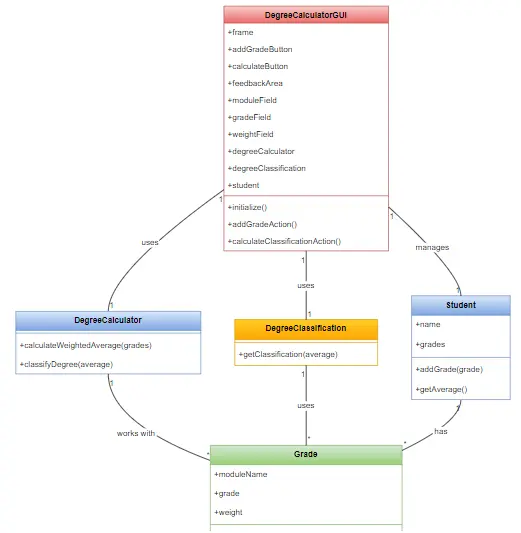
Figure 1: UML Class Diagram
There are few primary classes: DegreeCalculator, DegreeClassification, Grade, Student, and DegreeCalculatorGUI, which work together very harmoniously. The GUI provides direct user interaction while complex data processing and classification tasks are done by the back end classes. Properly designed, the system is scalable and the additional functionality is easily incorporated when required(Sunday et al. 2020). The main class is the application's entrance, which initializes the graphical user interface and controls the workflow from the user to the logic that sits at the backend of things. The system was thus designed with simplicity and common sense, hence making it a highly accessible application to people. By having a very good graphical user interface and having great processing in the backend, this application delivers the perfect kind of comprehensive and efficient result.
User Interface Design
This is an application that represents the graphical user interface application, which was implemented by Swing, and features an attractive user interface. It's designed keeping ease of use in mind; it employs vibrant, dynamic layout. Features of this application window include adding grades using input fields, buttons, calculating classification, and incorporating a text area for the display of feedback like added grades, classification results.
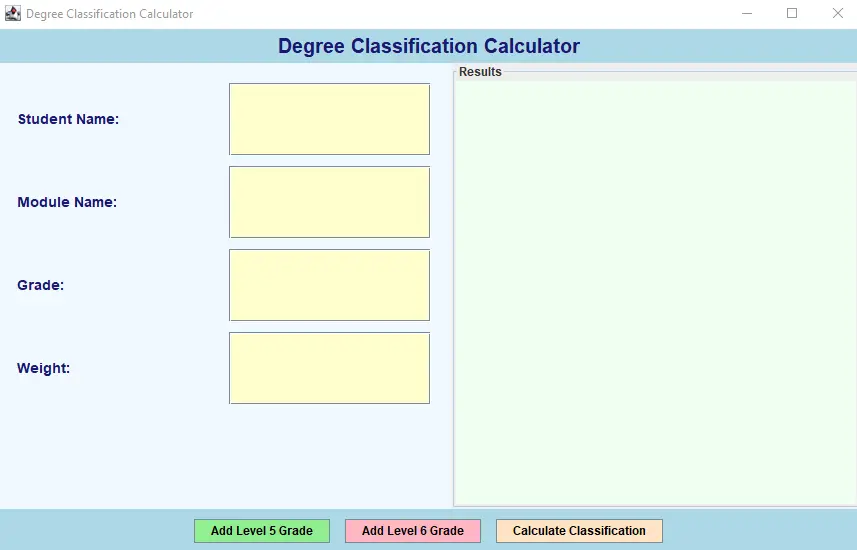
Figure 2: User Interface
This modern design follows the GUI standards. The light blue color is used as the background for a soothing effect, accompanied by contrasting buttons in light green and pink to differentiate between activities(Rahman et al. 2022). Complementary colors have been used for text fields so that they are readable. Additionally, labels and buttons have been placed in such a position to avoid confusion and guide a user through the process flawlessly. This thoughtful design balances aesthetic appeal against practical usability so that the application is intuitive for users from a broad spectrum.
Core Functionality
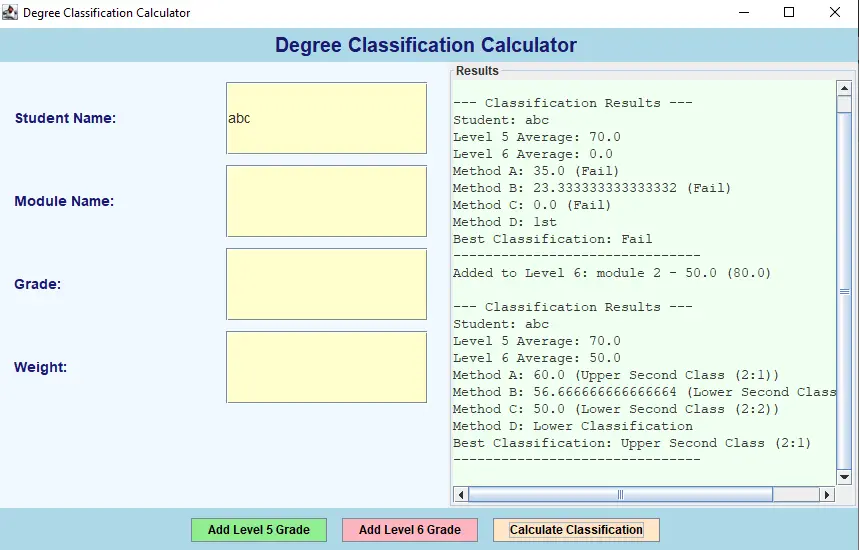
Figure 3: Functionalities in the Application
User operate based on three primary functions average calculation and degree classification and grade input. The DegreeCalculator and DegreeClassification classes perform the operations. In order to make sure that that every In terms of the, the module will contribute proportionally. assigned weight. The calculation is very easy, which can be broken down sum all weighted grades into the top line and then divide the top line by total weight. It is an easy and efficient formula(Santosa et al. 2021). The DegreeClassification The calculated average is mapped to standard degree classifications widely used in academic standards. The resulting was classified such that and applications generally anywhere in an institution that require structure. Logical statements that enhance readability and preciseness for mapping. This result ensures accurate but clear classification. Combining well-structured. These guarantees classes by robust functionality while remaining clear.
Explore our IT Assignment Help service covering networking, cybersecurity, databases, cloud computing, software development, and more.
IT Assignment Help online IEEEData Management
This application utilizes the Grade class in order to encapsulate the module data. It holds attributes such as the name of the module, the grade, and the weight. This encapsulation is used to make data handling easier and to ensure that every grade is treated uniquely(Llanos et al. 2023). Furthermore, it extends the class to allow for the grouping of Level 5 and Level 6 modules in a similar manner as that of real-world academic systems. With this hierarchy, the application keeps up with the proper order of academic programs: this keeps it clear and intuitive to use. With dynamic lists that actually hold grades, users can then enter as many grades as possible as long as it is needed in other modules or courses.
Implementation Details
This will ensure that the design of the application code will be modular and maintainable by the principles of OOP. Each class should have a distinct responsibility in it, and that ensures there is a clear separation of concerns. For example:
- The DegreeCalculatorGUI class handles exclusively the graphical user interface and interactions involving users.
- Classes such as DegreeCalculator and DegreeClassification handle backend computations like grade averaging and mapping of classification respectively.
This is achieved using action listeners for the event-handling logic, which are then bound to buttons and other GUI elements. The listener then, depending on user input, dynamically fires up the action being requested - whether adding a grade or computing a degree classification(Kyaw et al. 2020).
This type of event-driven architecture greatly increases the responsiveness and interactivity of the application. Extensive error handling is provided to catch frequent mistakes that the users will commit and thus maintain a stable application. For instance,
- The grade and weight fields are input fields that only accept numeric values.
- It flags invalid inputs with user-friendly error messages, preventing processing errors and crashes.
This responsible development improves the application's reliability and usability, creating a smooth user experience combined with adherence to excellent programming practice.
Testing and Validation
| Test Case ID | Test Scenario | Input | Expected Output | Actual Output | Status |
|---|---|---|---|---|---|
| TC01 | Add a grade to the system | Module: "Math", Grade: 70, Weight: 20 | Grade added successfully, reflected in the list of grades | Grade added successfully, reflected in the list of grades | Pass |
| TC02 | Calculate weighted average | Grades: [(Math, 70, 20), (Science, 60, 30)] | Weighted average: 64.0 | Weighted average: 64.0 | Pass |
| TC03 | Classify degree based on average | Weighted average: 64.0 | Degree Classification: Upper Second Class (2:1) | Degree Classification: Upper Second Class (2:1) | Pass |
| TC04 | Validate input fields | Module: "History", Grade: "abc", Weight: 10 | Error message: "Invalid grade input. Please enter a numeric value." | Error message: "Invalid grade input. Please enter a numeric value." | Pass |
| TC05 | Handle edge case at classification boundary | Weighted average: 70.0 | Degree Classification: First Class | Degree Classification: First Class | Pass |
| TC06 | Handle zero-weight module | Module: "Optional", Grade: 75, Weight: 0 | Module added successfully, does not affect the weighted average | Module added successfully, does not affect the weighted average | Pass |
| TC07 | Handle large number of grades | Add 50 grades with varying weights and scores | All grades added successfully, accurate calculation of weighted average and classification | All grades added successfully, accurate calculation of weighted average and classification | Pass |
| TC08 | GUI responsiveness | Click "Add Grade" and "Calculate Classification" buttons | System responds immediately with appropriate updates to grade list and results | System responds immediately with appropriate updates to grade list and results | Pass |
| TC09 | Error handling for empty input fields | Module: "", Grade: "", Weight: "" | Error message: "Please fill in all fields before adding a grade." | Error message: "Please fill in all fields before adding a grade." | Pass |
| TC10 | Display all grades | Grades added: [(Math, 70, 20), (Science, 60, 30)] | Display: "Math - Grade: 70, Weight: 20; Science - Grade: 60, Weight: 30" | Display: "Math - Grade: 70, Weight: 20; Science - Grade: 60, Weight: 30" | Pass |
Scalability and Future Enhancements
The application has a modular architecture. Therefore, it is scalable, so extra features such as exporting the results to a file or the integration of advanced analytics do not disturb the existing code base(Senol 2020). It can also be expanded to include other grading systems or frameworks, thus making its usage even more widespread.
Dependable academic support and assignment samples are provided by Native Assignment Help, offering well-structured, clear, and plagiarism-free content to support effective learning and task completion.
Conclusion
This is a thorough application for calculating degrees it is intended to provide students with better insights about their academic performance. Given its intuitive interface, accurate computation, and modular design, it serves both the student and the educator. It embodies the power of object-oriented programming in the creation of functional and influential tools for a real-world educational setting with Java. It is clearly structured and easy to use with reliable functionality and thus invaluable in monitoring student academic progress toward achieving the degree classification.
References
Journals
- Sunday, K., Ocheja, P., Hussain, S., Oyelere, S., Samson, B. and Agbo, F., 2020. Analyzing student performance in programming education using classification techniques. International Journal of Emerging Technologies in Learning (iJET), 15(2), pp.127-144.
- Rahman, M., Hasan, M., Billah, M.M. and Sajuti, R.J., 2022. Grading system prediction of educational performance analysis using data mining approach. Malaysian Journal of Science and Advanced Technology, pp.204-211.
- Santosa, R.G., Lukito, Y. and Chrismanto, A.R., 2021. Classification and prediction of students’ GPA using K-means clustering algorithm to assist student admission process. J. Inf. Syst. Eng. Bus. Intell, 7(1), p.1.
- Llanos, J., Bucheli, V.A. and Restrepo-Calle, F., 2023. Early prediction of student performance in CS1 programming courses. PeerJ Computer Science, 9, p.e1655.
- Senol, N.S., 2020. Periodic performance analysis to predict student success rates (Doctoral dissertation).
- Kyaw, H.H.S., Wint, S.S., Funabiki, N. and Kao, W.C., 2020. A Code Completion Problem in Java Programming Learning Assistant System. IAENG International Journal of Computer Science, 47(3).
Go Through the Best and FREE Samples Written by Our Academic Experts!
Native Assignment Help. (2026). Retrieved from:
https://www.nativeassignmenthelp.co.uk/com5003-further-software-development-assignment-sample-43680
Native Assignment Help, (2026),
https://www.nativeassignmenthelp.co.uk/com5003-further-software-development-assignment-sample-43680
Native Assignment Help (2026) [Online]. Retrieved from:
https://www.nativeassignmenthelp.co.uk/com5003-further-software-development-assignment-sample-43680
Native Assignment Help. (Native Assignment Help, 2026)
https://www.nativeassignmenthelp.co.uk/com5003-further-software-development-assignment-sample-43680
- FreeDownload - 42 TimesAutomation and Robotics Assignment Sample
Introduction : Automation and Robotics Assignment Sample Robotics is a design,...View or download
- FreeDownload - 44 TimesDiscuss How Work Defines Us In The UK And The Changes To The Working Practices Overtime Since The Industrial Revolution Assignment Sample
Introduction - Discuss How Work Defines Us In The UK And The Changes To...View or download
- FreeDownload - 44 TimesFinancial Performance Analysis Assignment
Introduction - Financial Decision Making The report is based on the...View or download
- FreeDownload - 39 TimesEvaluation of Strengths and Weaknesses in Learning Assignment
Evaluation of Strengths and Weaknesses in Learning Assignment...View or download
- FreeDownload - 39 TimesDeveloping Teaching, Learning And Assessment In Education And Training Assignment Sample
INTRODUCTION - Developing Teaching, Learning And Assessment In Education...View or download
- FreeDownload - 42 TimesHealth Belief Model Assignment Sample
Health Belief Model Assignment Sample Brief Description of Model The health...View or download
-
100% Confidential
Your personal details and order information are kept completely private with our strict confidentiality policy.
-
On-Time Delivery
Receive your assignment exactly within the promised deadline—no delays, ever.
-
Native British Writers
Get your work crafted by highly-skilled native UK writers with strong academic expertise.
-
A+ Quality Assignments
We deliver top-notch, well-researched, and perfectly structured assignments to help you secure the highest grades.